



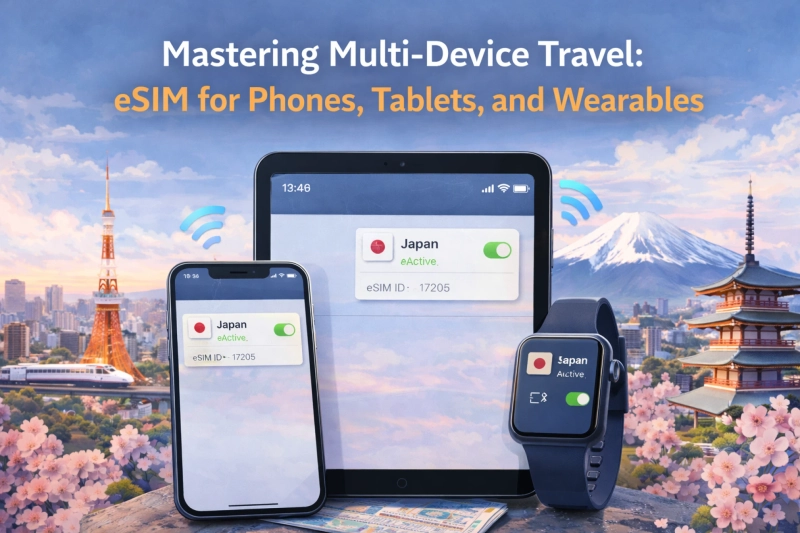
Modern travel is no longer limited to a single device. Today’s travelers move with an entire digital ecosystem: smartphones for navigation and communication, tablets for work and entertainment, and wearables for fitness, payments, and safety. While this makes travel more efficient, it also creates a new challenge: how to keep all devices connected seamlessly while abroad.
This is where eSIM technology is redefining international travel. Instead of juggling multiple physical SIM cards or relying on inconsistent Wi-Fi, travelers can now manage connectivity across devices with ease. Whether you’re visiting Japan for business or leisure, understanding how eSIM works across phones, tablets, and wearables can completely transform your travel experience.
Why Multi-Device Connectivity Matters When Traveling
Travel today is digital-first. A smartphone alone is rarely enough. Travelers often rely on:
- Phones for maps, translation, messaging, and ride-hailing
- Tablets for work, streaming, or managing travel documents
- Wearables for navigation prompts, health tracking, and contactless payments
When one device loses connection, the entire travel flow breaks. This is why many travelers are moving away from traditional roaming plans and toward flexible solutions like travel eSIMs and region-specific options such as a Japan travel eSIM.
What Is an eSIM and Why It’s Ideal for Multi-Device Travel
An eSIM (embedded SIM) is a digital SIM built directly into your device. Instead of inserting a physical chip, you activate a mobile plan digitally usually by scanning a QR code or using an app.
For travelers using multiple devices, eSIM offers major advantages:
- No physical SIM swapping
- Ability to store multiple plans on one device
- Faster activation across countries
- Easier management for frequent travelers
When paired with the best eSIM for Japan, travelers gain instant access to high-speed local networks without visiting a store or waiting in airport queues.
Using eSIM on Smartphones While Traveling in Japan
Smartphones are the core device for most travelers, and they benefit the most from eSIM adoption. A Japan travel eSIM allows your phone to connect instantly to Japanese mobile networks like NTT Docomo or SoftBank.
Key benefits include:
- Immediate connectivity upon landing
- Dual-SIM functionality (keep your home SIM active for OTPs)
- Better security compared to public Wi-Fi
- Predictable data costs without roaming surprises
For tourists, this often replaces the need to buy a Japan SIM card for tourist use at the airport. Instead of managing a physical SIM card for Japan, everything is handled digitally—simpler and more reliable.
Tablets and Laptops: Extending Connectivity Beyond Phones
Tablets and laptops with cellular support are increasingly popular among business travelers, digital nomads, and families. Devices like iPads and Windows tablets often support eSIM, making them ideal companions for international trips.
With an eSIM-enabled tablet:
- Business travelers can stay productive without tethering to a phone
- Families can keep kids entertained on long train rides
- Remote workers can join video calls from anywhere
Instead of buying separate physical SIMs for each device, travelers can activate multiple eSIM profiles or share data plans intelligently. This is especially useful in Japan, where consistent connectivity is essential for transportation apps and cashless payments.
Wearables and the Rise of Always-Connected Travel
Smartwatches and wearables are becoming a quiet but powerful part of the travel tech stack. Many modern wearables support cellular connectivity via eSIM, enabling features like:
- Turn-by-turn navigation on your wrist
- Emergency calls without carrying a phone
- Health and activity tracking across time zones
- Contactless payments in transit systems
In a country like Japan, where efficiency, transport, and precision matter, wearables paired with a Japan travel eSIM can significantly improve day-to-day travel convenience.
eSIM vs Physical SIM for Multi-Device Travelers
Traditional physical SIMs still exist, and a Japan SIM card for tourist travelers can work well for basic phone usage. However, they fall short when multiple devices are involved.
Physical SIM limitations include:
- One SIM per device
- Manual swapping between phones
- Risk of losing your home SIM
- No easy way to manage multiple devices
In contrast, eSIMs allow travelers to centralize connectivity across phones, tablets, and wearables. For travelers who still prefer physical options, a SIM card for Japan can act as a backup but eSIM remains the more scalable solution.
How to Choose the Best eSIM for Japan Travel
When selecting the best eSIM for Japan, especially for multi-device travel, consider the following:
- Network Coverage: Choose providers that partner with major Japanese carriers for strong nationwide coverage.
- Data Flexibility: Multi-device travelers consume more data. Look for plans with higher limits or easy top-ups.
- Device Compatibility: Confirm that your phone, tablet, and wearable support eSIM activation.
- Plan Duration: Options ranging from 7 to 30 days are ideal for short trips, extended stays, or business travel.
- Customer Support: Reliable support matters when managing connectivity across multiple devices.
A well-chosen eSIM eliminates the need to buy multiple local SIMs and simplifies your entire travel setup.
Practical Tips for Managing eSIMs Across Devices
To get the most out of eSIM technology while traveling:
- Activate your eSIM before departure
- Label each eSIM profile clearly (Japan, Home, Backup)
- Use hotspot sharing strategically
- Monitor data usage per device
- Keep a physical SIM card for Japan only as an emergency backup
These steps help ensure seamless connectivity across your travel tech ecosystem.
The Future of Multi-Device Travel Connectivity
As travel becomes more digital, multi-device connectivity will become the norm, not the exception. Airlines, hotels, and transportation systems already assume travelers are always connected. eSIM technology supports this shift by removing physical barriers and simplifying global mobility.
For Japan-bound travelers, the transition is especially noticeable. Whether you’re navigating Tokyo’s transit system, attending meetings in Osaka, or exploring rural destinations, a reliable Japan travel eSIM ensures every device works together seamlessly.
Final Thoughts
Mastering multi-device travel is no longer about carrying more gadgets; it’s about managing connectivity smarter. eSIM technology empowers travelers to connect phones, tablets, and wearables without the hassle of physical SIM cards.
While a Japan SIM card for tourist use or a traditional SIM card for Japan may still serve basic needs, the flexibility and efficiency of eSIMs make them the clear choice for modern travelers. With the best eSIM for Japan, your devices stay connected, your travel stays smooth, and your focus remains where it should be on the journey itself.