



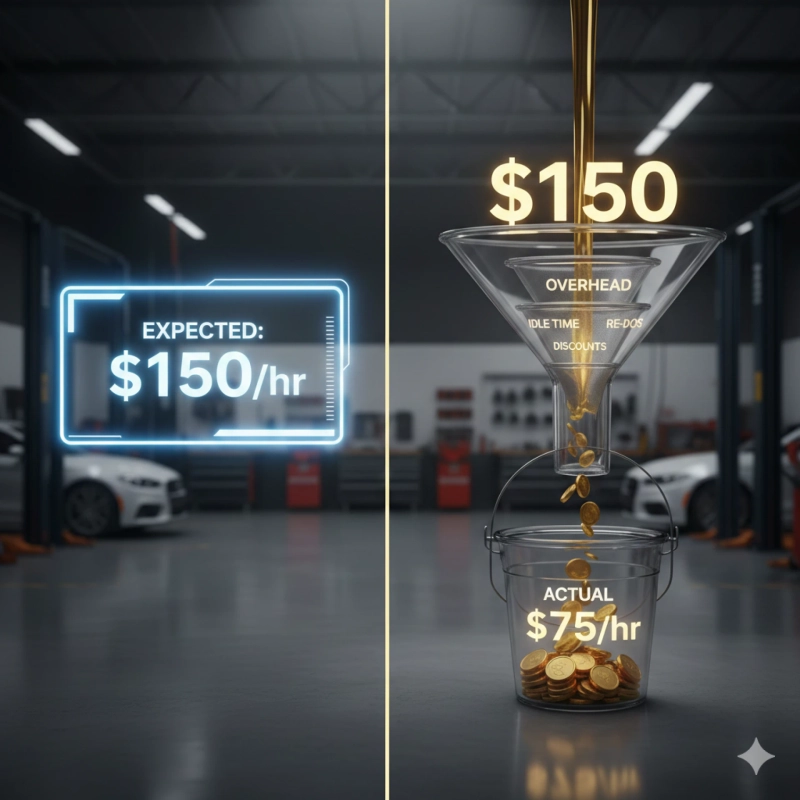
Most service directors believe their department’s listed labor rate matches what they actually earn per hour. The truth is, those numbers rarely tell the complete story. This makes it imperative understanding the gap between what’s displayed and what’s actual might expose thousands in hidden revenue every month.
This article dives into the Effective Labor Rate definition, why it often differs from a department’s posted rate, and how any store can close that gap by mastering today’s smartest Fixed OPS Metrics.
By the end, readers will know exactly how to measure their true Effective Labor Rate automotive performance, spot revenue leaks, and take practical steps to improve it.
Understanding Effective Labor Rate Definition:
In simple words, the Effective Labor Rate definition is simple: it’s the average labor revenue earned per billed hour. Unlike the advertised or posted rate which is merely the price printed on the wall—ELR reflects reality after every discount, adjustment, and warranty claim is included in.
The effective labor rate formula is basic math:
Total labor sales ÷ total labor hours billed = Effective Labor Rate.
Let’s imagine a dealership publishes a $ 150-per-hour price yet invoices 1,000 hours in a month while earning $120,000 in labor sales. The ELR isn’t $150—it’s $120. That $30 discrepancy reflects the money mistakenly left on the table.
Why ELR Isn’t the Number on the Wall?
That gap between posted and actual rates originates from several factors, typically imperceptible in everyday operations. These include:
· Discounts and coupons that erode margin over time.
· Warranty work that reimburses at lower hourly rates.
· Administrative write-offs or under-billed labor.
· Rework or callbacks that add hours but not billable dollars.
· Mix of labor types, where quick, low-value jobs replace high-margin ones.
Together, these factors skew how Fixed OPS Metrics reflect true profitability. Without reliable tracking, management may feel performance is consistent while the department’s true earning power quietly diminishes.
How to Calculate Your True Effective Labor Rate?
Knowing where your department stands begins with reliable data. Here’s how any dealership can calculate its Effective Labor Rate automotive accurately:
Gather total labor sales for the period—customer pay, internal, and warranty combined.
Add up total labor hours billed (from all repair orders).
Apply the effective labor rate formula:
ELR = Total Labor Sales
Total Hours Billed
ELR= Total Hours Billed
Total Labor Sales
Cross-check hours per repair order to see how service mix affects ELR over time.
A consistent process allows leadership to track actual trends and uncover areas where hours aren’t converting to revenue.
Where ELR Usually Leaks (and How to Plug It)?
Even the most well-run stores face lost potential revenue if they’re not watching for common pitfalls. Here are the biggest culprits—and solutions that drive quick wins:
Warranty claims: Poorly recorded or undercoded claims limit payment. Optimize submissions and routinely evaluate claim accuracy.
Misapplied hours: Ensure all billable hours correlate to completed work using auditing methods.
Uncontrolled discounting: Implement policy-driven authorization for discounts. Track and report their impact on profit weekly.
Time inefficiency: Technicians’ actual time vs. billed time can expose lost efficiency. Training and flat-rate monitoring help correct this.
Parts-to-labor imbalance: Align parts sales pricing with labor revenue targets to keep margins synchronized.
By auditing these areas monthly, managers can identify small leaks that, collectively, prevent an Effective Labor Rate increase of 5–10% or more.
How Data Improves Labor Pricing?
Modern Fixed OPS Metrics tools now go far beyond spreadsheets. Data analytics tools such as Fixed Ops Intel’s Revenue Intelligence Suite help dealerships connect every piece of the puzzle—from labor pricing to technician productivity and warranty patterns.
Access to large repair order (RO) databases exposes trends invisible at store level:
· Which service categories yield the best ELR.
· Which technicians outperform peers.
· Where discounts most often occur.
Real-time dashboards allow service managers to act on insights instantly rather than waiting for quarter-end reports. The consequence is speedier decision-making and verifiable, effective labor rate growth across the department.
How to Increase Effective Labor Rate?
Actionable growth in ELR doesn’t come from guessing—it comes from disciplined use of Fixed OPS Metrics. Consider these phased improvements:
Short Term (30–60 days):
Standardize labor pricing.
Review and approve discounts before applying them.
Audit warranty submission accuracy.
Mid Term (60–180 days):
Reprice common services using market-supported data.
Adjust technician pay plans that encourage billed-hour efficiency.
Track hours per repair order to ensure job mix alignment.
Long Term (Ongoing):
Set ELR goals, review monthly trends, and coach managers using data-driven reporting.
Continue using analytics tools that reveal new leakage points as operations evolve.
Following this roadmap not only boosts revenue but builds a culture that treats Effective Labor Rate automotive as a core performance metric rather than an abstract number.
Measuring Success Beyond ELR
An enhanced ELR naturally produces higher gross profit, but it also increases retention and customer happiness. More efficient shop processes mean faster repairs, better price consistency, and stronger trust—leading to repeat business and increased hours per repair order.
When leaders use Fixed OPS Metrics to guide pricing and performance, they build transparency and measurable accountability across every technician and advisor. It’s not just about greater rates—it’s about better, more predictable profitability.
Final Thought: Turning Insight into Action
Accurate understanding of ELR transforms the service department from a cost center into a steady profit engine. Relying simply on listed rates hides too much truth in today’s competitive landscape. Dealerships that track, coach, and adjust their ELR daily enjoy consistent development across every major metric.
Fixed Ops Intel partners with automotive retailers to uncover the story behind their Effective Labor Rate, leverage advanced analytics, and identify steps that achieve real operational improvement. Their coaching team helps dealerships align pricing, warranty performance, and marketing—all supported by their proprietary Revenue Intelligence Suite.
Learn how your true performance stacks up. Contact Fixed Ops Intel at 585‑371‑7607 today and start mastering the Fixed OPS Metrics that actually drive profit.