



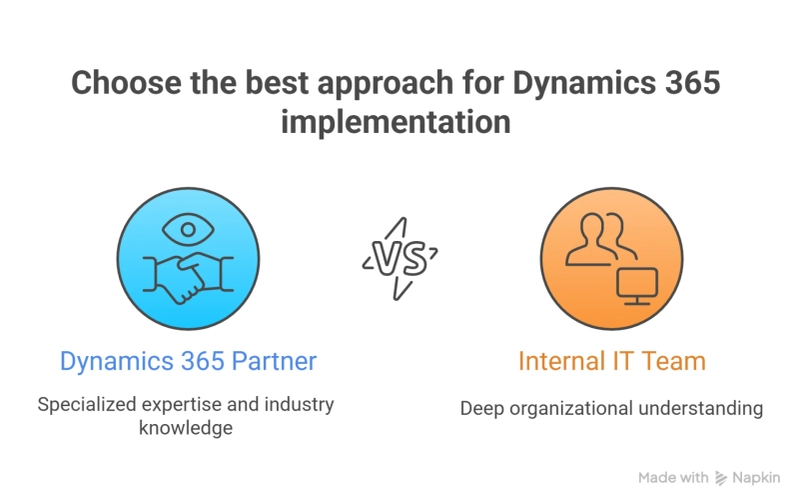
When companies adopt Dynamics 365, the first big decision is not features or licensing. It is execution. Who should implement, customize, and scale the system? An internal IT team or a Dynamics 365 partner.
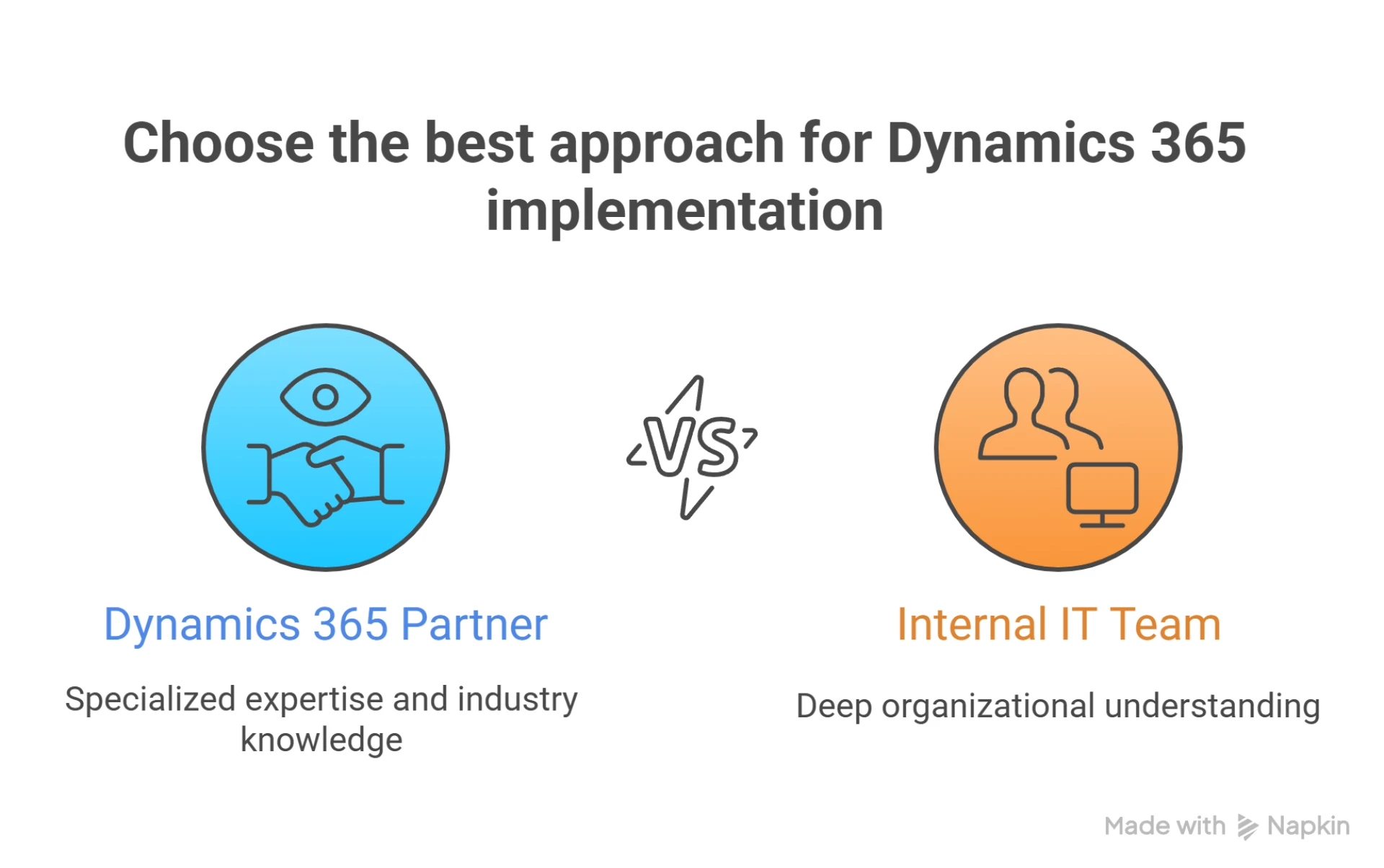
At a small scale, both can work. At enterprise scale, the difference becomes very visible. This blog breaks down what actually works when complexity, compliance, and growth pressure increase.
Understanding the Two Models
Internal IT Team
An internal IT team is made up of full-time employees who support systems across the organization. ERP is usually one responsibility among many. Infrastructure, security, user support, integrations, reporting, and firefighting all compete for attention.
Dynamics 365 Partner
A Dynamics 365 partner is a specialized firm focused entirely on implementation, customization, integration, and long-term optimization of Dynamics 365. Their teams include solution architects, functional consultants, technical developers, and industry specialists.
Where Internal IT Teams Perform Well
Internal teams are not useless. They are strong in specific areas.
Deep business context
They understand internal workflows, political constraints, and undocumented processes better than any external vendor.
Day-to-day support
User access, minor fixes, report tweaks, and first-line support are handled faster internally.
Lower visible cost
On paper, salaries look cheaper than partner invoices. This often hides opportunity cost and delayed outcomes.
Internal teams work best when Dynamics 365 usage is stable, customization is limited, and the business is not scaling aggressively.
Where Internal IT Teams Break at Scale
This is where most enterprises struggle.
Skill depth problem
Dynamics 365 is not one product. Finance, Supply Chain, Sales, Customer Service, Power Platform, integrations, and security all evolve continuously. Internal teams rarely have deep expertise across all these areas.
Upgrade and regression risk
Microsoft releases frequent updates. Without deep platform knowledge, internal teams delay upgrades or disable features. Technical debt grows quietly until it becomes expensive.
Single-point dependency
Key knowledge sits with one or two people. Attrition or burnout creates operational risk.
Slow execution
ERP projects compete with other IT priorities. Strategic improvements get postponed in favor of urgent tickets.
At scale, these issues directly impact reporting accuracy, compliance, and leadership trust in the system.
Where Dynamics 365 Partners Win at Scale
This is not marketing talk. It is a structural advantage.
Pattern-based execution
Dynamics 365 Partners have implemented similar solutions multiple times across industries. They know what breaks, what scales, and what should never be customized.
Specialized roles
Architects design future-proof solutions. Functional consultants map requirements correctly. Developers follow best practices. No single person is overloaded.
Upgrade-ready architecture
Good partners build extensions and integrations that survive Microsoft updates. This keeps the platform modern instead of frozen.
Faster time to value
Partners move faster because ERP is their only job. Speed matters when business models change or acquisitions happen.
Access to the Microsoft ecosystem
Certified partners work closely with Microsoft, roadmap insights, and escalation channels. Internal teams usually do not.
At scale, consistency and predictability matter more than short-term cost savings.
The Real Cost Comparison Most Companies Miss
Internal teams look cheaper. They are not.
Hidden costs include delayed go-lives, poor adoption, rework after failed customizations, compliance risks, and leadership time spent resolving system issues.
Partners cost more per hour. They cost less per outcome.
What Actually Works at Scale. The Hybrid Model
The strongest enterprises do not choose one. They design a clear split.
Internal IT owns
- Business knowledge and requirements
- User adoption and training
- First-line support
- Data governance
Dynamics 365 Partner owns
- Architecture and roadmap
- Major implementations and rollouts
- Complex customizations and integrations
- Performance, security, and scalability reviews
This model reduces risk, keeps knowledge inside the company, and avoids overloading internal teams.