



You don’t start looking into dental implants because you want a new hobby.
You start because something’s missing, uncomfortable, or getting harder to ignore—and you’d like a solution that holds up in real life, not just in a brochure.
The tricky part isn’t the concept. It’s the decisions hiding underneath it: timing, suitability, cost drivers, and what you’re signing up for after the “big appointment” is over.
If you’re in Sydney, there’s another layer too—commutes, calendars that are already full, and the reality that any treatment plan has to fit around work and family, not the other way around.
Here’s a more grounded way to think it through.
What implants are actually doing
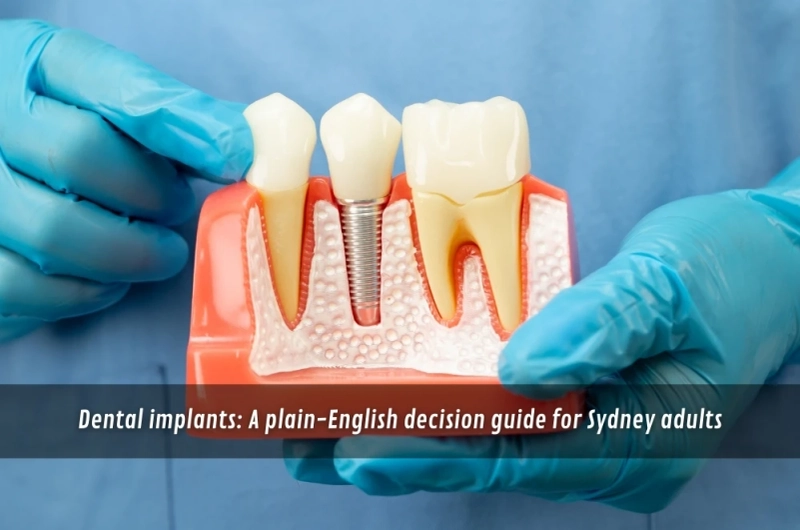
An implant isn’t a “replacement tooth” in the simple sense. It’s a foundation that supports a restoration.
That’s why people consider implants in the first place: the stability can feel closer to natural function than a removable option, and it can help when chewing confidence has taken a hit.
But implants aren’t automatically the right call. They rely on healthy gums, adequate bone, and a plan that suits your health profile and bite forces.
If your goal is mostly cosmetic—closing a visible gap for confidence—that might point you toward one set of options. If your goal is biting and chewing without thinking twice, that can point you toward another.
Naming your priority up front sounds basic, but it stops you from paying for features you don’t actually need.
The timeline, without the marketing gloss
Most implant treatment isn’t one neat “before and after” moment. It’s staged.
There’s typically an assessment phase (history, imaging, planning) where suitability and sequencing are worked out.
Then there’s the surgical placement stage, followed by healing time—because the body needs time to integrate and settle.
After that comes the restoration stage, where the visible tooth (or teeth) is fitted and adjusted.
And then comes the part many people don’t think about early enough: review appointments, cleaning access, and the habits that keep the tissues around the implant healthy.
Some plans can be streamlined; others shouldn’t be rushed. A good plan will explain why the timing is what it is, rather than simply promising speed.
Why does the cost vary so much
People hear “implant” and assume it’s one item with one price. In reality, it’s a treatment pathway made up of components.
The number of teeth being replaced matters, but so does the type of restoration (single crown versus bridging or a full-arch approach).
Bone and gum conditions matter because sometimes the foundation needs support before an implant is predictable—and that can mean extra steps, extra healing, and extra visits.
The plan itself matters too. Thoughtful planning can reduce nasty surprises later, even if it feels slower at the start.
And there’s the unglamorous truth: maintenance isn’t optional. If the plan doesn’t clearly cover how follow-up works and what you’ll be expected to do, that’s not a small detail—it’s a risk.
Decision factors that help you choose well
Forget the perfect checklist and focus on three simple themes: clarity, continuity, and realism.
Clarity looks like a clinician explaining the steps in order, including decision points (what could change the plan, and when).
Continuity looks like knowing who is doing what across the process, especially if multiple practitioners are involved.
Realism looks like an honest discussion of recovery, follow-ups, and how your day-to-day routine will be affected—not just what the final result looks like.
Ask questions like:
- What needs to be stable before we start?
- What are the likely “forks in the road” if healing or bone conditions don’t match expectations?
- What does follow-up look like in the first year, not just the first week?
- What does “maintenance” actually mean for me?
If it helps to keep your consult questions organised and compare plans without getting lost, the High Dental Implants Melbourne treatment planning guide can be used as a simple reference point.
If you’re travelling for treatment (common when people compare options across cities), get specific about logistics. Which appointments can be combined? Which can be done locally in Sydney? What happens if you need to be reviewed sooner than planned?
Alternatives you should at least hear about
Even if you think you’re “definitely getting implants,” it’s still worth asking what else is on the table.
A bridge can make sense in some cases, especially if neighbouring teeth already need restorative work, but it comes with its own trade-offs around tooth preparation and cleaning.
A denture—partial or full—can be quicker and more budget-friendly for some people, and modern designs can be far more wearable than the stereotypes. They can also require adjustments and an adaptation period that people don’t always anticipate.
Sometimes the best plan is staged: stabilise gum health, manage infection risk, use a temporary solution, then revisit implants once the foundation is better.
A solid consult doesn’t “sell” one option. It helps you understand what you’re trading off when you choose any option.
Common mistakes that trip people up
People often regret not asking the boring questions.
One mistake is comparing quotes without confirming inclusions, then being blindsided by extra imaging, temporary restorations, or additional follow-ups.
Another is treating the first timeline you hear as fixed, rather than a best-case range that depends on healing and what the assessment finds.
Some people push ahead while gum issues or unresolved dental problems are still in the background because they’re eager to move on. That can backfire when healing becomes less predictable.
There’s also a practical mistake: underestimating what multiple appointments do to a normal Sydney week. A “quick visit” can turn into a half-day once you factor in travel, parking, and work handover.
And the biggest quiet mistake is assuming implants are “set and forget.” They’re not. They still rely on good tissue health, and they still need proper cleaning and monitoring.
Operator Experience Moment
What I see most often is decision fatigue, not confusion. People understand the basics, then get worn down by options and timing and the feeling that they should decide quickly. The calmer decisions usually happen when someone picks two priorities, asks for the steps in writing, and gives themselves permission to take one extra day before committing. That small pause tends to stop the “why didn’t I ask that?” feeling later.
Sydney local SMB mini-walkthrough
Write down your top two outcomes and what would count as “worth it” after 12 months.
Book a consult and ask for the steps in order, plus what could change the sequence.
If treatment isn’t in Sydney, ask which visits can be bundled and what follow-ups can be local.
Get clarity on what’s included: imaging, temporary teeth, reviews, and maintenance checks.
Block tentative appointment windows in your calendar so you can see if it’s actually workable.
Set a buffer for “if needed” steps so you’re not forced into rushed decisions.
Practical Opinions
Pick a plan that matches your life, not just your ideal scenario.
If the steps aren’t clear, slow down until they are.
Maintenance is part of the deal—decide with that in mind.
A simple next 7–14-day plan
Days 1–2: Write a one-page brief for yourself: what you’re replacing, why it matters, and what you want the outcome to feel like day-to-day (eating, speaking, confidence).
Days 3–4: Draft your consult questions. Keep it tight: sequencing, what could change the plan, who does what, recovery expectations, follow-up schedule, and what you’ll need to do at home.
Days 5–7: Have the consult. Ask for the proposed sequence in writing, and ask what the “decision points” are (where the plan might fork depending on assessment or healing).
Days 8–10: Summarise what you heard in your own words while it’s fresh. If you can’t explain the plan simply, you don’t understand it yet—and that’s a sign to ask one more question.
Days 11–14: Compare plans using the same yardstick: clarity of steps, how risks are explained, how follow-ups are handled, and whether the schedule fits a Sydney routine without constant scrambling.
If you’re juggling a busy roster or school commitments, treat scheduling as part of the decision, not an afterthought.
Key Takeaways
- Implants are usually a staged pathway; the “in-between” time is often what makes outcomes more predictable.
- Cost differences usually reflect foundation needs, inclusions, restoration design, and planning assumptions.
- A good decision comes from clear sequencing, honest trade-offs, and realistic scheduling.
- Long-term results depend heavily on maintenance and follow-up, not just the surgical appointment.
Common questions we hear from businesses in Sydney, NSW, Australia
Q1: How do I plan time off when I don’t know the exact timeline yet?
Usually, the best move is to identify the likely “anchor appointments” (assessment/imaging, the surgical stage, and the restoration fitting) and plan around those first. A practical next step is to ask which appointments are fixed and which can move without affecting outcomes. In Sydney, commuting and parking alone can turn a short appointment into a half-day, so build extra margin.
Q2: Is choosing the fastest option sensible if I can’t afford downtime?
It depends on what’s making it “fast,” because some steps can be streamlined while others are tied to healing and stability. A practical next step is to ask what risks increase when steps are compressed and what the backup plan is if healing takes longer than expected. In most Sydney workplaces, predictability is often easier to manage than speed that turns into uncertainty.
Q3: How can I compare quotes without getting lost in the details?
In most cases, quotes differ because inclusions differ, and the assumptions about foundation work aren’t the same. A practical next step is to request a written breakdown of what’s included and what’s conditional (“if needed”), then compare like-for-like. In Sydney SMBs, it’s common to budget with a buffer so cash flow doesn’t get squeezed by an unexpected extra step.
Q4: What’s the most overlooked part after the implant is placed?
Usually, it’s the maintenance routine and review schedule, because attention naturally goes to the visible tooth. A practical next step is to leave the consultation with a simple home-care plan and a clear first-year review timeline. In Sydney, where travel and irregular hours are common, booking those review windows early makes follow-through far more realistic.