



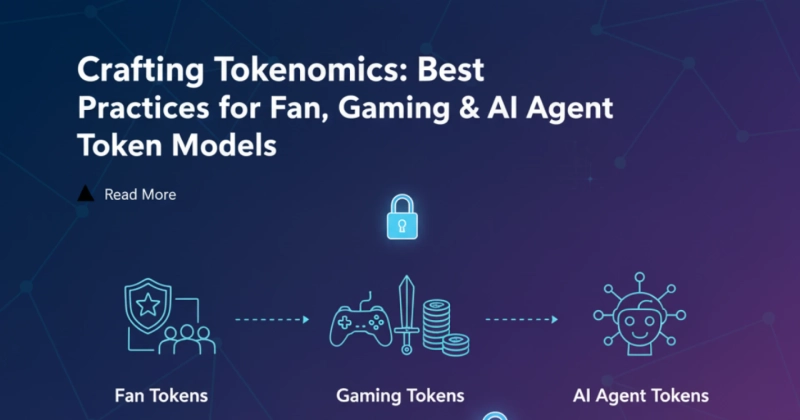
Tokenomics is no longer a one-size-fits-all discipline. The mechanics that make a sports fan token thrive are very different from what stabilizes a play-centric game economy or what sustains an AI-agent marketplace where compute, data, and model outputs are the goods. What these verticals share is a basic requirement: the token must sit at the heart of a value loop where users perform actions that create utility, the utility creates willingness to pay, and that willingness reliably flows back into the token (directly or indirectly) through sinks, fees, or rights.
This article translates that high-level loop into practical design choices for three of the fastest-moving categories: Fan, Gaming, and AI Agent tokens.
1) Start with the value loop, not the spreadsheet
Before debating supply caps or vesting tables, articulate a value creation–capture loop specific to your product:
Action: What useful action do users repeatedly take?
• Fan: voting, access purchases, merch drops, event participation
• Gaming: playtime, item crafting, tournament entry, trading
• AI agents: submitting tasks, consuming inferences, providing datasets/models
Utility: What outcome do those actions produce that users feel is valuable?
• Fan: status, recognition, proximity to the brand or team
• Gaming: fun, progress, rare assets, competitive edge
• AI agents: accurate outputs, faster automation, safer decisions
Payment & sinks: How does utility translate into token demand and sinks?
• Fan: gated access passes, auctions, membership tiers, vote power boosts
• Gaming: repair fees, crafting costs, entry tickets, marketplace commissions
• AI agents: per-inference fees, subscription credits, staking to access verified agents
Feedback: How does the system reward repeat behavior without runaway inflation?
• Dynamic emissions, non-inflationary rewards (discounts, boosts), time-bounded tiers
• Buybacks or redemption windows tied to real revenue or usage
Get this flywheel right and allocation math becomes a support act rather than the main show.
Crafting tokenomics for token development means designing the economic blueprint that defines how a token gains, holds, and circulates value. It involves aligning supply, demand, incentives, and governance to create a sustainable ecosystem where users, investors, and developers all benefit from long-term engagement.
2) Fan tokens: design for status, access, and brand alignment
Core objective: deepen brand affinity and monetize proximity without eroding trust. Fans are not “yield farmers”; they are community members seeking recognition, voting rights on safe decisions, and special access. The token must feel like a membership currency rather than a speculative instrument.
Utility design
- Access tiers: Token-gated channels, AMAs, behind-the-scenes content, presale windows, and meet-and-greets. Tiers should be clear, stable, and renewed on predictable cycles (e.g., seasonal).
- Experiential auctions: Limited “money-can’t-normally-buy” items (locker room tours, shout-outs, VIP seats). Design auctions with fair-chance mechanisms (e.g., raffle tickets proportional to tokens staked for the event) to include smaller holders.
- Brand-safe governance: Polls on non-core decisions (jersey themes, intro music) with rate-limited vote power and anti-sybil checks (fan-ID verification, stake-to-vote).
- Partner integrations: Merch discounts or loyalty multipliers when the token is used at partner brands; ensure the partner contract funds a buyback budget so off-chain spending recirculates on-chain.
Supply, emissions, and sinks
- Keep base supply conservative (fixed or slow-emission) and rely on non-inflationary perks for retention (badges, tier multipliers, POAP-style proof of attendance).
- Use time-boxed staking for event perks rather than uncapped APY. The return is access, not money.
- Create predictable sinks: season pass mints, voting boosts, raffle tickets, and merch redemptions. Tie them to real experiences so sinks feel like purchases, not penalties.
Pricing & distribution
- Favor multi-stage access sales over open-ended farming. Early fan membership NFTs can map to token boosts later, but avoid rewarding only early capital; reward verified fandom (ticket history, community quests).
- Prevent price whiplash by aligning announcements with redemption windows—e.g., list the season calendar and perk schedule at launch so buyers understand the cadence of utility.
Compliance
- Fan tokens should avoid promises of financial return. Keep language, dashboards, and campaign materials focused on access and experiences, not price. Implement robust KYC for high-value redemptions and clear refund/transfer policies for event cancellations.
3) Gaming tokens: control inflation, reward skill, and design for fun before finance
Core objective: create a sustainable economy where the token supports play, not the other way around. Historical failures in game tokens typically stem from mismatched emissions and weak sinks.
Single vs. dual token
- Single-token systems are simpler and work for casual or session-based games with limited crafting.
- Dual-token systems split roles: a governance/value token with capped supply and an in-game utility token with elastic emissions. This can reduce selling pressure on the governance token while allowing the utility token to scale with active users.
Sinks that feel like gameplay
- Crafting & upgrades: Pay utility token to mint or upgrade items; burnt tokens tie progression to supply control.
- Repair & durability: Item usage decays; paying the utility token to repair removes supply and encourages ongoing play.
- Matchmaking & tournaments: Entry fees partly burned, partly routed to prize pools; add anti-bot staking for high tiers.
- Marketplace fees: Take fees in the utility token and burn a portion; use the rest for seasonal prize support and live-ops.
Emissions you can dial
- Performance-based rewards: Tie emissions to skill, not pure time. Cap daily earnings and shift high-end rewards to tournaments.
- Seasonality: Treat emissions like a live-ops budget—reset each season with known targets; publish a token balance sheet for the game economy so the community understands targets and burn rates.
- Bot resistance: Proof-of-humanity gates for top rewards; require low-cost, time-limited season passes paid in token to access ranked rewards.
Marketplace equilibrium
- Resist the urge to subsidize early speculation. Seed liquidity prudently; allow price discovery to reflect fun and item demand. If you must bootstrap, direct incentives to creators and guild leaders who produce content, leagues, or quests that retain real players—not to pure arbitrage.
4) AI agent tokens: meter scarce resources and pay for verifiable quality
AI-native economies look different because the scarce goods are compute, high-quality data, reliable models, and verifiable outputs. Tokenomics must meter usage, incentivize high-quality supply, and penalize low-quality or malicious agents.
Demand drivers
- Per-inference metering: Users pay tokens for compute-backed tasks. This anchors the token to a measurable cost (e.g., GPU seconds, tokens processed).
- Subscriptions & credits: Stable UX for enterprises—fiat-onramp to credits that auto-convert on-chain for settlement and sinks.
- Priority access: Staked tokens unlock higher throughput, lower latency, or premium models.
Supply & quality
- Provider staking and slashing: Model or data providers stake to list; consistent low-quality outputs incur slashing. This converts the token into a quality bond.
- Reputation-weighted routing: Inference requests routed to agents with on-chain performance scores; top performers earn more tokens per job.
- Contribution rewards: Curate datasets and evaluation tasks; reward contributors with non-inflationary boosts (priority access, lower fees) or bounded emissions tied to verifiable usefulness.
Oracles and verification
- Integrate verification layers (spot-check tasks, cryptographic attestations, human-in-the-loop bounties). Budget these costs in your fee schedule so verification scales with usage rather than becoming a drain.
Treasury & sustainability
- Allocate a compute reserve: part of the treasury is earmarked to subsidize first-time usage and hackathons. Tie grants to milestones (throughput, accuracy, uptime) rather than to marketing metrics.
5) Cross-cutting allocation, vesting, and treasury policy
Regardless of vertical, disciplined distribution prevents early instability.
Pragmatic baseline (adapt per project maturity)
- Public float at TGE: 8–15% circulating; too low invites illiquidity, too high invites churn.
- Team & advisors: 12–20% combined; 12-month cliff, 36-month vest minimum; advisors on 18–24 months with deliverable-based unlocks.
- Ecosystem & rewards: 25–40% with seasonal release schedules governed by published budgets.
- Treasury/operations: 10–20% with clear policies for market support and runway management.
- Investors: Structure with longer vests and transfer restrictions aligned to product milestones; push for performance-based unlocks rather than pure time.
Treasury operating rules
- Publish a liquidity policy (how much is on AMMs vs. CEXs, who is the market maker, what are intervention thresholds).
- Use transparent buyback windows funded from real revenue (fees, partnerships). Avoid surprise burns; if you burn, tie it to user-visible achievements (season completions, championship wins, verified compute milestones).
- Anchor all disbursements to programmatic budgets with community visibility: live-ops (games), event calendar (fan), benchmark subsidy (AI).
6) Pricing, listing, and FDV discipline
Many token designs fail not because their mechanics are bad, but because they launch with an unsustainable fully diluted valuation (FDV) and misaligned unlocks.
- Back-solve FDV from credible 12–18 month utility projections. If your fan token has a realistic path to ₹10–15 crore in annual on-chain spend, ask whether the initial FDV reflects that, not a blue-sky future.
- Align unlocks to usage: Schedule ecosystem unlocks alongside seasonal content or model upgrades; do not unlock into dead air.
- Liquidity depth vs. volatility: Seed AMMs with enough depth to absorb event days or game season starts. Publish expected daily notional and spread targets with your market maker.
- Two-sided onramps: Support fiat and stablecoin flows so users can participate without becoming accidental speculators.
7) Measurement: the KPIs that actually predict sustainability
Dashboards should help you steer emissions and sinks, not just celebrate vanity metrics.
Fan
- Active members by tier, seasonal redemption rate, partner-funded buybacks, average cost per experience.
- Vote participation adjusted for anti-sybil filters.
- Ratio of off-chain sales that route back on-chain (via buybacks or credit redemptions).
Gaming
- Daily Active Users (DAU), ARPPU, retention cohorts, and token velocity (on-chain turnover / circulating supply).
- Inflation control: net emissions = new token rewards – all sinks (crafting, repair, fees, burns). Keep net emissions within a published seasonal band.
- Bot ratio and ban/appeal cycle time; match quality metrics for PvP.
AI agents
- Paid inferences per day, cost per inference, gross margin after verification, provider slashing events, model uptime, and SLA compliance.
- Reputation-weighted fill rate: % of jobs routed to top-quartile agents; signals healthy competition and quality.
8) Security, fairness, and anti-abuse
- Upgradable contracts with guardrails: Use timelocks, multi-sigs, and clearly documented upgrade paths; publish emergency-pause policies.
- Oracle hardening: Where external data influences rewards (match results, event verification, evaluation scores), use multiple feeds and delay finalization to mitigate manipulation.
- Fair launch versus real users: If you run allowlists, prefer proof-of-participation quests over capital-based lotteries to avoid instant flips.
9) Mini case patterns (anonymized) with lessons
- Fan platform A tied token sinks directly to an event calendar. Token demand spiked before marquee games, then softened. They stabilized demand by adding partner merch redemptions year-round and a monthly buyback funded from offline sales. Lesson: smooth seasonality through partner integrations and predictable buybacks.
- Game studio B started with generous emissions that attracted grinders and bots. By season 2, they switched to performance-tiered rewards, introduced item durability (repair burns), and capped daily earnings. Lesson: move rewards from time to skill and spend; add non-punitive sinks embedded in gameplay.
- AI network C paid providers per task without quality bonds, leading to output spam. Introducing provider staking + randomized spot checks with slashing improved accuracy and buyer trust. Lesson: tie rewards to verifiable quality; treat stakes as security deposits for behavior.
10) Implementation blueprint (90–120 days)
Phase 1: Model & simulate (Weeks 1–4)
Document the value loop; map utility inventory (events, sinks, features). Build a Monte Carlo or agent-based model of emissions vs. sinks under conservative adoption curves. Size treasury needs for live-ops, buybacks, verification, and security.
Phase 2: Contract architecture (Weeks 5–8)
Implement modular contracts: token, staking/lockers, marketplace fees, redemption/crafting, verification oracles. Wire multi-sig and timelocks; ship internal audits and third-party reviews.
Phase 3: Dry-run economics (Weeks 9–10)
Run a closed beta with faucets replacing real emissions, turn on all sinks, test attack surfaces (botting, oracle edge cases). Iterate budgets and parameters.
Phase 4: TGE with utility live (Weeks 11–12)
Launch with at least one fully functional sink per category (fan: tier mint; gaming: crafting/repair; AI: paid inference). Publish your seasonal budget and first buyback window. Establish incident response channels and public dashboards.
11) Common pitfalls and how to avoid them
- Inflation disguised as engagement: If your “engagement rewards” are just uncapped emissions, you’re diluting holders. Replace with discounts, boosts, and access that don’t expand supply.
- FDV theater: Overpriced launches cripple future fundraising and community morale. Back-solve valuations from credible usage, not comps.
- Utility drought at launch: Tokens listed before real utility quickly become speculation only. Always go live with at least one meaningful sink.
- Opaque treasury use: Vague buybacks or market support erodes trust. Publish rules, schedules, and accounting.
- Ignoring compliance: Especially for fan and gaming, ensure messaging doesn’t promise investment returns; for AI networks, document data rights and safety controls.
12) Putting it all together
Well-crafted tokenomics do not try to fight user behavior—they channel it. Fan tokens monetize belonging through access and recognition, not yield. Game tokens reward skill and time while keeping inflation in check with fun, organic sinks. AI agent tokens meter scarce, verifiable resources and align incentives for quality, availability, and safety.
Across all three, success depends on turning recurring actions into predictable demand, turning usage into measurable sinks, and turning revenues into transparent buybacks or credits. The spreadsheet matters, but only after the loop works. If you can explain—clearly—why someone would gladly spend the token again next week, you’ve already solved the hardest part of token design.