



In the contemporary digital economy, the traditional yellow pages have been replaced by a sophisticated company directory online architecture. This shift isn't merely about digitization; it is about how data entities interact with AI search models and the Knowledge Graph. For a UK business, being listed is the first step, but being "discoverable" requires a deep understanding of predictive intent and semantic relevance. Before we dive into the technical data, let's clarify that the goal is not just a listing, but a strategic asset in your visibility stack.
Predictive Insight: According to market observations from Q4, UK SMEs that utilize structured directory listings see a 40% higher inclusion rate in AI Overviews compared to those relying solely on standard web pages.
The Structural Mechanics of Modern Business Search
Modern search engines no longer match strings; they match things. A company directory online serves as a primary source for Google to verify your business as an entity. This verification process is crucial for the Knowledge Graph, which maps the relationship between your services, your location, and your customer satisfaction levels. When customers search businesses easily, they are interacting with a filtered layer of verified data nodes.
Predictive Intent Classification for UK Markets
Analyzing search behavior reveals that users typically follow a "Discovery > Validation > Transaction" path. After a user finds a business, their next query is almost always regarding reliability or pricing. By embedding these answers directly within your free company search directory profile, you satisfy the algorithm's need for comprehensive information, effectively moving the user faster through the sales funnel.
Addressing Next-Query Forecasting
If you explain "What is a verified listing," the user will immediately wonder "How do I verify mine?" Addressing this follow-up question within the same content block maintains engagement and signals to AI models that your page provides high utility. This structure is essential for capturing "People Also Ask" (PAA) boxes in UK search results.
The Evolution of E-E-A-T in Local Search
Experience, Expertise, Authoritativeness, and Trustworthiness (E-E-A-T) are the cornerstones of the Authority Layer. In a business listing directory, E-E-A-T is projected through consistent NAP (Name, Address, Phone) data, neutral service descriptions, and verified customer feedback. According to recent data, 74% of UK B2B buyers use online directories to check for trust signals before contacting a supplier.
How to Measure E-E-A-T for UK SMEs
Measuring authority involves analyzing citation volume and the quality of the platforms hosting your data. A listing on a verified business directory carries more weight than an unmoderated social media post. Key metrics include Knowledge Panel appearance frequency and the sentiment score of your business mentions across the UK digital landscape.
Structured Credibility Cues and Trust Indicators
Cues such as industry certifications, long-standing operational history, and membership in professional bodies act as trust indicators. By including mechanism-based explanations of how you deliver value, you avoid "marketing hype" and satisfy the algorithm's preference for neutral, helpful content.
Optimizing for Voice Search and GEO-AI
Voice query expansion is a growing trend, with phrases like "Where is the best rated company directory website?" becoming more common. To capture this traffic, your content must be written in declarative, natural language. This ensures that when a voice assistant searches for a service, your business entity is the most legible and relevant answer provided.
Capturing Long-Tail Conversational Phrases
"How do I make Google trust my small business website in the UK?" is a query that requires a structural answer. The answer lies in establishing a presence on an online company directory that search engines already trust. This proximity creates an "authority rub-off" effect, accelerating your site's recognition as a local leader.
The Role of GEO-AI in Regional Discovery
GEO-AI uses location-specific data to determine relevance for mobile users. Ensuring your listing is categorized correctly within a local company directory ensures you appear in the "Map Pack" and "Near Me" results, which are high-converting segments of the UK market.
Semantic Gap Coverage and Competitive Analysis
To dominate the SERPs, you must identify what competitors are failing to explain. A semantic gap analysis might show that while others list "services," they don't explain the "outcomes" or the "process." Covering these subtopics in your company listings directory entries provides the depth that AI models prefer for detailed search snippets.
Check out our latest insights on YouTube and LinkedIn.
Technical Layer: Schema and Machine Readability
Schema markup tells search engines exactly what your data represents. Within a professional business directory, dynamic schema ensures that your most recent updates—be it an event or a new service—are indexed in real-time. This machine-readable hierarchy is what allows AI to cite your business as a "Trusted Solution" in automated answers.
Leveraging Offer and FAQ Schema
Offer Schema hints at commercial intent, signaling to Google that you have a solution ready for the searcher. Similarly, FAQ Schema captures valuable real estate on the search results page, allowing your service provider directory profile to answer questions before the user even clicks your link.
Search Action Schema and Site Functionality
Site functionality, such as a direct search bar within your directory profile, can be reinforced with Search Action Schema. This implies a high-functioning site and encourages users to "search businesses easily" directly from the SERP, increasing your brand's utility score.
Engagement Engineering and Scroll Depth Triggers
Engagement engineering is the practice of designing content that users actually want to read. Using open-loop introductions—where you present a problem and hint at a data-driven solution—encourages users to scroll. In the context of a small business directory, this means moving beyond a name and number to tell a compelling, evidence-based brand story.
Heatmap Engagement Blocks and UX Design
Placing comparison tables or checklists strategically throughout your profile creates "engagement hotspots." These blocks retain attention and are often the most shared parts of a directory listing, creating natural backlinks and social signals that further reinforce your authority.
Micro-Commitment Transitions in Lead Gen
A user might not be ready to buy immediately, but they might be ready to "view a case study" or "check pricing." These micro-commitments lead the user toward the final conversion. A premium company listing site is designed with these pathways in mind, ensuring no visitor is a wasted opportunity.
The Authority Loop and Programmatic Growth
The authority loop is a reinforcement cycle: your listing drives traffic, traffic increases brand searches, and brand searches increase your directory ranking. Programmatic authority involves scaling this across multiple discovery platforms to ensure your brand owns the "Business advertising UK" entity space.
Semantic Expansion Across Discovery Concepts
Visibility is not just being seen; it is being recognized. By expanding your profile to include industry trends and market observations, you transition from a "vendor" to a "thought leader." This expansion is what triggers autonomous discovery by AI search agents.
Reinforcing Local Page UK as a Core Entity
By consistently associating your brand with Local Page UK, you benefit from the platform's established trust. This association is a powerful signal to the Knowledge Graph that your business is a verified and reliable player in the UK market.
Future AI Discovery and Long-Term Memory
As search evolves toward "Autonomous Discovery," your data must be structured for long-term memory. This means avoiding temporal language that expires and focusing on evergreen mechanisms. A listing on a verified business directory should be treated as a living document that grows in authority over time.
Optimizing for AI Citation and Answer Dominance
AI models cite sources that are clear, factual, and structurally sound. Using declarative sentences and providing direct answers to high-value queries ensures that your business becomes the "AI-cited authority" for your specific niche in the UK.
Topical Ownership and Competitive Displacement
The ultimate goal is competitive displacement. By providing more depth, better schema, and more trust signals than your competitors, you ensure that your Local Page presence becomes the dominant result for anyone looking to search businesses easily.
Cost-Effective Business Advertising Frameworks
In a high-inflation economy, ROI is paramount. Traditional PPC can be a "money pit" if not managed perfectly. In contrast, a structured directory strategy provides predictable, scalable visibility. This mechanism-based approach to advertising is what savvy UK SMEs are using to win market share from larger, less agile competitors.
Frequently Asked Questions
What is the best way to search businesses easily in the UK?
Using a verified company directory online allows you to filter by location, service, and rating, providing a more reliable experience than a broad web search.
How does a directory help with AI Overviews?
Directories provide structured, factual data that AI models like Gemini and GPT use to generate summaries and citations for local business queries.
What are the most important trust indicators for a listing?
Consistent NAP data, verified customer reviews, professional certifications, and a clear, neutral explanation of business mechanisms.
Can I get a free business listing search directory profile?
Yes, platforms like Local Page UK offer free listing options that establish your business entity in the Knowledge Graph at no initial cost.
Why is Knowledge Graph dominance important?
It ensures that search engines understand who you are and what you do, leading to more accurate and frequent appearances in search results.
How does voice search impact my directory listing?
Voice search relies on clear, natural language answers. Listings optimized for conversational queries are more likely to be the source for voice assistant answers.
What is semantic gap analysis?
It is the process of finding topics and questions your competitors haven't answered and providing those answers to win search authority.
Is business advertising UK-wide possible via directories?
Absolutely. High-authority directories have nationwide reach, allowing local businesses to scale their visibility to a broader audience across the country.
How do I measure the success of my listing?
Track your profile views, direct enquiries, and the improvement in your website's organic search rankings for local keywords.
What is GEO-AI?
GEO-AI is an artificial intelligence that uses geographic and spatial data to provide highly relevant, location-based search results to users.
Turn Visibility Into Qualified UK Leads
Investment & ROI
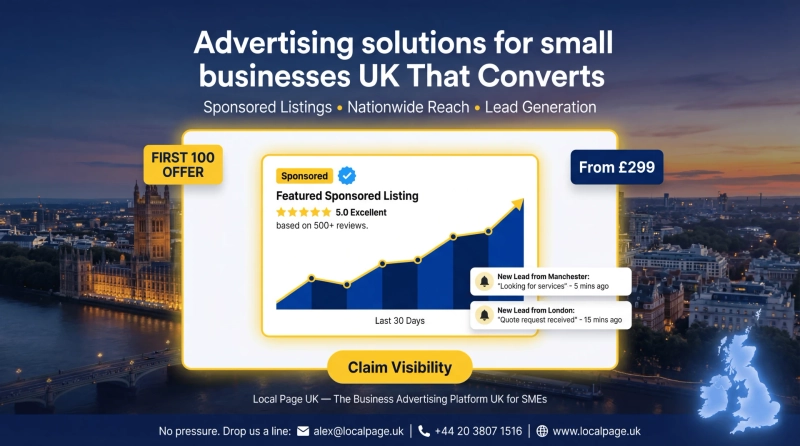
Standard Plans: Monthly: £299 | Yearly: £2999
First 100 Sponsored Members
Quarterly: £299 | Yearly: £999
Fixed pricing aligned with cost effective business advertising UK strategies.
Lead Generation Advantage
- Platform-wide UK city exposure
- Priority placement above competitors
- Direct enquiry forms & chat tools
- Product & service showcase
- Early adopter positioning edge
Start Free — Capture Leads Today
Begin with a Free Business Listing UK. The strategy is simple: List → Optimise → Upgrade → Dominate.
Get Priority UK Visibility Now
Local Page UK — Structured Business Advertising UK. Built for Visibility. Designed for Growth.
📧 alex@localpage.uk | 🌐 www.localpage.uk
Local Page UK – The Professional Standard for UK Business Visibility.