



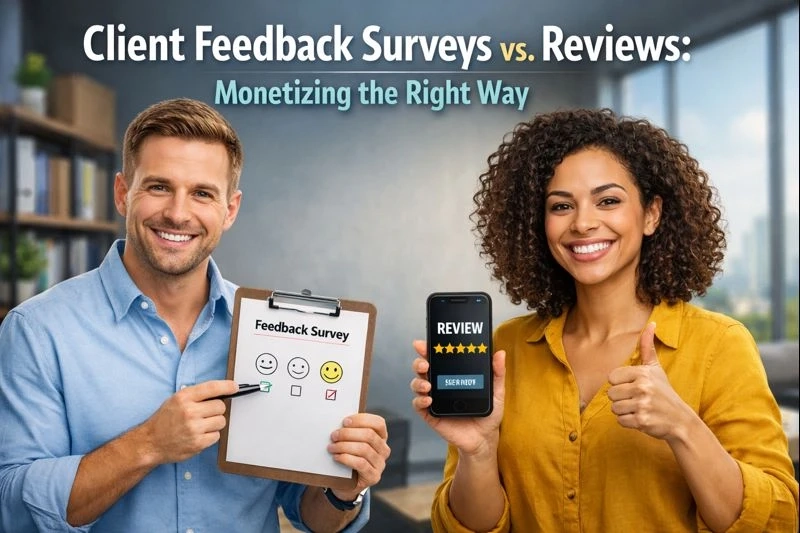
In the competitive world of digital business, gathering customer opinions isn't just polite—it's a goldmine for growth. Client feedback surveys and customer reviews both capture voices, but they serve distinct purposes. Surveys dive deep into structured insights, while reviews offer raw, public endorsements. The key to monetizing feedback lies in knowing when to use each, turning data into dollars without alienating your audience.
Businesses often blur the lines, chasing stars on review sites while ignoring private surveys that reveal actionable gems. This article breaks down the differences, highlights business growth strategies tied to each, and shows how to monetize them ethically. Whether you're running a fitness program or an e-commerce store, mastering this duo boosts online reputation and revenue.
Understanding Client Feedback Surveys
Client feedback surveys are private questionnaires sent post-interaction, designed for depth over display. They ask targeted questions like "How likely are you to recommend us?" or "What improved your experience most?" using scales, open-ended fields, or multiple-choice formats.
Unlike spontaneous reviews, surveys control the narrative. You choose timing—right after a session or 30 days later—and focus on specifics. This yields customer insights that pinpoint pain points, such as outdated equipment or session pacing.
Tools like Google Forms, Typeform, or SurveyMonkey make them easy to deploy. Response rates hover around 10-30% with incentives like discounts, far higher than public review prompts.
The Power of Customer Reviews
Customer reviews, on the other hand, are public testimonials on platforms like Google, Trustpilot, or Yelp. They're unfiltered, star-rated snapshots anyone can see, influencing 93% of buyers per recent studies.
Reviews build social proof instantly. A glowing 5-star comment on your fitness app's page can drive sign-ups. But negatives sting— one bad review drops trust by 30%. Review management involves encouraging positives through follow-up emails and responding publicly to critiques.
The virality factor sets reviews apart. They rank in search results, amplifying online reputation without ad spend.
Key Differences: Surveys vs. Reviews
Surveys and reviews differ fundamentally in privacy, depth, purpose, and response rates. Client feedback surveys keep everything private, allowing honest, detailed responses without public pressure. In contrast, customer reviews go fully public, exposing star ratings and comments to the world for instant credibility.
Depth varies too—surveys deliver high levels of structured data through guided questions, uncovering nuanced customer insights, while reviews stay low-depth with quick, emotional blurbs. Purpose aligns accordingly: surveys fuel internal improvements and strategy tweaks, whereas reviews drive external validation and sales conversions.
Response rates highlight the gap—surveys achieve 10-30% participation, especially with incentives, compared to reviews' typical 1-5% from passive users.
Monetizing Client Feedback Surveys
Monetizing feedback from surveys starts with analysis. Aggregate data reveals trends—like 70% wanting more home workouts—guiding product upsells. Impact Fitness Coaching Academy, for instance, uses post-program surveys to refine offerings, boosting retention by 25% and enabling premium add-ons like personalized nutrition plans.
Turn insights into revenue streams:
· Product Development: Launch features based on feedback, then charge for them.
· Email Nurturing: Segment respondents for targeted campaigns, increasing lifetime value.
· Testimonial Mining: With permission, excerpt anonymized quotes for sales pages.
Surveys also cut churn. Addressing issues proactively retains clients worth 5-25x acquisition costs.
Avoid pitfalls: Don't overload with questions (keep under 10) or spam. Incentives must feel genuine—no quid pro quo.
Monetizing Customer Reviews Effectively
Reviews shine in testimonial marketing. Positive ones convert browsers to buyers, with 72% trusting peers over ads. Impact Fitness Coaching Academy showcases client reviews on its homepage, driving a 40% uptick in enrollments by highlighting transformations.
Strategies include:
· Display Strategically: Embed 5-star snippets on landing pages and ads.
· Incentivize Ethically: Offer small perks for reviews, but never fake them—platforms ban this.
· Leverage UGC: Repost reviews on social media, tagging reviewers for amplification.
For negatives, respond empathetically: "Thanks for the feedback—we've upgraded our app interface." This turns detractors into advocates, improving review management.
Aggregate high ratings to access premium review platforms like Google Seller Ratings, enhancing ad performance.
Integrating Both for Maximum ROI
The real magic happens combining them. Use surveys for private intel, reviews for public proof. Impact Fitness Coaching Academy exemplifies this: Surveys identify improvements, then polished reviews validate changes publicly, creating a feedback loop that sustains growth.
Start with a hybrid system:
1. Send surveys immediately post-service.
2. Follow up with review requests for satisfied respondents (NPS 9-10).
3. Analyze both quarterly for business growth strategies.
This duo enhances online reputation holistically—surveys refine internals, reviews polish externals.
Best Practices and Common Mistakes
Success demands balance. Best practices:
· Automate with tools like Zapier linking surveys to review prompts.
· Personalize: Use names and reference experiences.
· Comply with laws—GDPR for EU clients, disclose incentives.
Common mistakes:
· Review-gating: Hiding negatives erodes trust.
· Survey fatigue: Bombarding clients drops engagement.
· Ignoring data: Collecting without acting wastes potential.
Future-Proofing Your Approach
As AI analyzes sentiment faster, monetizing feedback evolves. Tools like MonkeyLearn process surveys for instant insights; review aggregators like ReviewTrackers unify platforms.
In fitness coaching, where trust reigns, this matters doubly. Programs like those at Impact Fitness Coaching Academy thrive by monetizing feedback right—surveys for evolution, reviews for attraction.
Ultimately, client feedback surveys vs. reviews isn't either/or. It's strategic synergy. Master it, and watch your online reputation and revenue soar. Start surveying today—your bottom line will thank you.