



Career opportunities after data analytics courses in Pakistan, covering job roles, skills, industries, and growth paths for students and professionals.
Data analytics has become a strong career choice for students and working professionals across Pakistan. Companies now depend on data to plan strategies, manage risks, and improve daily operations. As a result, learners who complete Data Analytics courses in Pakistan often find doors opening across many industries, job roles, and career levels.
This field does not require everyone to be a math expert or a programmer from day one. With the right learning method, consistent practice, and clear goals, many people from commerce, science, IT, and even non-technical backgrounds build successful careers in analytics.
Why Data Analytics Is Becoming a Career Choice in Pakistan
Businesses in Pakistan generate large amounts of data every day. Banks register transactions, hospitals record patient data, retailers study buying behaviour, and software companies analyse user activity. Raw data alone has no value unless someone can study it, explain patterns, and help leaders make better decisions.
This growing need has increased interest in data analytics courses in Pakistan, especially among:
- University students plan their first job.
- Working professionals want career stability.
- IT professionals seeking to transition into data-based roles
- Business graduates looking to add technical skills
Analytics careers also offer flexibility. Many jobs allow remote or hybrid work, and skills learnt in Pakistan can be used globally.
Understanding What a Data Analytics Career Looks Like
A data analytics career is not limited to one job title. It includes several roles, each with different responsibilities and skill levels. Most learners start with basic analysis tasks and grow into advanced or leadership positions over time.
A typical data analytics method includes:
- Collecting data from different sources
- Cleaning and organizing data
- Studying patterns and trends
- Creating reports and dashboards
- Supporting business decisions with data-backed information
Professionals educated through data analytics courses in Pakistan are prepared to handle these tasks in real work environments.
Career Options After Data Analytics Courses in Pakistan
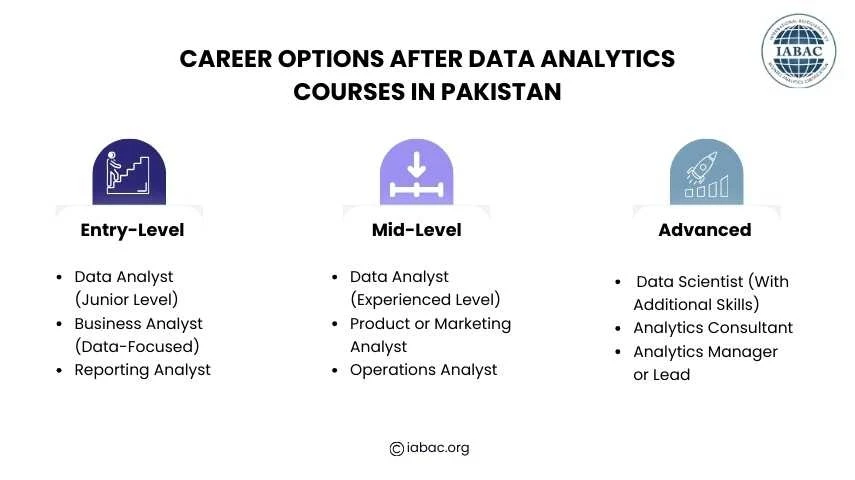
Many learners worry about getting their first job after completing a course. Entry-level roles are designed for beginners who understand tools, concepts, and basic problem-solving.
Entry-Level
1. Data Analyst (Junior Level)
This is one of the most common starting roles.
Responsibilities include:
- Working with spreadsheets and databases
- Creating simple reports and charts
- Supporting senior analysts
- Answering basic business questions using data
Who this role suits:
- Fresh graduates
- Career switchers
- Learners with hands-on project experience
2. Business Analyst (Data-Focused)
Some organisations prefer candidates who understand both data and business operations.
Responsibilities include:
- Analyzing sales, operations, or customer data
- Preparing reports for managers
- Identifying process improvements
This role is popular among commerce and management graduates who complete data analytics courses in Pakistan.
3. Reporting Analyst
Reporting analysts focus on preparing regular reports rather than deep analysis.
Common tasks:
- Monthly and weekly performance reports
- Dashboard updates
- Data accuracy checks
This role helps beginners gain confidence while working with real business data.
Mid-Level
With experience, professionals move beyond basic reporting and take more responsibility.
4. Data Analyst (Experienced Level)
At this stage, analysts work independently and handle complex tasks.
Key responsibilities:
- Advanced data analysis
- Creating dashboards using tools
- Working with multiple data sources
- Presenting findings to customers
Professionals at this level usually earn higher salaries and have better job security.
5. Product or Marketing Analyst
These roles focus on customer behaviour and product performance.
Tasks include:
- Studying user engagement
- Evaluating campaign performance
- Making data-based suggestions for improvement
Many e-commerce and software companies in Pakistan hire for these roles.
6. Operations Analyst
Operations analysts help organisations improve efficiency.
Work involves:
- Supply chain analysis
- Cost and performance tracking
- Process improvement suggestions
These roles are common in manufacturing, logistics, and service industries.
Advanced
Learners who continue developing skills can move into advanced and leadership roles.
7. Data Scientist (With Additional Skills)
Some data analysts transition into data science by learning advanced statistics and programming.
Responsibilities include:
- Predictive analysis
- Advanced data modeling
- Working with large datasets
This role usually requires extra training beyond basic data analytics courses in Pakistan.
8. Analytics Consultant
Consultants work with different clients and industries.
Typical duties:
- Understanding client problems
- Analyzing data
- Providing strategic recommendations
This role suits professionals who enjoy variety and client communication.
9. Analytics Manager or Lead
Leadership roles focus on managing teams and strategy.
Responsibilities include:
- Guiding analytics teams
- Matching data work with business goals
- Reviewing reports and insights
Experience, communication skills, and domain knowledge matter greatly at this level.
Industries Hiring Analytics Professionals in Pakistan
Analytics jobs are not limited to IT companies. Many sectors hire professionals trained through data analytics courses in Pakistan.
Key industries include:
- Banking and financial services
- E-commerce and retail
- Healthcare and pharmaceuticals
- Telecommunications
- Software and IT services
- Education and training
- Manufacturing and logistics
Each industry uses data differently, but the foundation skills remain similar.
Skills Employers Need After Data Analytics Courses in Pakistan
Completing a course is only one step. Employers look for practical ability and problem-solving skills.
Technical skills often expected:
- Spreadsheet analysis
- SQL basics
- Data visualization tools
- Understanding of databases
Non-technical skills that matter:
- Clear communication
- Logical thinking
- Attention to detail
- Business understanding
Strong candidates can explain data findings in simple language, which helps decision-makers act quickly.
Challenges Learners Often Face and How to Handle Them
Many learners think twice before choosing analytics due to common concerns.
Common concerns include:
- “Do I need strong maths skills?”
- “Is coding required?”
- “Will I get a job without experience?”
These concerns are valid but manageable.
Helpful approaches:
- Start with basic concepts
- Practise using real datasets
- Build small projects
- Focus on understanding, not memorisation
Structured data analytics courses in Pakistan usually address these challenges step by step.
Why Timing Matters for Analytics Careers
Analytics roles are growing, but competition is also increasing. Learners who delay skill development may find it harder to stand out later.
Professionals who improve their skills early generally benefit from:
- Better job options
- Faster career growth
- Higher salary potential
- Stronger professional profiles
Starting now helps learners grow with the industry instead of catching up later.
The Role of Certifications in Career Growth
While degrees matter, certifications help validate skills. A recognised data analytics certification shows that a learner matches industry standards and understands practical concepts.
Professional platforms like IABAC support learners by offering structured certification processes that match with real-world analytics roles, helping professionals build credibility and confidence in their skills.
Career Growth and Salary Progression
Analytics careers usually follow a regular growth path.
Typical progression:
- Entry-level analyst
- Experienced analyst
- Specialist or consultant
- Manager or lead
With experience and continuous learning, professionals often see salary improvements and better job stability.
How to Prepare for Analytics Jobs While Studying
Learners can improve job abilities even before completing their courses.
Practical steps include:
- Working on sample projects
- Practicing data analysis problems
- Learning to present insights clearly
- Staying updated with industry trends
These habits improve confidence during interviews and on the job.
Long-Term Career Stability in Data Analytics
Data analytics skills remain useful across roles and industries. Even if one sector slows down, professionals can move to another with minimal retraining.
This flexibility makes data analytics courses in Pakistan a practical choice for learners seeking long-term career reliability.
Future Outlook for Analytics Careers in Pakistan
Digital transformation is increasing across Pakistani businesses. As more organisations depend on data-based planning, demand for skilled analysts continues to grow.
Future opportunities may include:
- Advanced analytics roles
- Industry-specific analytics positions
- Leadership roles in data strategy
Learners who build strong foundations now are better prepared for these future roles.
Brief Look at Related Learning Areas
While data analytics focuses on understanding and explaining data, related areas like data science and artificial intelligence involve deeper technical work. Learners often start with analytics and later move into advanced fields if interested.
A career in data analytics offers growth, stability, and opportunities across industries. With the right learning approach, practical experience, and professional validation, learners can move forward with confidence.
Start your journey today by strengthening your skills and exploring certification programmes that support long-term career growth.