



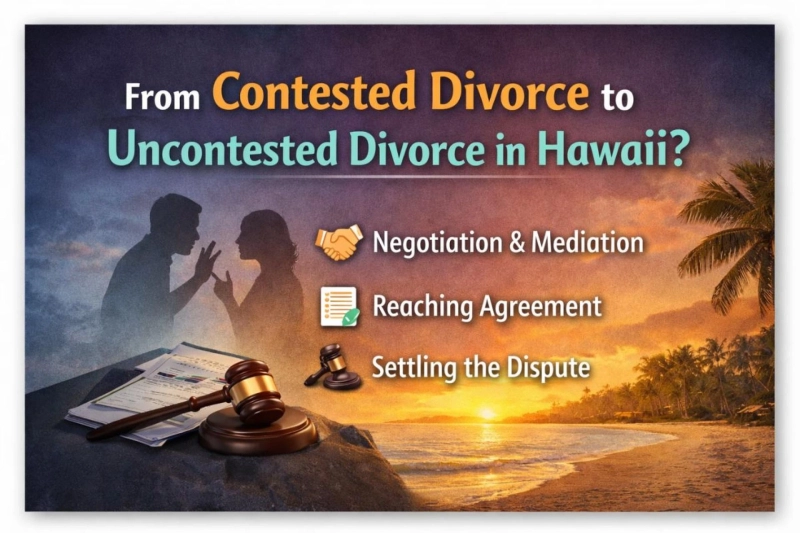
Divorce proceedings in Hawaii often begin with disagreement—over property division, child custody, alimony, or support. When spouses cannot initially agree, the case is filed as a contested divorce. However, it is not uncommon for these cases to evolve. With negotiation, mediation, or shifting priorities, a contested divorce can later become uncontested. Understanding how and when this transition occurs is critical for spouses navigating Hawaii’s family court system.
Contested vs. Uncontested Divorce in Hawaii
A contested divorce arises when one or more issues remain unresolved between spouses. These may include:
- Division of marital assets and debts
- Child custody and visitation
- Child support calculations
- Spousal support (alimony)
- Responsibility for attorney’s fees
An uncontested divorce, by contrast, means both parties reach full agreement on all material issues and present a signed settlement to the court. The judge’s role becomes largely administrative—reviewing the agreement for fairness and legality.
The key point: a divorce’s status is not fixed. A case filed as contested can shift to uncontested if the parties resolve all disputes before trial.
How a Contested Divorce Becomes Uncontested
In many cases, understanding the dynamics of Contested vs Uncontested Divorce helps spouses recognize that a disputed case can eventually transition into a cooperative resolution. Several procedural and strategic developments can move a case from contested to uncontested:
1. Negotiated Settlement
As discovery progresses and each side gains clarity on finances, parenting schedules, and legal positions, settlement discussions often intensify. Attorneys may exchange proposals until a full agreement is reached, shifting the matter from a contested posture toward an uncontested resolution.
2. Mediation
Hawaii courts frequently encourage or require mediation, especially in cases involving children. A neutral mediator helps both spouses reach mutually acceptable terms. Successful mediation can convert a contested case into an uncontested one and demonstrates how disputes in a contested vs uncontested divorce framework can be resolved without trial.
3. Informal Agreements Between Spouses
In some situations, spouses resolve issues independently after filing. Once a written agreement is drafted and signed, the case can be reclassified procedurally as uncontested, reducing litigation time and cost.
4. Financial Disclosure and Realism
Early disputes often stem from incomplete financial information or unrealistic expectations. Once assets, debts, and income are fully disclosed, parties may become more willing to compromise and move from a contested divorce into an uncontested final agreement.
Similar Link: Legal vs Physical Custody in Hawaii: Key Differences Every Parent Should Understand
Procedural Steps in Hawaii Courts
When parties settle a contested divorce in Hawaii:
- Settlement Agreement Drafted
- Attorneys prepare a comprehensive divorce settlement or stipulation covering all issues.
- Submission to Court
- The agreement is filed along with required forms, including property division, custody, and support documentation.
- Uncontested Hearing (if required)
- Some cases require a brief hearing where the judge confirms both parties understand and agree to the terms.
- Decree Issued
- Once approved, the judge signs the divorce decree. The case is finalized without a trial.
Timing Considerations
A contested divorce can become uncontested at almost any stage:
- After initial filing
- During discovery
- Following mediation
- Even shortly before trial
The earlier settlement occurs, the more time and legal fees both parties typically save. However, settlement close to trial is still preferable to litigation in many cases.
Benefits of Converting to an Uncontested Divorce
Transitioning from contested to uncontested offers several advantages:
- Lower legal costs: Avoids prolonged litigation and trial preparation
- Faster resolution: Courts finalize uncontested cases more quickly
- Greater control: Spouses craft their own agreement rather than relying on a judge
- Reduced conflict: Particularly beneficial when children are involved
- Privacy: Settlements limit public courtroom disputes
Situations Where Conversion May Not Happen
Not every contested divorce can become uncontested. Conversion is less likely when:
- There are high-conflict custody disputes
- One party refuses to negotiate
- Complex assets or hidden finances exist
- Domestic violence or safety concerns are present
In such cases, court intervention may be necessary to reach a resolution.
Strategic Advice for Hawaii Divorces
If you are involved in a contested divorce in Hawaii but hope to settle:
- Remain open to mediation
- Ensure full financial disclosure early
- Focus on long-term outcomes rather than short-term wins
- Work with counsel experienced in Hawaii family law
- Prioritize workable parenting arrangements if children are involved
Many contested cases settle before trial, and courts generally favor agreements reached by the parties themselves.
Conclusion
Yes—a contested divorce in Hawaii can later become uncontested if both spouses ultimately agree on all terms. This transition often occurs through negotiation, mediation, or evolving circumstances during the legal process, often with guidance from an experienced Divorce Lawyer Hawaii residents trust. Converting to an uncontested divorce can reduce cost, shorten timelines, and give both parties greater control over the outcome.
While not every contested case will settle, many do. For spouses willing to engage constructively and explore resolution options with the support of a qualified Divorce Lawyer Hawaii, moving from contested to uncontested remains a practical and often beneficial path within Hawaii’s divorce framework.