




In today’s hyper‑connected world, a company’s reputation is built—or broken—on the quality of every customer interaction. For call centers, where the voice of the brand is heard in real time, maintaining consistently high standards is no longer optional; it’s a strategic necessity. This is where call center quality assurance software (often abbreviated as call center QA software) steps in, transforming the way organizations monitor, coach, and enhance their customer service operations.
In this post we’ll explore how modern QA tools are reshaping the landscape of customer service quality assurance, why they matter more than ever, and what key features you should look for when selecting a solution. By the end, you’ll understand how these platforms empower teams to deliver superior service—every call, every time.
The Evolution of Call Center Quality Assurance
From Manual Audits to Real‑Time Intelligence
Traditionally, quality assurance in call centers relied on a manual, labor‑intensive process:
- Random Call Sampling – Supervisors would pull a handful of recorded calls each week.
- Paper Checklists – Agents were scored against static checklists, often based on outdated criteria.
- Periodic Coaching – Feedback sessions occurred weeks or months after the call, diluting relevance.
This model suffered from several pain points: limited sample sizes, subjective scoring, delayed coaching, and a lack of actionable insights. As call volumes rose and customer expectations sharpened, the need for a more agile, data‑driven approach became clear.
Enter call center QA software. Leveraging cloud storage, AI transcription, and analytics dashboards, modern platforms deliver continuous, objective, and scalable quality monitoring—turning QA from a periodic audit into a strategic engine for excellence.
Why Quality Assurance Matters Today
- Customer Retention: A single poor experience can cost a company up to 10% in lost revenue. Consistent QA helps identify and eliminate friction points before they churn customers.
- Regulatory Compliance: Industries such as finance, healthcare, and telecommunications must adhere to strict call recording and disclosure regulations. QA tools automate compliance checks, reducing legal risk.
- Agent Development: Data‑rich insights enable personalized coaching, boosting morale and productivity.
- Brand Consistency: Across multiple channels and locations, QA ensures every interaction reflects the brand’s voice and values.
Core Capabilities of Modern Call Center QA Software
Below are the hallmark features that distinguish a robust QA platform from a legacy system.
Automated Call Scoring with AI
Using natural language processing (NLP) and machine learning, the software can:
- Transcribe Calls in Real Time – Convert speech to text for instant analysis.
- Detect Keywords & Sentiment – Spot compliance phrases (“I’m sorry for the inconvenience”) and gauge emotional tone.
- Apply Scoring Models – Automatically assign quality scores based on pre‑defined criteria, reducing human bias.
Integrated Quality Dashboards
A unified view of performance metrics—average handling time, first‑call resolution, CSAT scores, and QA ratings—lets supervisors spot trends at a glance. Drill‑down capabilities allow deep dives into specific agents, teams, or campaigns.
Flexible Calibration & Custom Scoring
Every organization has unique standards. Modern QA tools let you:
- Build custom rubrics (e.g., sales compliance, technical support, upsell effectiveness).
- Conduct calibration sessions where multiple evaluators score the same call to align interpretations.
- Adjust weighting of criteria over time as business priorities shift.
Real‑Time Alerts & Coaching
When the system detects a potential issue—high negative sentiment, policy violation, or prolonged hold time—it can trigger instant alerts to supervisors, who can intervene or schedule a timely coaching session. Some platforms even enable live whisper or barge‑in capabilities, allowing managers to guide agents mid‑call without the customer noticing.
Seamless Integration with Existing Tech Stack
A QA solution should speak the language of your ecosystem:
- CTI & VoIP: Direct access to call recordings and metadata.
- CRM (Salesforce, Zendesk, etc.): Sync interaction data for a 360‑degree view of the customer journey.
- Workforce Management: Align coaching schedules with shift patterns.
- Analytics Platforms: Export data to BI tools for deeper insight.
Compliance & Security
End‑to‑end encryption, role‑based access controls, and audit trails ensure that recordings and evaluation data remain secure and meet industry standards such as GDPR, PCI‑DSS, and HIPAA.
How Call Center QA Software Boosts Customer Service Quality Assurance
Let’s walk through a typical scenario to illustrate the tangible impact.
Early Issue Detection
A financial services call center implements AI‑driven QA. Within minutes of a call, the system flags the agent for not properly disclosing the “call recording consent” script—a regulatory requirement. The supervisor receives an automated alert, reviews the call, and schedules a brief corrective coaching session. Because the issue was identified instantly, the agent can rectify the behavior before it escalates into compliance violations or customer complaints.
Data‑Driven Coaching
Over a month, the QA dashboard reveals that Agent A consistently receives lower scores on “empathy” despite meeting productivity targets. Using sentiment analysis, the manager discovers that the agent’s tone becomes monotone after the first 10 minutes of each call. A targeted coaching plan—role‑playing, speech pacing exercises, and real‑time feedback—improves the empathy score by 18%, leading to higher CSAT and reduced churn.
Continuous Process Improvement
Aggregated QA data highlights a pattern: calls related to a new product launch have a higher average handling time and lower first‑call resolution. The operations team investigates and uncovers gaps in the knowledge base. By updating scripts and providing a focused training module, the average handling time drops by 22% and first‑call resolution climbs 15% within two weeks.
Empowered Agents
Many platforms include a self‑service portal where agents can review their own recordings, see score breakdowns, and access learning resources. This transparency fosters ownership of performance and accelerates skill development, reinforcing a culture of continuous improvement.
Selecting the Right Call Center QA Software
When evaluating vendors, keep these criteria in mind:
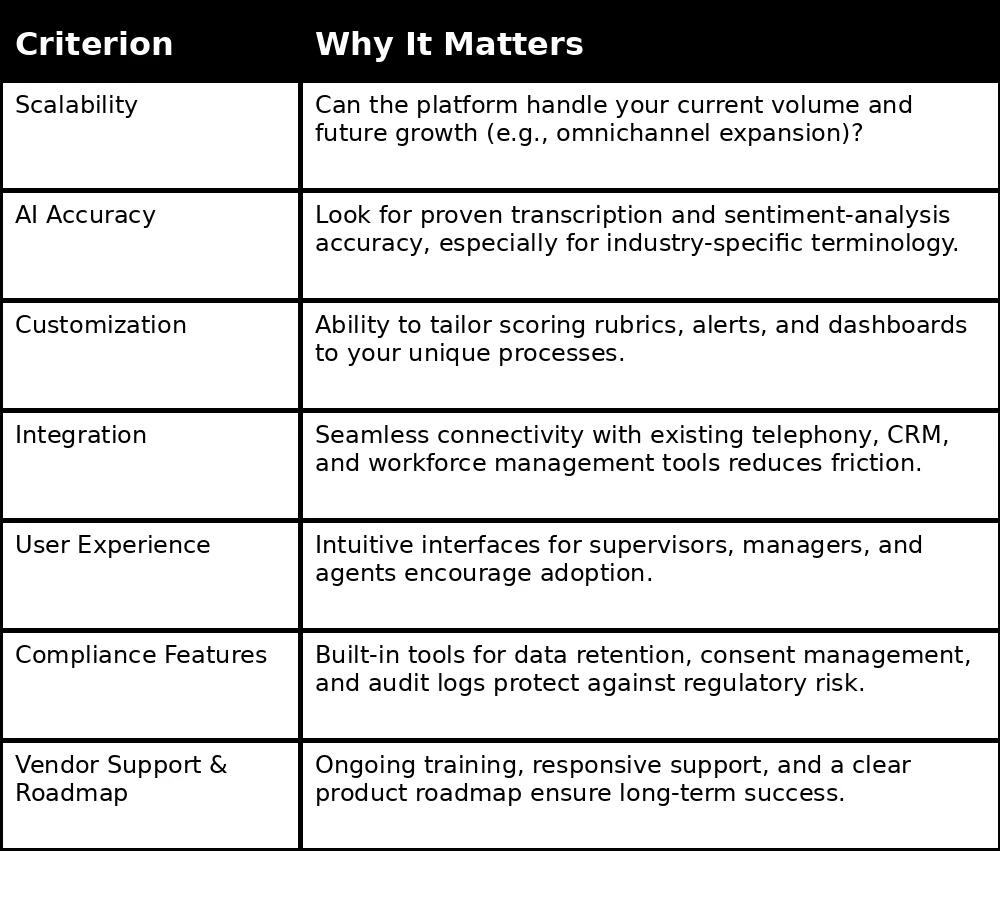
Request demos that showcase real‑time analytics, AI scoring, and integration points. Ask for case studies from similar industries to gauge ROI expectations.
Measuring ROI: The Business Case for QA Automation
Investing in call center quality assurance software delivers measurable returns:
- Reduced Attrition: Agents who receive regular, data‑driven coaching report higher job satisfaction, lowering turnover by up to 15%.
- Higher CSAT/NPS: Consistent quality interactions improve customer satisfaction scores, often translating to a 5‑10% lift in net promoter scores.
- Compliance Savings: Automated monitoring reduces the risk of costly fines and litigation—potentially saving millions in regulated sectors.
- Operational Efficiency: Automated scoring eliminates manual review time. One study showed a 70% reduction in QA labor costs, allowing supervisors to focus on strategic initiatives.
- Revenue Growth: Better first‑call resolution and upsell opportunities drive incremental sales—averaging a 2‑4% increase in average revenue per user (ARPU).
When you factor in the cost of software licensing versus the savings from decreased manual effort and the revenue impact of improved service, the payback period often falls within 6–12 months.
Future Trends: What’s Next for Call Center QA?
Multichannel & Omnichannel Quality Assurance
Customers now interact via chat, email, social media, and voice. Future QA platforms will aggregate quality metrics across all channels, providing a holistic view of the customer journey.
Predictive Analytics
By correlating QA scores with churn, upsell, and satisfaction data, AI models will predict which interactions are at risk, enabling proactive intervention before a problem escalates.
Voice‑Biometrics & Emotion Detection
Advances in audio analytics will allow systems to detect stress, frustration, or excitement in a caller’s tone, prompting real‑time escalation to senior agents or specialized support.
Gamified Coaching
Integrating gamification—badges, leaderboards, and micro‑learning—will make continuous improvement fun and drive higher engagement among agents.
Takeaway: Quality Assurance as a Competitive Advantage
In the fiercely competitive arena of customer service, call center QA software is no longer a back‑office checkbox; it’s a strategic differentiator. By automating the evaluation process, delivering real‑time insights, and fostering a culture of data‑driven coaching, these platforms empower organizations to:
- Consistently exceed customer expectations.
- Reduce operational risk and regulatory exposure.
- Elevate agent performance and satisfaction.
- Unlock measurable revenue growth.
If your call center is still relying on manual spreadsheets and sporadic audits, now is the moment to explore how a modern QA solution can revolutionize your quality assurance program and set the stage for superior service—today and tomorrow.
Ready to transform your call center? Start by mapping your current QA workflow, identifying the biggest pain points, and reaching out to reputable vendors for a tailored demo. The future of customer service excellence is just a click away.