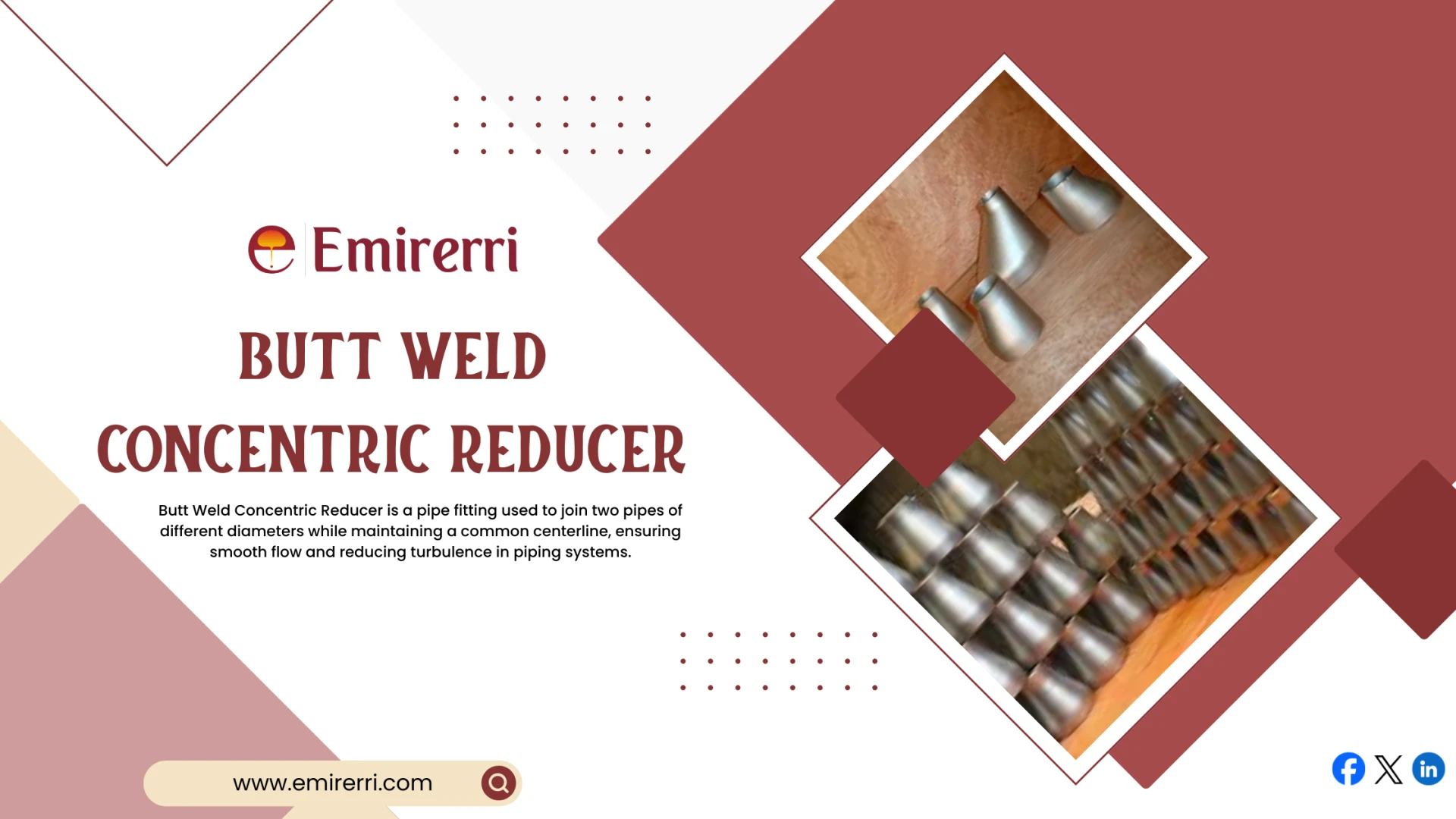
A Butt Weld Concentric Reducer is a vital component in piping systems used for connecting pipes of different diameters while maintaining a central alignment. These fittings ensure a smooth and gradual transition in flow between larger and smaller pipes, reducing turbulence and preventing pressure loss. Manufactured using high-quality metals such as stainless steel, carbon steel, or alloy steel, reducer concentric steel butt-welding fittings are essential in industries such as oil & gas, petrochemical, power generation, and water treatment.
What is a Concentric Reducer?
A concentric reducer is a type of pipe fitting designed to join two pipes of different diameters that share a common centerline. It forms a cone-shaped transition between the pipes, keeping the flow direction consistent. The larger end connects to the bigger pipe, and the smaller end connects to the smaller pipe. This design ensures the fluid flow remains balanced, avoiding vortex formation or cavitation.
When discussing what is a concentric reducer, it’s important to highlight its geometric precision and ability to maintain uniform pressure within the system. Unlike eccentric reducers (which have offset centers), concentric reducers are perfectly symmetrical along their axis, making them ideal for vertical piping systems where air or gas accumulation needs to be avoided.
What is a Concentric Reducer for Pipe?
A concentric reducer for pipe serves the purpose of reducing the diameter of a pipeline while maintaining the flow’s alignment and uniformity. These reducers are particularly useful in applications involving pumps and compressors, where pressure and velocity changes must be managed carefully.
In piping design, the concentric reducer for pipe ensures:
- Smooth fluid flow without sudden expansion or contraction.
- Elimination of air pockets and cavitation.
- Consistent pressure and velocity distribution.
- Better pump suction efficiency and reduced wear.
In addition, butt weld concentric reducers are welded directly to the pipe ends, forming a permanent, leak-proof connection. This butt-welding process strengthens the joint and minimizes the risk of leakage under high pressure or temperature conditions.
Manufacturing and Materials
Butt weld concentric reducers are produced according to international standards such as ASME B16.9, MSS-SP-75, and DIN standards. These fittings are made using various materials depending on the application requirements, including:
- Stainless Steel (SS 304, 304L, 316, 316L, etc.) – Ideal for corrosive and sanitary applications.
- Carbon Steel (ASTM A234 WPB, WPC) – Commonly used in oil, gas, and industrial piping.
- Alloy Steel (ASTM A234 WP5, WP9, WP11, WP22) – Suitable for high-temperature services.
- Nickel Alloys, Inconel, and Monel – Used in chemical processing and marine environments.
Each reducer is manufactured using hot-forming or cold-forming methods, followed by heat treatment and dimensional inspection to ensure perfect fitment and strength.
Advantages of Butt Weld Concentric Reducer
- Smooth Flow Transition: Prevents turbulence and minimizes pressure loss.
- Strong Welded Joint: The butt-weld connection provides excellent mechanical strength.
- Leak-Proof Design: Ideal for high-pressure and high-temperature operations.
- Corrosion Resistance: Especially in stainless and alloy steel types.
- Long Service Life: Durable and cost-effective solution for long-term installations.
- Aesthetic and Structural Uniformity: Maintains central alignment in vertical piping systems.
Applications of Butt Weld Concentric Reducers
- Oil & Gas Pipelines: Used to connect sections with different diameters and manage pressure transitions.
- Chemical & Petrochemical Plants: Handle corrosive fluids with stable flow.
- Power Generation Plants: Installed in boiler and condenser systems.
- Water Treatment Systems: Ensure controlled and efficient flow through pipes of varying sizes.
- HVAC & Firefighting Systems: Maintain smooth transitions in piping networks.
The versatility of the reducer concentric steel butt-welding fitting makes it an integral component in both industrial and commercial piping layouts.
Concentric Swage vs Reducer
When comparing concentric swage vs reducer, the difference lies primarily in size and application. A swage nipple (or concentric swage) is a short length of pipe that reduces size from one diameter to another, commonly used in small bore piping or instrument connections. On the other hand, a concentric reducer is a full-size fitting used in large-diameter piping systems.
Parameter
Concentric Reducer
Concentric Swage Nipple
Design
Cone-shaped fitting with welded ends
Short piece of pipe with different end diameters
Usage
Large-diameter pipes
Small-bore or threaded systems
Connection Type
Butt-welded
Threaded or socket-welded
Applications
Industrial pipelines, fluid transfer
Instrument lines, auxiliary systems
Both serve the same basic purpose—connecting pipes of different diameters—but are used in distinct piping configurations.
Installation Guidelines
To ensure reliable performance, butt weld concentric reducers should be installed carefully:
- Ensure proper alignment between the pipes before welding.
- Maintain correct welding procedures to avoid distortion or cracks.
- Inspect weld joints using non-destructive testing (NDT) methods.
- Clean internal surfaces to prevent contamination or flow restriction.
- Use matching material electrodes for consistent weld strength.
Following these steps guarantees the fitting performs optimally throughout its service life.
Conclusion
A Butt Weld Concentric Reducer plays an essential role in creating smooth and efficient transitions between varying pipe sizes while maintaining a balanced and central flow path. Its robust construction, superior weld integrity, and versatility across industries make it a preferred choice for high-performance piping systems. Whether used in oil refineries, power plants, or water processing units, reducer concentric steel butt-welding fittings ensure safety, reliability, and long-term functionality.