




Learn how to get business analytics jobs with in-demand skills, real role insights, and certification guidance.
You’ve probably read A Complete Guide to Business Analytics and wondered how to turn that knowledge into paid work. If you want stability, growth, and the freedom to choose projects, business analytics jobs are one of the clearest paths. In this post I’ll walk you through what hiring teams look for, the skills that really matter, and a practical plan to move from curious to hired — quickly and with confidence.
Why this moment matters
Technology, AI, and data science tools are changing how decisions get made. Companies need people who can translate data into action. That demand is why business analytics jobs are growing across industries — not just in tech, but in finance, retail, healthcare, and public sector work. If you learn how to ask the right business questions and answer them with data, you become the person leaders call when they need results.
What employers really want
A surprising truth: hiring managers often prefer candidates who can tell a clear story about impact over someone who simply lists tools. The checklist below shows what gets attention in short order.
- Business thinking: Can you connect analysis to revenue, cost reduction, or customer retention?
- Technical basics: SQL, a visualization tool, and an understanding of statistics and machine learning concepts.
- Communication: Can you explain insights to non-technical stakeholders?
- Product or domain sense: Knowing the industry multiplies your value.
If you’re aiming for business analyst roles or stepping up toward Data scientist positions, these skills are non-negotiable. A focused professional certification can speed trust-building with recruiters and hiring panels.
The roles you can start with (and how they differ)
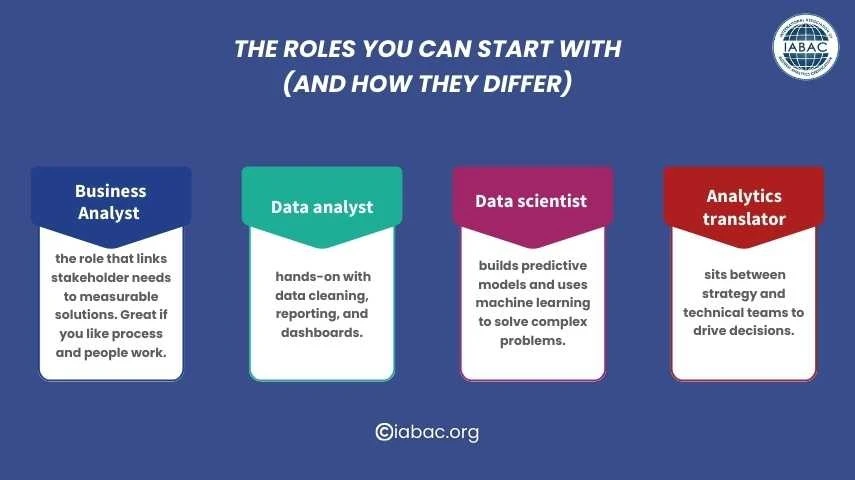
- Business analyst — the role that links stakeholder needs to measurable solutions. Great if you like process and people work.
- Data analyst — hands-on with data cleaning, reporting, and dashboards.
- Data scientist — builds predictive models and uses machine learning to solve complex problems.
- Analytics translator or product analyst — sits between strategy and technical teams to drive decisions.
Each path sits under the broad umbrella of business analytics jobs and offers different ladders to leadership and strategy roles.
Real proof: market signals that matter
Industry reports and job-market studies show steady growth for analytics roles and higher pay for people who can combine technical skill with business impact. AI automates repetitive tasks, but it increases the value of professionals who know which models to apply and how to interpret their outputs. That combination — domain knowledge + data skill — is what separates mid-level practitioners from leaders.
A practical 90-day plan to get interview-ready
You don’t need years to be competitive. Here’s a focused plan I’ve used with students and professionals that works quickly.
Weeks 1–2 — Target and research
- Choose one role (e.g., business analyst or data analyst).
- Read 5 job descriptions and list the top 8 skills recruiters ask for.
Weeks 3–6 — Learn and build
- Master SQL, Excel, basic statistics, and one visualization tool.
- Build one project: pick a public dataset, ask a business question, and create a short dashboard + 2-slide summary of impact.
Weeks 7–10 — Validate and certify
- Take a relevant professional certification or short course that aligns with your role — for example, consider the Certified Business Analytics for Managers Certification to show focused capability.
- Polish two portfolio pieces that show clear business outcomes.
Weeks 11–12 — Apply and network
- Tailor your resume and apply to targeted roles.
- Do 10 informational conversations with people currently in analytics roles.
- Iterate and practice interviews.
How to beat common fears
You might worry, “I don’t have a stats degree,” or “AI will replace me.” Both are valid concerns, but here’s the practical perspective:
- Diverse backgrounds win: Employers hire people from many fields when they show problem-solving and real projects.
- AI is a multiplier: It handles routine work, which raises the value of people who frame problems, design solutions, and explain outcomes. So focus on context, storytelling, and domain knowledge as much as tools.
Resume & portfolio checklist hiring managers see in 10 seconds
When a recruiter scans your profile, these signals matter most:
- Clear role target (business analyst, data analyst, data scientist)
- SQL + data modelling basics listed near the top
- One or two portfolio items with measurable outcomes (e.g., reduced churn by X%)
- Visualization examples or dashboard links
- A certification or structured learning path that shows commitment
If you can answer “what was the business question?” and “what changed because of your work?” in one line, you’re in a strong position.
Integrate learning with credibility
A certification that maps to managerial outcomes helps bridge academic knowledge and workplace impact. When hiring teams see a certification that emphasizes applied projects, they trust your ability to deliver faster. That trust shortens interview cycles and improves offer rates. Seamlessly consider adding a recognized credential like Certified Business Analytics for Managers Certification into your learning path to signal both competence and commitment.
Small action that creates momentum
Pick one business question this week, find a dataset, and create a one-page insight: a short visual and two bullets with business recommendations. Share it with a mentor or on a professional forum. Doing one concise insight every week builds a body of work that hiring managers notice — and it accelerates your path into business analytics jobs.
If you want help choosing the best learning path or tailoring a portfolio piece for a role, I can review your project and suggest changes that hiring teams care about. For a structured next step, look into the business analytics main certification page to align skills with market expectations. When you’re ready to commit, visit the IABAC certification page to explore the certification options that help professionals move from learning to leadership.
You have the skills to build a resilient career. Start small, show impact, and keep learning — the market for business analytics jobs rewards consistent, outcome-focused effort.
Ready to level up your career? Visit the business analytics certification page to choose the certification that accelerates your path into business analytics jobs.