



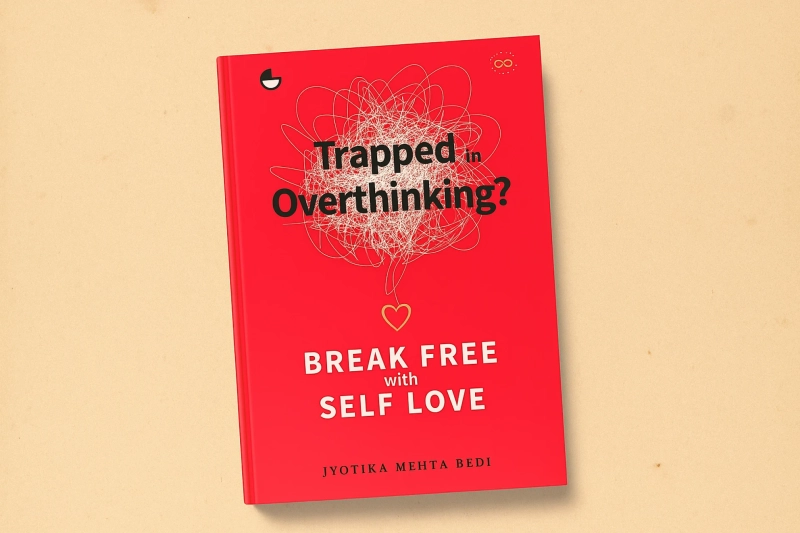
I didn’t buy this book expecting anything life changing. In fact, I almost scrolled past it. Another book about self love? Another promise to fix the mental mess? I’ve heard it all before.
But something in the title paused me. It wasn’t the “self love” part that caught me. It was “trapped in overthinking.” Because that’s what it feels like sometimes. Not just stress or confusion. But trapped.
So I picked up the book. And somewhere between the first chapter and the last page, I started to feel like I was learning how to loosen the knots in my own mind.
This wasn’t about fixing myself. It was about meeting myself. And that changed the game.
Not a Guru Voice. A Human One.
The first thing I noticed was how normal Jyotika sounds. Not like a guru preaching perfect habits or someone who figured it all out twenty years ago. She feels like someone who has sat with these thoughts herself.
Her writing is warm, but not coddling. Direct, but not harsh. She speaks from experience, not authority, and that makes all the difference.
From the very beginning, she makes it clear this isn’t about becoming a “better” version of yourself. It’s about remembering the version that got buried under doubt, pressure, and endless mental noise.
And honestly, I needed to hear that.
Also read: Book Review Of Design Your Thinking
What the Book Actually Talks About
The structure of the book is easy to follow. It covers things like:
- What self love actually means (hint: it’s not bubble baths and quotes)
- Why we fall into overthinking loops
- How early life experiences shape how we treat ourselves
- What self worth really looks like in action
- How boundaries aren’t selfish, they’re survival
- Why forgiveness matters, especially toward ourselves
But beyond all that, what I appreciated most was how practical the book is.
There are reflective prompts, short exercises, and gentle affirmations—not as decorations, but as real tools. You don’t have to be in a perfect headspace to try them. You can do them even if you feel stuck, unsure, or tired. Especially then.
The Chapter That Got Me
There’s a chapter about childhood patterns that had me sitting in silence for a while.
Not because it was dramatic, but because it was true.
It talked about how our early experiences shape the way we speak to ourselves. How criticism can turn into an inner voice that never lets us rest. How we become adults still trying to earn love or prove our worth in ways we don’t even realize.
That hit hard.
I saw myself in every paragraph. And for once, instead of feeling exposed, I felt understood.
The Quiet Power of Boundaries
Another standout part of the book was how it handles boundaries.
There’s something calming about the way Jyotika explains them. She doesn’t make you feel guilty for needing space. She doesn’t frame “no” as confrontation.
Instead, she invites you to see boundaries as an act of kindness—to yourself and others.
She asks you to think about how often you say yes because you’re afraid of being seen as difficult. How often you stay quiet to keep things smooth. And what it’s costing you.
That perspective stayed with me. It’s been showing up in the way I respond to texts, the way I plan my time, and even the way I rest.
Exercises That Don’t Feel Like Homework
I’ve read enough self help books to be wary of exercises. Most of them feel like chores. Not these.
These prompts felt like someone nudging you to stop for just a second and check in. Not with goals. Not with outcomes. Just with you.
One day, I tried one of her suggested affirmations before opening my laptop. It said, “I do not need to prove anything to be enough.”
I didn’t believe it fully at first. But repeating it softened something. Like a thought was starting to shift before I even noticed.
That’s the thing with this book. It works quietly.
No Rush. No Pressure. Just Presence.
What I loved most is that this book doesn’t rush you. It doesn’t make you feel like you have to change your entire life in a week.
You can read a chapter and sit with it for days. You can come back and reread parts without feeling behind. You can pause.
And if you’re someone who overthinks and constantly pushes yourself to do more and be more, you’ll know how rare that feeling is.
Who This Book Is Really For
This book is for anyone who:
- Feels overwhelmed by their own thoughts
- Overanalyzes their relationships or decisions
- Struggles to say no without guilt
- Wants to understand what self love actually looks like in real life
You don’t need to be a mental health expert to get value from it. You just need to be honest enough to admit that something inside you wants to feel lighter.
And if you’re there, this book will meet you gently.
Final Thoughts
I didn’t expect Trapped In Overthinking to be what it was.
I expected advice. I got reflection.
I expected tools. I got clarity.
I expected another self love book. I got something far more personal.
This book didn’t try to fix me. It didn’t push me toward becoming someone new.
It just helped me reconnect with the version of me I’ve been too busy judging. The version I left behind when I started believing I had to be perfect to be loved.
And honestly, that was the version I needed most.