



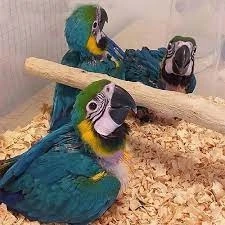
Blue-and-Gold Macaw
Introduction
The blue-and-gold macaw is one of the most visually striking parrot species. As their name suggests, they showcase a vivid blue back and wing feathers contrasted with bright golden-yellow underparts.
These vibrantly colored macaws are native to rainforests in South and Central America. Blue-and-gold macaws are highly intelligent, social birds that can mimic speech and form strong bonds with human owners.
However, their large size, extremely loud vocalizations, need for ample space, and potential aggressive tendencies means they are better suited for experienced parrot keepers. Providing the specialized lifetime care they require is demanding but rewarding for dedicated owners.
key facts about the blue and gold macaw:
- Native to rainforests of Central and South America.
- Length ranges from 33-37 inches.
- Weigh between 2-3 pounds as adults.
- Lifespan in captivity is 30-50 years.
- Vivid blue upperparts, bright yellow underparts.
- Powerful greyish-black beak adapted for cracking nuts.
- Loud, raspy vocalizations can reach 100+ decibels.
- Highly intelligent and social. Require abundant interaction.
- Able to mimic speech and learn vocabularies when young.
- Need very large cage with ample room for flying.
- Active foragers that use their beaks extensively.
- Can become aggressive/nippy without proper training.
- Require diverse diet with fruits, veggies, nuts, seeds.
- Prone to obesity if fed too many nuts and seeds.
- Need many durable toys to prevent boredom and stress.
- Should be housed in detached homes where noise isn\'t an issue.
Scientific classification of the blue and gold macaw:
Kingdom: Animalia
Phylum: Chordata
Class: Aves
Order: Psittaciformes
Family: Psittacidae
Genus: Ara
Species: Ara ararauna
To break this down:
- Kingdom Animalia includes all multicellular organisms that are not plants, fungi, protists or bacteria. This encompasses animals.
- Phylum Chordata includes all vertebrate animals with a backbone.
- Class Aves includes all bird species.
- Order Psittaciformes includes parrots and related species.
- Family Psittacidae specifically refers to true parrots.
- Genus Ara contains the large macaw species.
- Species Ara ararauna denotes the blue and gold macaw specifically.
So in summary, the scientific classification establishes the blue and gold macaw as a large true parrot within the diverse psittacine family of birds. Its genus and species indicates it as a distinct macaw type.
Natural Habitat and Range
The natural habitat of blue-and-gold macaws is lowland rainforests and adjacent woodlands. They prefer forests with palm trees, which provide their favorite fronds for nesting material.
Their historical range extended from Panama down into Peru and Brazil in the eastern regions of South America.
However, habitat destruction has decreased wild populations significantly. The species is now most commonly found in captivity, though small wild populations still exist in certain protected areas.
Physical Features
Blue-and-gold macaws are substantial in size, measuring 33-37 inches long and weighing 2-3 pounds as adults.
Their bright plumage features vivid blue feathers on the back, wings and head. The underside of their wings and body are a stark golden yellow.
They have a bare white facial patch of skin surrounded by a ring of small black feathers. Their eyes are dark and alert, above a heavy greyish-black beak adapted for cracking hard nuts and seeds.
The long tapered tails of blue-and-gold macaws provide balance and steering while flying swiftly through forest canopies.
Captive Care
In captivity, the average lifespan of a blue-and-gold macaw is 30-50 years with excellent care and nutrition.
Their diet consists of a quality pelleted base along with ample fresh fruits, vegetables, sprouted beans, nuts, seeds and grains for variety. Clean water should always be available. Owners need to provide an extremely large cage, at minimum 4 feet long by 3 feet deep and 4 feet high.
The cage should contain multiple perches, toys, and food bowls. Daily interaction and supervised time out of the cage is essential as well.
Macaws are active birds that need space to move and climb. Providing new toys, mist baths, foraging activities and training exercises provides important mental stimulation and enrichment.
Personality and Behavior
Blue-and-gold macaws are highly social, intelligent parrots. They thrive on frequent interaction with their owners when properly trained and socialized from a young age.
Macaws form very strong, affectionate bonds with family members who spend time gently handling, socializing and interacting with them.
However, their loud screaming fits, nippy behavior and powerful beaks capable of seriously injuring handlers means they are not suitable pets for first-time bird owners.
Experienced guidance using positive reinforcement is essential to manage their behavior, powerful bite and loud vocalizations.
Common Health Issues
Common health conditions owners need to watch for include obesity, respiratory infections, feather damaging behaviors, vitamin deficiencies, heavy metal poisoning, and bumblefoot. Annual checkups, proper nutrition, and weighing birds regularly helps monitor their health. Blue-and-gold macaws are susceptible to obesity, so their diet should be carefully controlled and augmented with ample exercise. Like many birds, they may try to mask illnesses - so owners should watch for any subtle changes in appearance, behavior or droppings that could indicate a health issue needing veterinary attention.
Acquiring a Blue-and-Gold Macaw
The cost to purchase a hand-raised baby blue-and-gold macaw from a breeder ranges from $1500-$3500. Less expensive birds may have questionable origins. Always research breeders thoroughly, visit facilities, and ask lots of questions before purchasing. Hand-fed baby birds have better pet potential versus parent-raised. Adopting through a rescue organization is another possibility, often at lower cost. Current owners should carefully consider all the needs and responsibilities of owning a macaw before acquiring one.
Conservation Status
Due to ongoing deforestation and capture for the pet trade, blue-and-gold macaw populations are declining across their native range. However, managed breeding programs help maintain captive populations while efforts continue to protect sections of rainforest habitat needed for their survival in the wild.
10 steps Blue and Gold Macaw Care Guide
- Select an Appropriately Sized Cage
- Minimum dimensions of 4ft x 3ft x 4ft
- Bars spaced 3/4 to 1 inch apart
- Allow ample room for perches, dishes, toys
- Line the Cage Bottom Properly
- Use cage liner or natural substrates like recycled paper, corn cob, pine shavings
- Avoid sand, gravel, newspaper which can cause health issues if ingested
- Include Plenty of Perches
- Offer a range of perch sizes - some wide, some narrow
- Use natural wood branches in addition to concrete or plastic perches
- Place perches strategically to encourage flying and climbing
- Pick Durable Food and Water Dishes
- Use heavy, stainless steel bowls that attach securely to cage
- Choose a size that encourages natural foraging behaviors
- Offer a Nutritionally Balanced Diet
- Quality pellet blend formulated for large macaws
- Chopped fruits, vegetables, sprouted beans, cooked grains
- Nuts, seeds, limited healthy table foods
- Maintain Fresh, Clean Water Daily
- Change water at least once if not twice a day
- Wash and disinfect water bowls regularly
- Provide Abundant Sturdy Toys
- Interactive toys, foot toys, chew toys, shredders
- Ensure sizes suit large macaws - they destroy smaller toys
- Rotate new toys in frequently to prevent boredom
- Allow Daily Supervised Out-of-Cage Time
- Use a secure macaw play stand for interaction and socialization
- "Bird proof" any areas they will be in
- Never leave unsupervised outside cage
- Offer Regular Baths
- Spritz/mist daily, provide showers or bath pan 2-3 times weekly
- Ensure feathers dry properly after bathing to prevent chill
- Schedule Annual Checkups with an Avian Vet
- Have baseline exam, bloodwork, weight check
- Discuss any concerns, get nutrition advice
- Keep immunizations current
Following these care steps helps keep blue and gold macaws healthy and content.
Conclusion
In summary, blue-and-gold macaws are stunning but demanding parrots best suited for very experienced bird owners. Providing the extensive lifetime care they require is costly and time-intensive but rewarding for dedicated caretakers able to fully commit. For the right owner willing to focus time and resources meeting their specialized needs consistently, blue-and-gold macaws make wonderfully engaging, affectionate companions. However, more novice bird keepers should consider easier species first.