



When couples go through IVF, they often hear the term blastocyst transfer and wonder what it actually means. Is it better than a day-3 embryo transfer? Does it improve success rates? And is it right for everyone? Understanding this can help couples feel more confident about their IVF decisions.
Doctors at an experienced IVF hospital near me usually recommend blastocyst transfer only when it offers a real advantage for the couple.
What Is a Blastocyst Transfer?
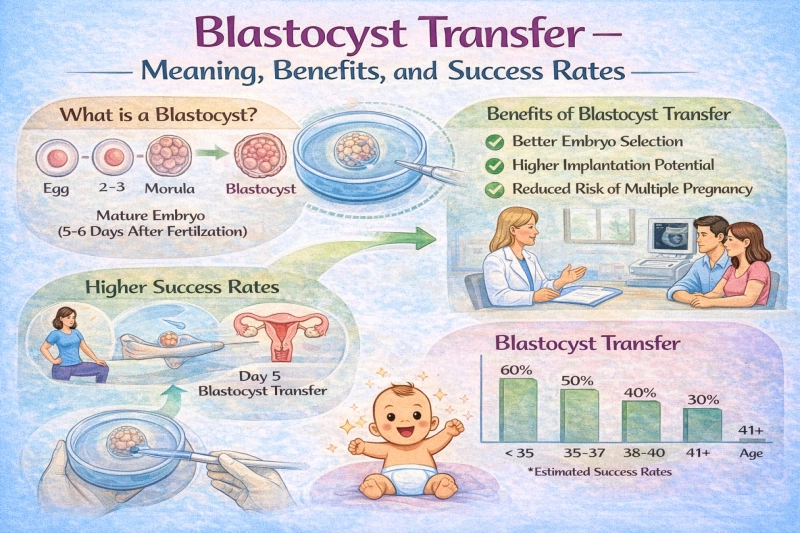
After fertilization, embryos start dividing. By day 5 or day 6, a healthy embryo reaches a more advanced stage called a blastocyst.
In blastocyst transfer:
- Embryos are cultured in the lab for 5–6 days
- The strongest embryos continue to develop
- One or two blastocysts are transferred into the uterus
This stage closely matches the natural timing of implantation.
How Is Blastocyst Different From Day-3 Transfer?
Day-3 embryos are transferred earlier, when they have fewer cells. Blastocysts are more developed and have a clearer implantation potential.
Key differences:
- Blastocyst = more advanced stage
- Better embryo selection
- Improved synchronization with the uterus
However, not all embryos reach the blastocyst stage.
Benefits of Blastocyst Transfer
Blastocyst transfer offers several advantages when conditions are suitable.
Key benefits include:
- Higher implantation potential
- Better embryo selection
- Reduced risk of multiple pregnancies when single embryo transfer is done
- More natural timing with uterine receptivity
Because only stronger embryos survive to day 5, doctors can choose embryos with better chances.
Success Rates of Blastocyst Transfer
Blastocyst transfer often shows higher success rates per transfer compared to day-3 transfer, especially in:
- Younger women
- Couples with good embryo numbers
- Previous IVF failures
However, success depends on many factors:
- Age
- Egg and sperm quality
- Uterine health
- Overall IVF protocol
An experienced team at an IVF hospital near me will explain realistic expectations rather than guaranteed numbers.
Is Blastocyst Transfer Suitable for Everyone?
No. Blastocyst transfer is not recommended in all cases.
It may not be ideal when:
- Very few embryos are available
- Previous embryos did not survive to day 5
- Certain medical conditions exist
In such situations, day-3 transfer may offer better chances.
Fresh vs Frozen Blastocyst Transfer
Blastocysts can be transferred:
- In the same cycle (fresh)
- In a later cycle (frozen)
Frozen blastocyst transfers often allow better uterine preparation and hormone balance, which can improve implantation in some cases.
Emotional Side of Blastocyst Transfer
Waiting until day 5 can be emotionally stressful. Some embryos may stop developing, which can be disappointing.
However, reaching blastocyst stage often gives couples confidence that the embryo is stronger and more developmentally ready.
Final Thoughts
Blastocyst transfer is an advanced IVF approach that can improve implantation and success rates in the right patients. It is not about choosing the latest technique, but choosing the right technique for your situation.
With guidance from a trusted IVF hospital near me, couples can make informed decisions that balance medical science with emotional readiness.