



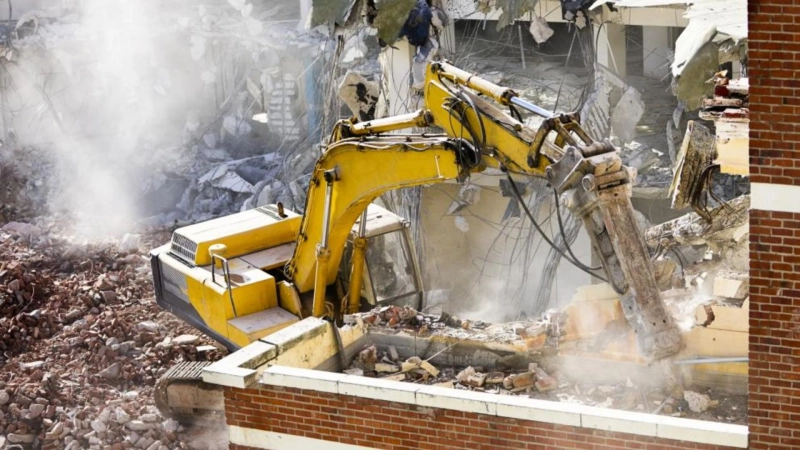
Imagine standing inside a Chicago building at dawn, the city still humming quietly below the floorboards. Sensors glow. Dust has not yet risen. Nothing has been broken, but everything is about to change. Demolition today is no longer a blunt moment of destruction. It is a calculated reset, a careful unraveling of the past so the future can take shape. In a city defined by reinvention, how we take things apart has become just as important as how we build them back.
The Quiet Evolution of Demolition
For decades, demolition carried a single image: force, speed, and spectacle. A wrecking ball swinging like a punctuation mark at the end of an old sentence. But Chicago, with its layered architecture and zoning nuance, has pushed the industry to mature.
Modern demolition services in Chicago operate more like surgical teams than demolition crews. Buildings here are dense with history, utilities, neighbours, and regulations. You cannot simply tear into a structure without understanding what connects it to the street, the block, and the city grid itself.
That evolution mirrors something larger happening across industries. In an era defined by AI, optimization, and sustainability, even physical labour has become deeply strategic. The smartest demolition work today begins long before the first wall comes down, often with digital mapping, structural analysis, and scenario planning that feels closer to engineering than brute force.
Renovation Starts with What You Remove
There is a misconception that renovation is about addition. New walls, new finishes, new energy. In practice, the success of any renovation is determined by what gets removed and how.
Renovation demolition in Chicago sits at the intersection of preservation and progress. Older commercial spaces, century-old walk-ups, and mid-century office buildings were not designed for today’s wiring loads, HVAC expectations, or hybrid work realities. Removing the wrong wall or rushing a teardown can derail timelines and inflate costs downstream.
The best renovation demolition work reads the building like a manuscript. What can stay. What must go. What looks structural but is decorative, and what looks insignificant but holds weight. This discernment is what separates thoughtful renovation from expensive improvisation.
In Chicago’s competitive real estate and construction market, that distinction matters. Developers do not just want speed. They want predictability. They want clean transitions from demo to build, without surprises hiding behind drywall.
The City as a Constraint and a Canvas
Chicago is not a blank slate city. It is layered, regulated, and alive. That reality shapes every serious demolition decision.
Tight alley access, shared walls, transit-adjacent buildings, and strict noise windows mean demolition must adapt to the city’s rhythms. Crews work in phases. Materials are sorted with intention. Debris removal is timed to traffic patterns, not convenience.
This is where demolition becomes less about machinery and more about choreography. Each move affects multiple stakeholders: neighbours, inspectors, trades that follow.
The smartest demolition services in Chicago understand that success is measured by what does not happen. No delays. No damage to adjacent structures. No community complaints. Silence, in this context, is a metric of excellence.
Why Precision Has Replaced Power
There is a subtle parallel between modern demolition and modern technology. AI systems do not brute-force solutions, they optimize. They identify dependencies, minimize waste, and learn from constraints.
High-level demolition work now follows a similar logic. Selective demolition allows buildings to evolve instead of reset entirely. Structural elements are preserved. Materials are recycled. Carbon costs are considered alongside financial ones.
In renovation demolition in Chicago, this precision-first mindset is becoming the expectation, not the exception. Property owners and architects want partners who think several steps ahead, who anticipate how demolition choices will influence framing, finishing, and long-term building performance.
This shift also reflects changing values. Cities are under pressure to reduce waste, noise, and disruption. Demolition, once the loudest part of construction, is quietly becoming one of the most disciplined.
Demolition as the Foundation of Trust
In many ways, demolition sets the emotional tone for an entire project. A clean, controlled start builds confidence across the board. Contractors work faster. Designers trust the space. Owners sleep better.
When demolition is sloppy, everything downstream feels unstable. Timelines stretch. Budgets creep. Trust erodes.
That is why high-quality demolition services in Chicago are increasingly viewed as a strategic investment rather than a commodity. The work is temporary, but its influence is permanent.
The most respected teams in this space do not sell spectacle. They sell calm execution. They make complexity feel manageable, even invisible.
In a Nutshell
Chicago has always understood reinvention. From fire to skyline, from industry to innovation, the city’s identity is built on renewal. What is changing now is our appreciation for the first step.
Demolition is no longer the violent erasure of the past. It is a considered conversation. Done right, it clears space without erasing context, allowing something better to emerge with fewer compromises.
As cities grow smarter, quieter, and more intentional, the way we take buildings apart may tell us as much about our future as the way we build them.