



In the modern healthcare landscape, a profound paradox exists. The very technology designed to improve patient care and streamline operations—the Electronic Health Record (EHR)—has become a primary source of administrative burden and a major contributor to clinical burnout. Physicians, nurses, and administrative staff are spending an ever-increasing portion of their day not on patient care, but on manual data entry, navigating clunky interfaces, and re-keying information between disconnected systems.
This is more than just an inefficiency; it is a systemic problem that impacts patient safety, operational costs, and the well-being of our healthcare professionals. Studies have shown that physicians can spend up to two hours on administrative tasks for every one hour of direct patient care. But there is a powerful prescription for this ailment: intelligent, HIPAA-compliant automation. By leveraging modern technology to handle the immense data entry workload, we can liberate our clinical teams to focus on their true purpose: caring for patients.
The Diagnosis: The True Cost of Manual Data Entry
The negative impact of manual data entry in healthcare is a multi-layered problem with severe consequences.
- The High Cost of Clinical Burnout: When highly skilled clinicians are forced to act as data entry clerks, it leads to immense job dissatisfaction, frustration, and burnout. Burnout is not just a personal issue; it is an organizational crisis that leads to higher staff turnover, increased medical errors, and a lower quality of patient care.
- The High Cost of Errors: Manual data entry is inherently prone to human error. A mistyped lab result, an incorrect medication dosage, or a transposed insurance code can have dire consequences for both patient safety and the hospital's revenue cycle. These errors can lead to claim denials, costly rework, and, in the worst cases, adverse patient outcomes.
- The High Cost of Inefficiency: The time spent manually transcribing information from patient intake forms, referral documents, and lab reports into the EHR is time that could be spent on higher-value activities. This operational drag slows down the entire care delivery process, leading to longer patient wait times and lower overall throughput.
The Prescription: A Multi-Layered, HIPAA-Compliant Automation Strategy
Curing the data entry problem requires a multi-faceted automation strategy that uses the right technology for the right task, all built upon a foundation of uncompromising security and HIPAA compliance.
Technology 1: Robotic Process Automation (RPA) for Structured Tasks
RPA is the workhorse of healthcare automation. It involves software "bots" that are programmed to perform repetitive, rules-based tasks by mimicking human interactions with user interfaces.
- In Action: An RPA bot can be configured to automatically log into a patient registration portal, copy the new patient's demographic and insurance information, and then paste that information into the corresponding fields in the hospital's EHR system. This is a perfect solution for structured, predictable data transfer between systems that lack a direct API connection.
Technology 2: Intelligent Document Processing (IDP) for Unstructured Forms
Much of healthcare data is "unstructured," locked away in faxes, scanned PDFs, and referrals. IDP combines Optical Character Recognition (OCR) with Artificial Intelligence to read and understand these documents like a human.
- In Action: When a new patient referral is received as a fax, an IDP solution can automatically "read" the document, extract key clinical information (like diagnoses, medications, and allergies), and intelligently populate that data into the correct fields in the patient's chart, flagging any ambiguous information for human review.
Technology 3: AI-Powered APIs for System Integration
For modern systems, Application Programming Interfaces (APIs) provide a secure and reliable way to connect and share data automatically.
- In Action: A hospital's lab information system can use a secure API to send new test results directly and instantly into the correct patient's record in the EHR. This eliminates the need for a nurse to manually look up the results and transcribe them, ensuring the data is both timely and error-free.
The Transformational Benefits of Automation
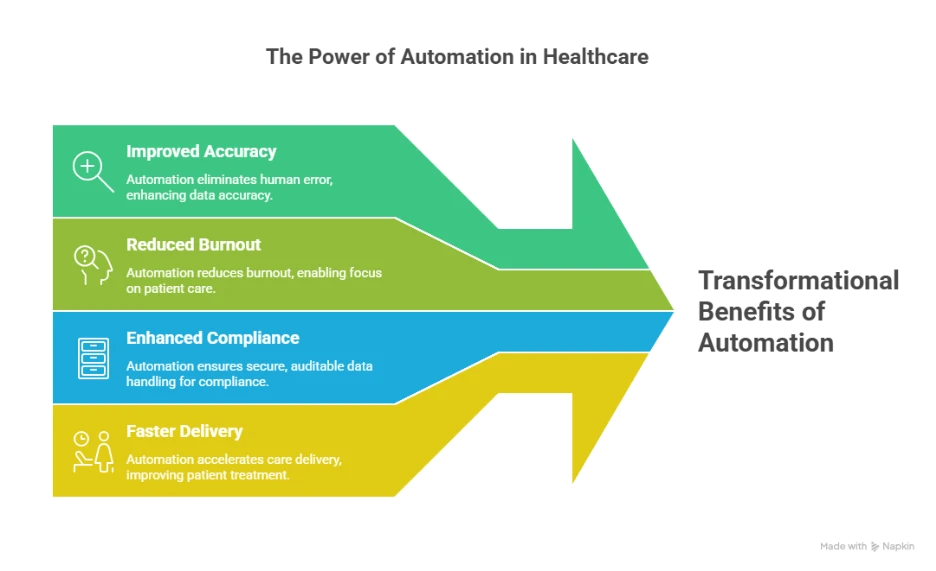
By implementing a holistic automation strategy, healthcare organizations can achieve profound, system-wide benefits that go far beyond simple efficiency.
How Hexaview Engineers Secure Healthcare Automation
At Hexaview, we are acutely aware that in healthcare, automation must be engineered with a security-first, compliance-by-design mindset. Our expertise lies in developing and implementing intelligent automation solutions that are not only powerful but are also built on a foundation of robust security and strict HIPAA adherence. We architect RPA and IDP solutions that handle Protected Health Information (PHI) within secure, encrypted environments, with comprehensive logging and auditing for every action. We build the systems that streamline your data entry workflows, reduce your administrative burden, and, most importantly, free your clinicians to do what they do best: provide exceptional patient care.