



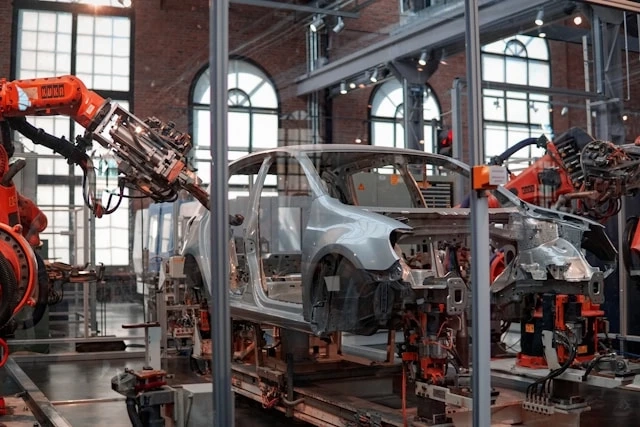
When we think of the automotive revolution, our minds jump to sleek electric vehicles (EVs), sophisticated self-driving sensors, and sustainable factories. We celebrate the software engineers and battery chemists. But behind these visible advancements lies a less-heralded, yet equally critical, enabler: the radical evolution in precision automotive machining.
This isn't your grandfather's manufacturing. The shift from internal combustion to electric power, and from human drivers to AI co-pilots, demands a new class of components. They must be smaller, lighter, stronger, and machined with microscopic accuracy. This is where advanced techniques, capable of producing complex Swiss machining products, are shifting from a niche service to a mainstream industrial backbone.
The New Demands of a Digital Drive-Train
The heart of an EV is fundamentally different from a traditional engine. This creates a cascade of new manufacturing challenges:
- Electric Motors: These require high-speed rotors and complex stator housings that operate with extreme efficiency. Any imbalance or imperfection in these components leads to energy loss, vibration, and noise—unacceptable in a premium EV.
- Power Electronics: The inverters and converters that manage battery power are filled with intricate heat sinks and sensor housings. These parts often require complex internal channels for liquid cooling, machined from conductive materials like aluminum or copper with absolute precision to manage intense thermal loads.
- Lightweighting: Every ounce saved in a vehicle extends its range. This drives the use of advanced, often difficult-to-machine, materials like high-strength aluminum alloys and composites, where precision is key to removing excess weight without compromising structural integrity.
Conventional machining struggles to meet these demands cost-effectively at scale. This gap is being filled by specialized manufacturing solutions.
The Swiss Advantage - Technical Differentiators
The Swiss Advantage: A Deep Dive into the Technology Powering Modern Mobility
While the previous section established the why, it's crucial to understand the how. The superiority of Swiss-type machining isn't magic; it's a result of a fundamentally different mechanical philosophy that directly addresses the most stringent demands of the automotive industry. The core differentiators lie in its unique approach to stability, complexity, and efficiency.
1. Unrivaled Stability and Its Impact on Miniaturization
The single most defining feature of a Swiss-type lathe is the guide bushing. In conventional CNC lathes, the material bar is held in a chuck and extends unsupported. As tools cut the far end, the material can flex and vibrate, limiting the achievable precision and surface finish, especially on long, slender parts.
- The Guide Bushing Solution: In a Swiss machine, the material bar is held tightly in a guide bushing, a precision component that acts as a movable support. The cutting occurs within millimeters of this bushing, effectively eliminating tool pressure-induced deflection.
- Automotive Application: This is critical for producing components like fuel injector nozzles for hybrid systems, miniature valve stems for emission control systems, and long, thin pins for advanced transmissions. These parts can be machined to tolerances under ±0.0002 inches with mirror-like finishes, directly contributing to higher fuel efficiency, lower emissions, and reduced NVH (Noise, Vibration, and Harshness).
2. Mastering Complexity in a Single Setup
Modern vehicles are a symphony of integrated systems, and their components often reflect this complexity. A single part might combine turned diameters, milled flats, cross-drilled holes, and intricate contours. Swiss-type machines are engineered to handle this "done-in-one" philosophy masterfully.
- Multi-Axis Synchronization: Advanced Swiss machines are not merely lathes; they are multi-tasking powerhouses. They typically feature a main spindle, a secondary subspindle, and numerous live tooling stations (drills, mills) that can operate on both the main and back-worked part simultaneously.
- Automotive Application: Consider a sensor housing for an anti-lock braking system (ABS). This part might start as a simple bar stock. The Swiss machine can:
- Turn the outer diameters and threads.
- Drill and bore the internal sensor cavity.
- Use a live tool to mill an alignment flat.
- Cross-drill a port for the wiring harness.
Part-off the finished component, all without an operator ever touching the part between operations. This eliminates cumulative errors from multiple fixturing and drastically reduces lead times, making the production of complex swiss machining products like these highly efficient and reliable.
3. The Economic Advantage of Material and Time Efficiency
In high-volume automotive manufacturing, saving seconds or cents per part translates to millions in annual savings. The Swiss process is inherently efficient in both material usage and cycle time.
- Near-Net-Shape Machining: Because the cutting happens so close to the support, parts can be machined with extremely thin walls and minimal stock allowance. This "sculpting" approach significantly reduces material waste, which is a major cost factor when using expensive alloys like Inconel for turbocharger components or titanium for high-performance applications.
- Simultaneous Operations: While one feature is being turned, another can be milled, and a previously completed part can be finished in the subspindle. This overlapping of operations compresses the total cycle time. For a manufacturer providing precision automotive machining services, this high throughput is a critical competitive edge, allowing them to meet the automotive industry's aggressive cost and delivery targets without sacrificing the legendary quality of swiss machining products.
Case in Point: Electric Vehicle Innovation
Consider the development of a new-generation electric vehicle. The engineering team is tasked with increasing the motor's power density while reducing its size. A key component is a hollow motor shaft that needs to be both incredibly strong and lightweight, with internal coolant passages and precise bearing seats.
A manufacturer specializing in precision automotive machining would likely employ a Swiss-type lathe with live tooling and Y-axis capabilities. This single setup can mill, drill, and turn the part from a solid bar of high-strength steel, completing it in one operation. This "done-in-one" philosophy minimizes handling, reduces the chance of error, and ensures the concentricity and dimensional accuracy critical for a component spinning at tens of thousands of RPMs.
The result is a flawless, high-performance swiss machining product that enables the motor to run cooler, more efficiently, and more reliably. This is a tangible example of how advanced manufacturing directly translates to a better end-product for the consumer.
The Road Ahead: Smart Factories and Sustainable Manufacturing
The future of precision automotive machining is intertwined with Industry 4.0. The machines producing these critical components are becoming nodes in a connected factory, streaming real-time data on tool wear, dimensional accuracy, and production efficiency. This allows for predictive maintenance and zero-defect manufacturing strategies, further elevating quality and reducing waste.
Furthermore, the efficiency of these processes contributes to sustainability goals. By producing parts with near-net-shape accuracy, material waste is minimized. The high reliability and long life of these precision components also mean less frequent replacement, contributing to a circular economy.
Conclusion: Engineering the Future, One Micron at a Time
The automotive revolution is not just happening on the test track or in the software lab. It is happening on the factory floor, in the relentless pursuit of perfection measured in microns. The ability to produce complex, reliable, and miniature components through advanced methods like Swiss-type machining is a foundational pillar supporting the industry's transformation.
As vehicles continue to evolve into sophisticated, software-defined machines on wheels, the demand for the exquisite swiss machining products that form their physical core will only intensify. It's a powerful reminder that in the age of digital disruption, the art and science of physical manufacturing have never been more important.