



In our modern pursuit of the perfect domestic sanctuary, we have become meticulous curators of our internal environment. We optimize, we purify, we filter. We buy air purifiers to scrub the atmosphere of particulates, we install reverse-osmosis systems to cleanse our water, and we fine-tune our circadian rhythms with smart lighting that mimics the dawn. We have declared war on VOCs, mold, and allergens, transforming our homes into high-tech cocoons designed for optimal health. Yet, in this comprehensive audit of our well-being, we have almost entirely overlooked one of the most fundamental and pervasive elements of our indoor lives: the quality of our heat.
We have accepted, without question, the modern standard of "fast heat" a system of blowing hot, dry air to achieve a specific number on a digital thermostat. This is the heat of convection. It is functional, it is quick, and it is, from a wellness perspective, deeply flawed. This method is a blunt instrument, one that creates an environment that is technically "not cold" but is far from "comfortable." It is an invisible, persistent irritant that dries our bodies, circulates pollutants, and creates a subtle, jarring acoustic and thermal instability.
Now, a counter-movement is quietly emerging. It is a philosophy that re-frames "heating" as "thermal wellness." It argues that the way we are warmed is as important as the air we breathe. This revolution is not about a new app or a smarter algorithm. It is a return to a more profound, elemental, and physically superior form of warmth. And its unlikeliest icon is one of the oldest, heaviest, and most "archaic" objects in domestic history: the solid iron radiator.
The Invisible Irritant: Unmasking the Flaws of "Fast Air"
The vast majority of modern homes are warmed by convection. This is true for forced-air systems that blast air through vents, as well as for the ubiquitous, lightweight, thin-panel radiators. The operating principle is the same: a heating element warms the air directly in contact with it. This newly-hot air, being less dense, rises rapidly to the ceiling. As it cools, it falls, pushing the colder air near the floor toward the heater, which in turn heats it and sends it skyward. This creates a perpetual, rolling current of air within the room. While this "convection current" does eventually heat the space, it comes with a cascade of significant, often-unseen, negative side effects.
The most immediate and noticeable impact is on humidity and air quality. These systems are incredibly drying. They act like a sponge, pulling moisture from the air, from our skin, and from our respiratory tracts. The result is the familiar "winter household" environment: dry, static-filled air that leads to itchy skin, chapped lips, and irritated sinuses. For those with respiratory conditions, this dry, hot air can be a constant aggravator, inflaming sensitive passages and contributing to a cycle of discomfort.
Worse still is what this constant air current carries. Our homes are filled with microscopic particles: dust mites, pet dander, pollen, mold spores, and other allergens. In a room with still, calm air, these particles would naturally settle on surfaces where they could be wiped away. A convection-based system, however, does the opposite. It actively churns the room's entire volume of air, picking up these settled particles and keeping them in constant, airborne circulation. It is, in effect, a perfect allergen distribution system. The very act of heating the home becomes an act of contaminating the air we breathe.
Finally, there is the quality of the comfort itself. Convection heat is inherently uneven and unstable. It creates a phenomenon known as "thermal stratification," where the hottest air is pooled uselessly at the ceiling, while the floor remains uncomfortably cold. This forces the system to work harder and longer to make the occupied part of the room feel warm. This process is also defined by a jarring "on-off" cycle. The system blasts the room with hot, dry air until the thermostat is satisfied, then shuts off, allowing a perceptible chill to creep back in before the cycle violently repeats. This is not a gentle, enveloping warmth; it is a series of thermal jolts, an unstable environment that keeps the body in a state of low-level stress.
The Physics of a Deeper, Cleaner Comfort
The solution is not a new app or filter; it is a return to a more fundamental principle: radiant heat. This is the kind of warmth we feel from the sun or a log fire, and its most effective domestic delivery system is the cast iron radiator. This object doesn't just blast the air; it saturates the environment with long-wave infrared energy. This fundamental difference in physics is the key to unlocking a truly "well" thermal environment. Unlike convection, which heats the air, radiation heats objects. The infrared waves travel outwards from the iron and are absorbed by every solid surface they touch: the walls, the furniture, the floor, and, most importantly, the people in the room.
The result is a complete reversal of the convection experience. Instead of the air being the primary source of heat, the room itself becomes the radiator. The walls, floor, and furniture all absorb this energy and then gently release it back into the space, creating a 360-degree, floor-to-ceiling envelope of warmth. This is why a room heated by this method feels so profoundly different. The "cold spots" are eliminated. The floor is as warm as the air at eye level. You are not being hit by a stream of hot air; you are existing within a stable, uniformly comfortable space.
The health benefits of this process are immediate. Because radiant heat does not rely on moving air, the radiator itself is virtually silent and still. There are no fans, no blowers, and no significant convection currents. This "still heat" means that the dust, dEN, and allergens in the room are not being perpetually churned and kept airborne. They remain settled on surfaces, where they belong. For anyone with allergies, asthma, or respiratory sensitivities, this is nothing short of a revelation. The air remains cleaner, less contaminated, and easier to breathe.
Furthermore, this method preserves the natural, healthy humidity of the indoor air. The heat is transferred by radiation, not by super-heating and drying the air. The atmosphere retains its moisture, and in turn, so do you. The dry sinuses, static shock, and irritated skin associated with winter heating simply vanish. This is a system that warms the body directly, all while leaving the air you breathe in a clean, calm, and naturally humid state.
The Tangible Anchor: Materiality in a Dematerialized World
Beyond the superior physics of its heat, the cast iron radiator serves another, more modern psychological function. It is a tangible anchor in an increasingly dematerialized world. We live in an environment of the intangible. Our entertainment is streamed, our money is digital, and our "smart" homes are controlled by invisible signals and inscrutable code. Many of the objects we interact with are just plastic shells, their value derived from the fleeting software within them—software that is vulnerable to glitches, reliant on an internet connection, and designed for planned obsolescence. This creates a subtle but persistent anxiety. We own nothing that lasts. Our environment is fragile.
The cast iron radiator is a powerful antidote to this anxiety. It is, by its very nature, an object of profound substance. It is forged in a foundry, a product of elemental fire and earth. It is unapologetically heavy, raw, and real. Its function is not dependent on a microchip, a Wi-Fi signal, or a subscription service. Its function is a simple, immutable law of physics: a dense mass, once heated, stays heated. It is the ultimate "dumb" object in the smartest possible way. It is offline. It is permanent. It cannot be hacked, and it will never need a firmware update.
This permanence is not a figure of speech. It is a physical fact. A modern lightweight radiator or a furnace might have a lifespan of 10 to 15 years before it corrodes, clogs, or fails. A cast iron radiator has a proven lifespan of over a century. There are countless examples in buildings today that were installed in the 1890s, functioning as perfectly as the day they were cast. This "buy it for life" (or, more accurately, "buy it for several lifetimes") quality is a radical act of sustainability. It has fostered a vibrant circular economy where antique units are salvaged, refurbished, and re-installed, ready for another hundred years of service. It is a total rejection of the disposable, "replace-it-every-five-years" culture that defines our modern gadgets. This object is an heirloom, a capital improvement to the building itself, not a temporary appliance.
The Aesthetics of Honesty
This physical substance and honesty are what inform its unique aesthetic power. For decades, interior design sought to hide heating elements behind covers or paint them into obscurity. The resurgence of the cast iron radiator is part of a broader cultural shift toward celebrating the functional and the authentic. This object is not trying to be anything other than what it is: a heavy, powerful, and effective heating machine.
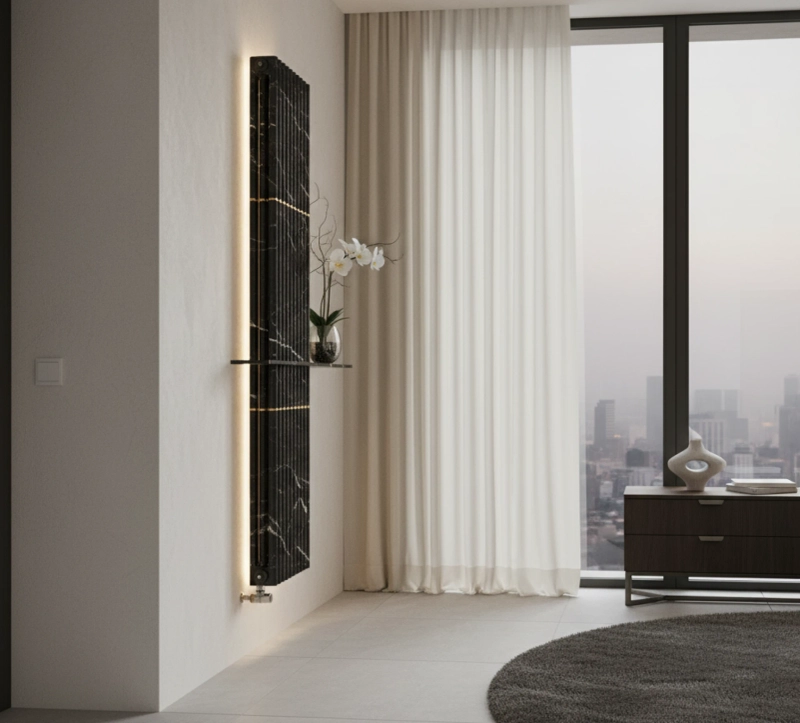
This is why it is so versatile. It is not a "retro" or "vintage" object, though it excels in those settings. In a minimalist or industrial space, a raw, stripped, and clear-coated column radiator becomes a piece of functional sculpture—a celebration of its own raw material and casting marks. In a classic Victorian home, an ornate, scrolled model is a piece of historical jewelry, authentic to the architecture. In a contemporary setting, a simple column model, powder-coated in a bold, unexpected color, becomes a deliberate, confident statement piece.
Its beauty is not derived from ornamentation alone, but from its honesty. It is a physical manifestation of its own function. It doesn't hide behind a plastic cover. Its form—the columns, the fins, the sheer mass—is a perfect expression of its purpose: to hold and radiate thermal energy. This alignment of form, function, and material is the very definition of great design.
Conclusion: The Solid Core of a Truly "Well" Home
The quest for a "well" home cannot be limited to purifying the air we breathe and the water we drink. We must, with equal scrutiny, consider the thermal environment we inhabit. The lazy, "brute force" method of blowing hot, dry, contaminated air around our living spaces is a relic of an older way of thinking, one that prioritized simple temperature over holistic comfort.
The cast iron radiator represents a more intelligent, sophisticated, and wellness-oriented approach. It is a choice to embrace a fundamentally superior quality of heat: a silent, draft-free, radiant warmth that cleans the air, preserves natural humidity, and creates an unparalleled sense of stable, enveloping comfort. But it is also a deeper, philosophical choice. It is a decision to reject the fragile, disposable, and intangible culture of "fast tech" and instead anchor our homes with objects of substance, permanence, and honest-to-God reality. It is not just a heating appliance; it is the solid, unwavering, iron core of a true domestic sanctuary.