



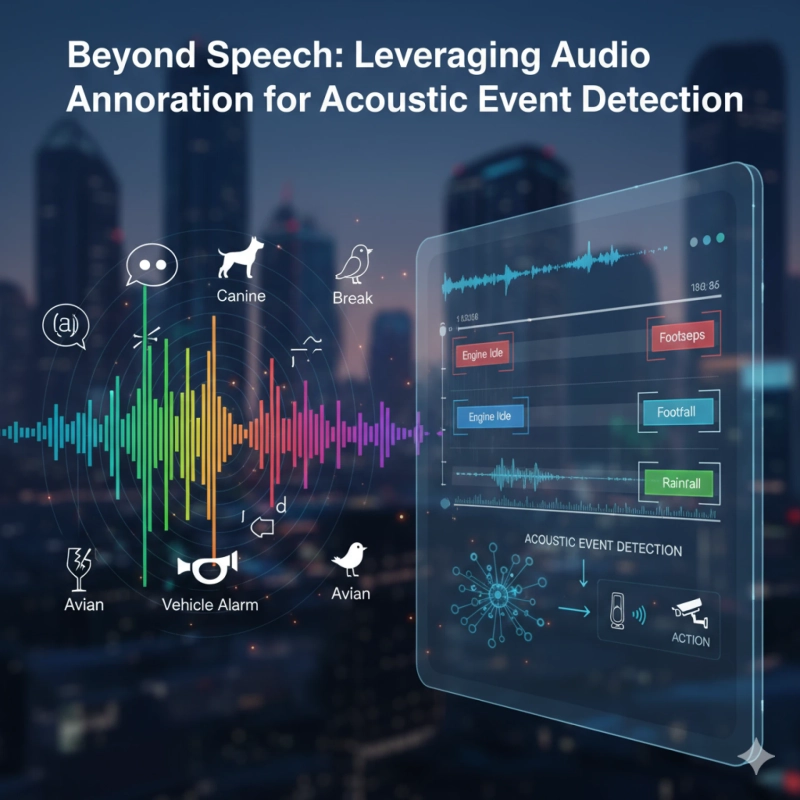
For years, the focus of audio-based Artificial Intelligence (AI) was predominantly on speech recognition—transcribing words and understanding language.While this field continues to advance, a parallel, equally crucial domain is gaining prominence: Acoustic Event Detection (AED), also known as Sound Event Detection (SED).AED is the task of automatically identifying and classifying specific sounds or "acoustic events" within an audio stream, along with their precise onset and offset times. From the breaking of glass to the chirp of a specific bird species, these non-speech sounds offer a wealth of data that can unlock next-generation monitoring and security systems, and this is where the precision of audio annotation becomes indispensable.
The Critical Role of Audio Annotation in AED
AED systems, like all supervised machine learning models, require high-quality, meticulously labeled training data. This is where professional audio annotation, a core service offered by Annotera, steps in. Unlike simple audio classification, where a clip is tagged with a single event label, effective AED relies on strong labels—annotations that not only name the event (e.g., 'dog bark', 'siren', 'doorbell') but also define its exact temporal boundaries (start and end times) within the audio stream.
The complexity of real-world acoustic scenes makes this an arduous human task. Environments are inherently polyphonic; multiple sounds overlap, often making it difficult even for a human ear to separate them. Annotators must meticulously listen to raw audio, often visualizing the sound wave (spectrograms) with advanced tools, to accurately mark the precise moments an event begins and ends, even amid significant background noise or overlapping events. The quality and granularity of this strong labeling directly correlate with the model's performance in real-world scenarios, particularly its ability to localize an event in time with high precision.
Applications Beyond the Spoken Word
The applications for AED, powered by precise annotation, are vast and rapidly expanding far beyond typical speech-based use cases:
- Security and Smart Homes: Systems can be trained to immediately recognize and alert residents or authorities to critical sounds like glass breaking, smoke alarms, or even the sound of a fall, significantly enhancing safety and response times.
- Environmental Monitoring: Bioacoustics relies heavily on AED to monitor wildlife. Annotated datasets of animal vocalizations (e.g., specific bird calls, whale songs) allow AI to track species movement, population density, and assess ecosystem health without continuous human presence.
- Industrial Maintenance (Predictive Analytics): Machinery sounds can be highly indicative of their health. Annotating audio recordings for specific anomalies like grinding, scraping, or high-pitched squeals enables AED models to detect early signs of equipment failure, paving the way for crucial predictive maintenance.
- Healthcare and Assisted Living: Monitoring for specific acoustic events, such as a sharp cough, a sudden crash, or a distressed cry, can provide crucial, non-intrusive safety monitoring for elderly or vulnerable patients.
- Automotive Safety: Within vehicles, AED can identify external critical sounds like a honking horn or emergency sirens, even when music or conversation is present, providing drivers with enhanced situational awareness.
Annotated Data: The Foundation of Model Accuracy
The robustness of an AED model is inextricably linked to the quality and diversity of its training data. A system trained only on pristine, single-event recordings will fail in a noisy urban environment. Annotera focuses on providing diverse, highly contextualized data that accounts for:
- Acoustic Variety: Capturing the same event (e.g., a "door slam") across different door types, surfaces, distances, and volumes.
- Noise Robustness: Labeling target events within varying levels of background noise, ensuring the model can generalize to real-world chaos.
- Temporal Precision: Providing sub-second accurate start and end times for events, which is critical for real-time monitoring.
Furthermore, advanced annotation projects now employ weak labels (clip-level presence of an event) alongside strong labels to train more efficiently on large, partially labeled datasets, a technique that requires specialized expertise to implement effectively.
In conclusion, as AI systems move towards a complete understanding of the acoustic world, the ability to accurately interpret the full soundscape—not just the speech component—is paramount. By leveraging precise, sophisticated audio annotation, Annotera is providing the foundational data necessary to build powerful, reliable Acoustic Event Detection systems that will redefine the standards for safety, monitoring, and environmental intelligence across countless industries.