




In regulated industries such as finance and healthcare, the decision to invest in intelligent automation is a high-stakes proposition. The potential benefits are immense, but so are the risks if implemented incorrectly. When building the business case for an automation program, leaders often fall into a common trap: they focus exclusively on a single metric, such as cost savings or headcount reduction. This narrow view fails to capture the full, multi-dimensional impact of automation and significantly undervalues its strategic importance.
The true business impact of automation is not a single number; it is a composite of improvements across the entire organization. To measure it effectively, leaders must adopt a more holistic framework. The Balanced Scorecard is a classic strategic management tool that is perfectly adapted for this purpose. It provides a structured way to measure success across four critical perspectives: Financial, Operational, Compliance & Risk, and the often-overlooked Human Impact. This approach moves the conversation from a simple cost-cutting exercise to a strategic discussion about building a more resilient, efficient, and compliant organization.
A Holistic Approach: The Four Perspectives of Automation Impact
Instead of a single ROI calculation, the balanced scorecard provides a comprehensive view of the value created.
1. The Financial Perspective: Quantifying the Hard Savings
This is the most traditional and straightforward perspective, but it is a critical starting point. It answers the question: "How is this initiative impacting our bottom line?"
- Key Metrics to Track:
- Return on Investment (ROI) and Payback Period: The classic calculation comparing the cost of the automation (software, implementation, maintenance) to the direct financial savings.
- Reduced Operational Costs: This includes quantifiable savings from reduced Full-Time Employee (FTE) hours spent on manual tasks, elimination of late payment fees, and reduction in costs associated with errors and rework.
- Increased Revenue (where applicable): Automation can also drive top-line growth. For example, automating the client onboarding process in a financial institution can lead to faster client acquisition and revenue generation.
2. The Operational Perspective: Measuring Speed, Quality, and Scalability
This perspective focuses on how automation improves the core processes of the business. It answers the question: "Are we doing things better, faster, and more reliably?"
- Key Metrics to Track:
- Process Cycle Time: The time it takes to complete a process from start to finish. For example, reducing the average time to process a medical claim from 10 days to 24 hours.
- Error Rate Reduction: Measuring the decrease in errors in a given process. Automation can often reduce manual data entry errors by over 95%.
- Increased Throughput & Scalability: The ability to handle a higher volume of work without a proportional increase in resources. An automated system can process 10,000 invoices in the same time it takes a human to process 100.
3. The Compliance & Risk Perspective: Quantifying Risk Reduction
For regulated industries, this is arguably the most critical perspective. Automation's ability to create consistent, auditable processes is a powerful tool for risk mitigation. It answers the question: "Is this initiative making our organization safer and more compliant?"
- Key Metrics to Track:
- Audit Trail Completeness: Automation creates a perfect, immutable log of every action taken, which is invaluable during regulatory audits (e.g., for HIPAA or SOX compliance).
- Reduction in Compliance Breaches: Tracking the decrease in incidents related to data handling errors or missed compliance checks.
- Improved Data Security: Automating the transfer of sensitive data between systems eliminates the risk of human error, such as an employee accidentally emailing a spreadsheet of patient data to the wrong recipient.
4. The Employee & Customer Perspective: Measuring the Human Impact
This perspective measures the often-overlooked but crucial impact of automation on the people it affects. It answers the question: "Is this initiative improving the experience for our employees and our customers?"
- Key Metrics to Track:
- Employee Satisfaction Scores (eNPS): Surveying employees whose most tedious tasks have been automated often reveals a significant increase in job satisfaction and morale.
- Customer Satisfaction Scores (CSAT/NPS): Faster response times, higher accuracy, and 24/7 availability of automated services can dramatically improve the customer experience.
- Time Reallocated to Strategic Work: Measuring the number of hours that are freed up from repetitive tasks and reallocated to high-value, strategic activities like patient care or client relationship management.
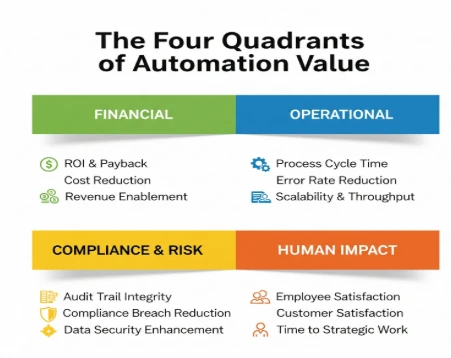
The Four Quadrants of Automation Value
Visualizing the impact across these four areas shows how a single automation initiative can deliver holistic, enterprise-wide value.
How Hexaview Helps Measure and Maximize Automation Impact
At Hexaview, we believe that a successful automation program is a measurable one. Our approach goes beyond simply building bots; we partner with our clients in regulated industries to create a comprehensive framework for measuring business impact. We help define the key performance indicators for each quadrant of the balanced scorecard, we build the analytics dashboards to track these metrics in real-time, and we provide the ongoing analysis to prove the full, multi-faceted ROI of your automation investments. We ensure that your automation initiatives are not just delivering efficiency, but are creating strategic, quantifiable value across the entire enterprise.
Sources:
- The balanced scorecard is a widely adopted strategic management framework. The metrics and perspectives described are based on best practices from industry sources like the Institute for Robotic Process Automation & AI (IRPA AI) and major consulting firms.