



For many enterprises, the "Cloud Transformation" journey has been underwhelming. They migrated their data centers to AWS or Azure, shut down their on-premise servers, and waited for the magic to happen. Instead, they got the same slow performance, the same downtime issues, and a monthly cloud bill that was 20% higher than before.
The reason for this failure is a fundamental misunderstanding of what "Cloud" actually is.
Simply moving a monolithic application from a physical server to a virtual server (a strategy known as "Lift and Shift") is not cloud engineering; it is just renting someone else's computer.
Cloud-Native Product Engineering is different. It is an approach to building software that exploits the unique advantages of the cloud model: elasticity, distributed computing, and on-demand resources. It is about treating infrastructure not as hardware, but as flexible code. When you build Cloud-Native, you don't build servers that need to be patched and nursed; you build ephemeral, stateless processes that can scale from zero to infinity and back again in seconds. This is the foundation of modern scalability.
The Core Philosophy: Cattle, Not Pets
In the old world (On-Premise), servers were "Pets." You gave them names (e.g., "Zeus," "Apollo"), you logged into them to fix issues, and if one died, it was a crisis.
In Cloud-Native Engineering, servers are "Cattle." You generate them in herds using code. You don't name them; you number them. If a server acts up, you don't fix it; you kill it and spin up a new one automatically. This shift from manual maintenance to Immutable Infrastructure allows engineering teams to manage thousands of servers with the same effort required to manage one.
Pillar 1: Microservices (The Decoupling)
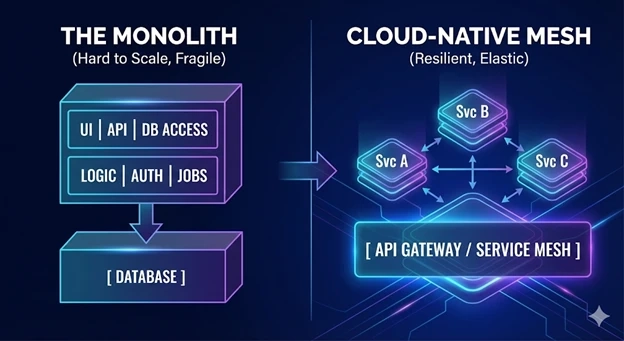
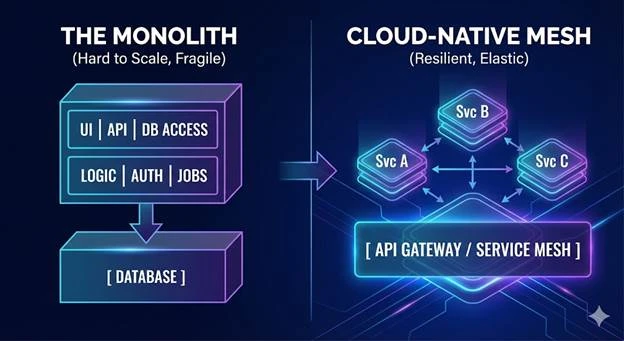
Scalability is impossible if your application is a single, giant block of code (a Monolith). If the "Checkout" feature needs more power, you have to duplicate the entire application, including the "Blog" and "User Profile," which wastes resources.
· The Cloud-Native Way: Break the application into Microservices. The "Checkout" is one service; "Inventory" is another.
· The Benefit: If Black Friday traffic hits, you can auto-scale only the Checkout service to 500 instances, while leaving the Blog service at 2 instances. This precise, granular scaling is the secret to high performance at low cost.
Pillar 2: Containerization (The Shipping Container)
To run microservices efficiently, you need Containers (Docker). A container wraps the code and all its dependencies into a single, lightweight package that runs exactly the same way on a developer's laptop as it does in production.
· The Orchestrator: To manage these thousands of containers, Cloud-Native engineers use Kubernetes (K8s). Kubernetes is the "Traffic Controller." It watches the system health. If a container crashes, K8s restarts it. If traffic spikes, K8s adds more containers. It is the self-healing engine of the modern cloud.
Pillar 3: Serverless (The Ultimate Abstraction)
The evolution of Cloud-Native leads to Serverless (AWS Lambda, Azure Functions). Here, the engineer doesn't manage servers or containers. They just write a function (e.g., "Resize Image").
· The Benefit: The cloud provider listens for an event (e.g., "User uploaded a photo"). It instantly spins up the compute power to run that function for 200 milliseconds, and then shuts it down.
· The Economics: You pay only for those 200 milliseconds. If no one uses your app at 3 AM, your cost is literally $0. This is "Scale-to-Zero" efficiency.
Visualizing the Shift: From Monolith to Mesh
The architecture changes from a single heavy block to a distributed mesh of lightweight services.
Pillar 4: DevOps & CI/CD (The Automation)
You cannot manually deploy 50 microservices. Cloud-Native requires DevOps Automation.
· Infrastructure as Code (IaC): Engineers use tools like Terraform or CloudFormation to script the environment. The entire data center setup is versioned in a Git repository.
· CI/CD Pipelines: Every time a developer commits code, an automated pipeline builds the container, runs tests, creates a staging environment, and (if tests pass) deploys to production. This allows companies like Netflix or Uber to deploy thousands of times a day without downtime.
How Hexaview Builds for Infinity
At Hexaview, "Cloud-Native" is our default setting. We don't just build apps; we architect ecosystems.
Our product engineering services leverage the full power of the cloud:
· Kubernetes Enablement: We design and manage production-grade Kubernetes clusters (EKS/AKS) that handle auto-scaling and self-healing for your critical workloads.
· Serverless Refactoring: We analyze your legacy code and refactor resource-heavy functions into serverless architectures, often reducing cloud bills by 30-50%.
· Resiliency Engineering: We implement "Chaos Engineering" practices—intentionally injecting failures into the system during testing to ensure that your product can survive an AWS zone outage without blinking.
We build software that grows with you, from your first user to your hundred-millionth.