



Small businesses depend heavily on fast and personal communication. Every day, you answer customer questions, confirm orders, share delivery updates, and solve issues. For many businesses, WhatsApp is the preferred channel because customers already trust and use it daily.
However, when businesses start growing, managing conversations manually becomes difficult. That is why many owners look into the WhatsApp Business API for small businesses. While the official API offers advanced features, it often feels complex, expensive, and hard to manage for small teams. As a result, business owners actively search for easier and more affordable whatsapp api alternatives.
In this guest blog, we explore why the official API may not suit everyone and highlight better options that small businesses can confidently use in 2026.
Why Small Businesses look beyond the Official WhatsApp Business API
At first glance, the WhatsApp Business API for small businesses sounds like the perfect solution. It allows automation, team inboxes, templates, and integration with CRM tools. However, many small business owners face real challenges once they try to use it.
High Costs Add Up Quickly
The official API works on a conversation-based pricing model. Every customer interaction costs money, and fees increase as your message volume grows. For small businesses with tight budgets, this pricing becomes hard to justify.
Technical Setup Is Complicated
You often need a WhatsApp Business Solution Provider (BSP) to get started. The onboarding process includes Facebook Business verification, API approvals, template reviews, and sometimes developer support. This makes the WhatsApp Business API for small businesses feel overwhelming.
Strict Rules and Limitations
WhatsApp enforces strict policies around message templates, customer opt-ins, and response windows. Small teams struggle to follow these rules consistently, which increases the risk of account restrictions.
Because of these challenges, many businesses now prefer Whatsapp api alternative that offer similar benefits without the complexity.
What Small Businesses actually need from a Messaging platform
Before choosing any tool, it is important to understand what truly matters for small businesses.
Most small teams need:
- Simple setup without technical skills
- Affordable pricing with no hidden charges
- Easy automation for FAQs and order updates
- A shared inbox for multiple agents
- Reliable customer support
While the WhatsApp Business API for small businesses provides these features, it often delivers them in a complicated way. This gap has created demand for smarter alternatives.
Top WhatsApp Business API Alternatives for Small Businesses
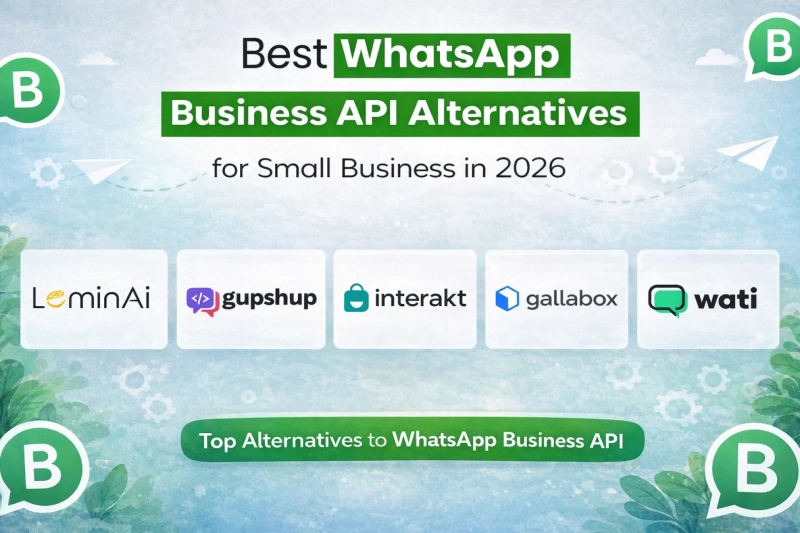
Below are some of the most practical whatsapp api alternatives that small businesses can use to scale customer communication smoothly.
1. LeminAi – Built Specifically for Small Businesses
LeminAi stands out as one of the most practical solutions for small and mid-sized businesses. It focuses on simplicity, speed, and affordability while offering features similar to the WhatsApp Business API for small businesses.
Why LeminAi Works Well
LeminAi removes the technical barriers usually associated with WhatsApp integration. Businesses can start quickly without hiring developers or dealing with long approval processes.
Key benefits include:
- Fast and easy onboarding
- Multi-agent live chat
- Automation for FAQs and order updates
- Clear and affordable pricing
- AI-powered chat assistance
For businesses that want power without complexity, LeminAi is a strong choice among modern whatsapp api alternatives.
2. WATI – Popular but Costly
WATI is a well-known platform built on the official WhatsApp Business API. It offers automation, broadcasts, and team inbox features.
However, WATI may not be ideal for all small businesses.
Pros
- Reliable platform
- Official WhatsApp partner
- Automation and templates
Cons
- Higher pricing
- Extra charges for advanced features
- Setup can feel slow
While it supports the WhatsApp Business API for small businesses, many owners feel the cost is too high compared to newer Whatsapp api alternative.
3. Interakt – Made for Indian SMBs
Interakt is designed specifically for Indian small businesses and integrates WhatsApp messaging with eCommerce platforms.
Key Features
- WhatsApp order notifications
- Customer segmentation
- Simple dashboard
However, automation options are limited, and pricing increases as usage grows. While it uses the WhatsApp Business API for small businesses, it may not suit companies looking for flexibility.
4. Gupshup – Omnichannel Platform Built for the Indian Market
Gupshup provides WhatsApp messaging along with other communication channels, making it a strong option for businesses operating in India. It is especially useful for companies that want to manage conversations across multiple platforms from one place.
Pros:
- Supports several channels, including WhatsApp and RCS
- Enables customized workflows and advanced messaging use cases
Cons:
- Pricing and onboarding may feel more suitable for larger or enterprise-level businesses
If your business handles multiple brands or requires complex messaging scenarios, Gupshup can be a solid option to explore.
Comparing WhatsApp Business API and Its Alternatives
When comparing the WhatsApp Business API for small businesses with alternatives, the biggest differences appear in ease of use, pricing, and flexibility.
FeatureOfficial APIAlternativesSetupComplexSimpleCostHighAffordableAutomationAdvanced but restrictedFlexibleSupportThrough BSPsDirect supportScalabilityGood but expensiveCost-effective
This comparison clearly shows why many small businesses now prefer modern whatsapp api alternatives.
How to choose the right platform for your Business
Choosing between the WhatsApp Business API for small businesses and alternatives depends on your needs.
Ask yourself:
- Do I have a technical team?
- Can I afford per-message pricing long term?
- Do I need complex workflows or simple automation?
- How fast do I want to get started?
If your goal is quick setup, low cost, and easy management, alternatives like LeminAi make more sense than the official API.
The Future of WhatsApp Messaging for Small Businesses
In 2026, customer expectations continue to rise. People want instant replies, accurate information, and friendly conversations. Messaging platforms must support these expectations without creating stress for business owners.
While the WhatsApp Business API for small businesses remains powerful, it is no longer the only option. Modern whatsapp api alternatives now provide similar features with fewer limitations, better pricing, and easier onboarding.
Small businesses that choose flexible tools gain more time to focus on customers instead of managing technical systems.
Final thoughts
The WhatsApp Business API for small businesses was created to help companies scale communication. However, its cost, complexity, and strict rules often make it unsuitable for small teams.
Thankfully, reliable whatsapp alternatives now exist. Platforms like LeminAi offer simplicity, automation, and affordability without compromising on performance.
For small businesses planning long-term growth in 2026, choosing the right messaging platform is not just a technical decision—it is a business strategy. The right tool can improve customer experience, reduce workload, and support steady growth.