



What you know about cancer treatment today may not be sufficient or may be outdated, as recent advancements in the field of medical oncology have occurred. YES, cancer Treatment in Medical Oncology has moved far beyond a one-size-fits-all approach. For many patients, the real question now is how to combine the best of standard oncology with newer immunotherapy and NK cell–based options.
This HOT TAKE explores the latest cancer treatment landscape, showing how traditional methods, immune‑driven therapies, and specialized clinics such as Cancer Killer Cells can work together to create more effective cancer treatment strategies for those seeking both survival and quality of life.
Peek Into The Latest Cancer Treatment In Medical Oncology Today
In medical oncology, long-standing therapies are being combined with rapidly developing immune-based approaches to treat cancer, providing patients with more options and control than ever before. Chemotherapy, radiation therapy, surgery, targeted medications, and hormone therapy remain the mainstays of standard oncology; however, immunotherapy and NK cell techniques, which work with the body rather than against it, are increasingly being added to these treatments.
Today, the answer to the question "what is oncology treatment?" is a spectrum that includes biologic and cellular therapies that improve the immune system's capacity to identify and eliminate cancer, as well as tumor-directed treatments.
What is Oncology Treatment?
Using specialists such as medical, radiation, and surgical oncologists, oncology treatment involves applying therapies like chemotherapy, radiation, surgery, immunotherapy, and targeted therapy to kill cancer cells, shrink tumors, and enhance quality of life.
This approach entails a variety of methods to cure, control, or alleviate cancer symptoms. Palliative care, adjuvant therapy, or primary therapy can all be used to eradicate cancer (to manage symptoms).
Common Types of Cancer Treatments:
Surgery: eliminating malignant tissue and tumors via physical means.
Radiation Therapy: This procedure works by using high-energy radiation to destroy cancer cells and reduce tumor size.
Chemotherapy: Systemically administered medications that destroy rapidly proliferating cells (throughout the body).
Hormone Therapy: reducing or halting the progression of hormone-driven malignancies (such as breast and prostate).
Immunotherapy: Supporting your body's defenses against cancer.
Stem Cell Transplantation: Stem cell transplantation is the process of restoring blood-forming cells following severe chemotherapy or radiation therapy.
Core Types of Cancer Treatment Options
Chemotherapy, radiation therapy, and surgery continue to be the primary cancer treatment choices; these are frequently combined in carefully planned regimens. Surgery help removing visible tumor tissue when physically accessible, radiation distributes concentrated energy to decrease or eliminate tumors in specific regions, and chemotherapy circulates systemically to destroy fast-dividing cells.
By blocking particular signaling pathways or hormone drivers that fuel specific malignancies, such some breast or prostate tumors, targeted medicines and hormone treatments increase accuracy.
These modalities can have serious side effects, such as immunological suppression, exhaustion, organ toxicity, and long-term functional repercussions, despite their significance and decades of effectiveness.
Because of this, patients and medical professionals are looking more and more to the most recent advancements in cancer treatment that preserve effectiveness while lowering side effects and promoting long-term health.
The Rise of Immunotherapy
By using the body's natural defenses to combat malignancies, immunotherapy has revolutionized expectations in medical oncology. For instance, immune checkpoint inhibitors release molecular "brakes" on T cells, resulting in long-lasting clinical responses in historically challenging diseases like melanoma, lung cancer, kidney cancer, and others.
This idea is furthered by adoptive cell therapies, such as CAR-T cells and modified immune cells, which increase or alter a patient's immune cells in the lab and then reinfuse them to find and eliminate cancer cells with high specificity.
Although dangers like cytokine storm, high expense, and restricted availability continue to be obstacles, these techniques are frequently emphasized in the most recent cancer cure news because some patients with otherwise refractory disease obtain long-lasting remissions.
Related: “How Advanced Cancer Centers Use NK Cell Therapy Alongside Oncology Care?”
Where NK Cells Fit in Integrative Oncology?
Natural killer (NK) cells hold a special role in integrative oncology. In contrast to T cells, NK cells use cytotoxic granules and cytokine release to eradicate aberrant cells and mold broader immune responses. They also rely on a mix of activating and inhibitory signals to choose whether to destroy a target.
According to recent studies, NK cell-based treatments can provide encouraging response rates and disease control for various tumor types, often with a favorable safety profile and low rates of severe immune-related adverse events. Because of this, NK cell immunotherapy is an attractive adjunct to traditional cancer treatment in medical oncology, particularly for patients seeking immune-supportive approaches that do not increase the toxicities of radiation or chemotherapy.
Comparing Standard Oncology and NK‑Focused Immunotherapy
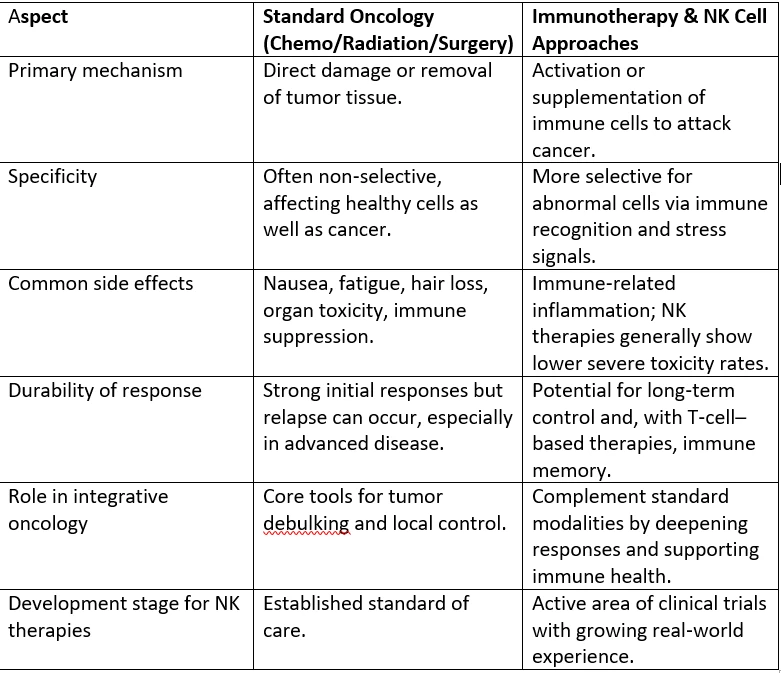
This contrast highlights why many specialists view immunotherapy and NK cell-based treatments as essential complements to conventional cancer treatment in medical oncology, rather than as alternatives. While immunotherapy and NK cells may prolong disease management, enhance response quality, and strengthen the immune system, standard treatments lessen tumor burden and alleviate symptoms. .
The Function of Cancer Killer Cells and NK Cell Therapy in Mexico
In this changing environment, patients seeking NK cell-based integrative cancer therapies in addition to standard treatment are increasingly turning to specialized centers in Mexico. In regulated clinics in locations such as Cancun, Tijuana, and Nuevo Vallarta, Cancer Killer Cells offers NK cell therapy to patients with kidney cancer, lung cancer, leukemias, ovarian cancer, and those seeking immunological support and cancer prevention.
When compared to conventional chemotherapy, NK cell therapy at Cancer Killer Cells is positioned as non-toxic and minimally invasive. It is administered as a customized infusion, typically with doses ranging from 1 to 5 million cells per kilogram. In line with a contemporary integrative oncology model that respects both evidence-based oncology and immune-enhancing techniques, the program places a strong emphasis on carefully timing chemotherapy and radiation, often suggesting intervals such as two weeks before or after standard treatments to maximize effectiveness and minimize interference.
The brand emphasizes the importance of NK cells in tissue repair and the control of viral infections, highlighting that these cells can eliminate virus-infected or damaged cells, promote healthier tissue regeneration, and directly attack tumors. Patients seeking more effective cancer therapy choices that address tumor burden as well as general immunological resilience and long-term well-being will find this expanded immune role appealing.