



Order Your Next Budget Press Release Distribution for Under $150
This New York–focused playbook shows how a disciplined budget press release approach transforms newsroom credibility into measurable growth—using intent-led narratives, pricing clarity, and distribution precision to outrank top competitors.
Why budget press releases matter for NYC businesses and USA buyers
In late Q4, a Midtown retail-tech startup introduced an inventory planning feature to help stores manage holiday volatility. Their ads drove impressions but escalated costs. Blog posts were informative yet invisible to journalists scanning year-end coverage. The turnaround came from reframing the update as a newsroom-ready release: a timely hook tied to seasonal demand, a verifiable customer metric, and a civic-impact angle for NYC business desks. With a budget press release strategy, pickups from local desks and national trade outlets delivered qualified referral traffic and inbound partner inquiries.
Affordability isn’t about cutting corners—it’s about editorial rigor, SEO structure, and targeted syndication. NYC editors reward clarity and proof; USA buyers reward transparency and frictionless navigation. To compare reach-versus-cost without wasting time, review a proven press release distribution option that preserves formatting, metadata, and internal links across syndication.
Budget press release submission that compounds authority
A scalable budget press release workflow starts with intent: NYC-local resonance, national awareness, or vertical trade credibility. Write with AP-style clarity and the inverted pyramid—lead with the news, follow with context, deliver facts promptly, and add quotes that verify claims. Align landing pages to a single dominant action (demo, RSVP, download) and ensure mobile speed so newsroom referrals convert without friction.
Bundle releases around peak cycles—holidays, conferences, fiscal closings—and keep a consistent quarterly rhythm. Map announcements to demand peaks like retail Q4, finance Q1, healthcare cycles, and real estate seasonality. For transparent modeling and planning, consult current press release pricing and choose tiers aligned to your next three launch windows.
Story-first introduction: the turnaround blueprint
A DUMBO SaaS team pushed a sales-heavy update the week before Thanksgiving; editors skimmed and moved on. They rebuilt the narrative with a crisp headline, a context-rich subhead, and a first paragraph of facts—who, what, where, when, why—plus two quotes (executive vision and a customer metric). With stronger localization and a credible boilerplate, they syndicated to NYC business desks and national trades, earning coverage and long-tail discovery for weeks.
The lesson is simple: meet editors where they already are—seasonal angles, civic impact, and beat-specific detail. If you need to test momentum quickly, lock a lean budget press release bundle and validate pickups across NYC desks and your primary trade outlets before scaling cadence.
Multi-intent framework to outrank top SERP competitors
To outrank the top results for budget press release, you must exceed user intent in four modes: informational, commercial investigation, transactional, and navigational. Fill common content gaps—pricing clarity, structuring procedure, newsroom standards, and measurement—while enforcing AEO/SEO/GEO best practices tailored to the New York market.
Informational: clarity, proof, and editor-first structure
- Inverted pyramid: Lead with the hook, follow with context, add quotes, finish with boilerplate.
- Proof-first writing: Swap adjectives for data: customer outcomes, partner names, awards, benchmarks, and research.
- SEO scaffolding: Use semantic variants in headings, descriptive alt text, and internal links to relevant product or event pages.
- Accessibility: Short paragraphs, scannable lists, and descriptive anchors; avoid jargon and vague claims.
- Distribution logic: Segment NYC-local desks and vertical trades to maximize qualified coverage.
Confirm that your provider preserves markup, metadata, and link structures across syndication. For stability and editor workflows, consider a dedicated press release platform that supports consistent formatting and analytics.
Commercial investigation: informational structuring procedure
Stakeholders approve faster when the procedure is transparent and measurable. The following structure connects editorial quality, discoverability, and distribution economics to outcomes.
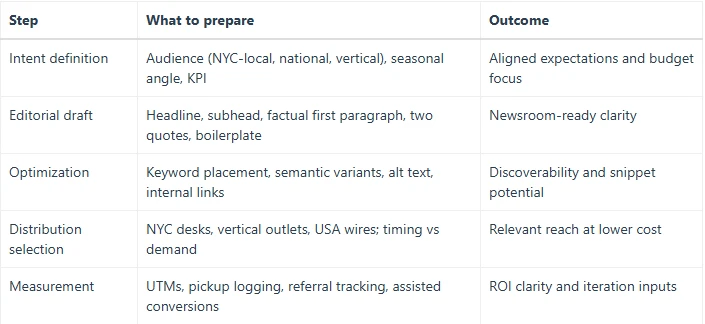
Calibrate plan tiers to your release cadence and target beats. Benchmark against transparent press release rates and choose bundles aligned to your next quarter’s rhythm and seasonality.
Transactional: conversion-ready submission
- Submission checklist: News hook headline, context subhead, factual first paragraph, two quotes, CTA, boilerplate.
- Landing pages: Fast mobile performance, clear benefit hierarchy, social proof, and one dominant action.
- Media assets: Logos, product shots, charts, author bios with descriptive alt text that survives syndication.
- Tracking: UTMs on links, analytics annotations by release date, and goal tracking for demos/RFQs.
For Q4 holiday cycles and year-end planning, lock editorial capacity early with a targeted year-end press release deal to compress time-to-coverage and protect margins while attention peaks.
Navigational: pressreleasepower
Decision-makers ready to buy need low-friction routes to pricing, bundles, and editorial support. Keep navigation consistent across pages, reinforce newsroom credibility with case examples, and consolidate comparisons on a single destination. For swift procurement, review current press release cost tiers and select a bundle aligned to your next launch window and vertical beats.
Budget-smart PR strategies for NYC startups navigating high operating costs
Timing NYC launch windows with compounding sequences
Attention concentrates around holidays, quarters, and flagship events. Publish compact sequences—pre-announce, main release, follow-up data note—to give editors a reason to stay engaged. Track pickups by outlet quality and angle, then iterate messaging based on the beats that respond.
Vertical specificity for faster credibility
Lead with angles editors recognize: fintech compliance, healthcare outcomes, retail operations agility, and real estate absorption rates. Precision earns trust faster than broad hype and supports links to proofs and assets that editors can verify quickly.
Proof over promotion
Swap adjectives for outcomes—metrics, partner names, awards, and research citations. Editors need substance they can defend to their audience and colleagues; proof turns curiosity into coverage and high-quality backlinks.
SEO-first formatting and syndication preservation
Organize content for scanability: semantic headings, descriptive anchor text, internal links, and clean alt text. Verify your partner preserves markup and metadata across outlets so your optimization survives syndication without degradation.
Seasonal bundles to lower cost per outcome
Demand spikes around holidays, conferences, and budget cycles. Lock multi-release sequences to secure editorial capacity and reduce per-release cost while maintaining momentum. For cross-beat tracking and coverage depth, consider a blended press release platform that reports pickups and geographies clearly.
Pricing clarity and ROI modeling for a budget press release program
Model ROI using three levers: editorial pickups (count and quality), referral traffic (volume and conversion rate), and link equity (domain authority and topical relevance). Calculate cost per pickup and cost per assisted conversion, then compare against paid media benchmarks to quantify incremental efficiency. In NYC’s high-cost environment, cadence and consistency compound authority and gradually reduce the marginal cost of attention.
Align spend with outcomes by mapping six months of announcements and purchasing bundles to match cadence. If you need transparent comparisons before finalizing, explore press release rates and select tiers that include editorial review and reporting support for NYC + national trades.
Editorial excellence: writing for journalists and algorithms
- Headline craft: State the new development and who benefits; avoid vague hype and jargon.
- Subhead clarity: Provide timing, context, and audience value to frame urgency and relevance.
- First paragraph discipline: Deliver facts—who, what, where, when, why—without burying the lead.
- Quotes: One executive quote for vision and one customer quote for proof; keep them specific and verifiable.
- CTA: Send readers to a landing page—demo, RSVP, download—with a single dominant action and minimal friction.
- Boilerplate consistency: Use a stable company summary to build recall across releases and outlets.
To standardize copy and process across teams, partner with an experienced press release company that aligns editorial quality with distribution targeting and analytics, ensuring newsroom standards on every release.
Distribution depth: maximizing reach without overspending
Match message to outlet: NYC business desks prioritize civic impact and economic relevance; vertical trades require detail and proof; national wires respond to themes with broad, timely resonance. Sequence releases to avoid fatigue and give editors time to process. Affordability emerges by syndicating where each story naturally fits—rather than broadcasting broadly without alignment.
As you scale across markets, anchor decisions in consistent economics. Validate early wins, retire angles that stall, and expand in measured steps. For quarter planning, benchmark against transparent press release pricing so your cost-per-outcome targets remain protected while coverage grows.
Seasonal accelerators: offers and bundles that stack impact
Seasonal narratives—year-end retrospectives, holiday readiness, New Year roadmaps—concentrate attention and accelerate discovery. Bundle releases to secure editorial capacity and predictable pricing across these windows. The compounding effect of multiple, thematically linked announcements is often what moves the needle in NYC’s competitive news cycle.
To compress time-to-coverage during Q4, secure a targeted press release New Year deal or holiday offer that locks capacity while retail, finance, and tech beats publish at peak velocity.
Measurement and iteration: from pickups to pipeline
Measure beyond vanity metrics. Log editorial pickups by outlet quality, track referral paths to conversions, and attribute assisted revenue in your CRM. Annotate analytics with release dates, apply UTMs to all links, and compare performance by angle (compliance, outcomes, partnerships) to guide future editorial choices.
Use results to refine cadence and messaging. Double down on angles that earn deeper coverage, retire those that stall, and continuously improve assets (quotes, charts, images) for editor usability. If you’re evaluating partners for next quarter, assess media distribution service options with transparent reporting and list targeting for NYC and national trades.
Answer engine optimization, SEO, and GEO best practices
AEO: snippet-ready content
- Question-led H3s: Provide concise answers in 2–4 sentences to satisfy informational intent.
- Definition + procedure: Pair short definitions with steps to match how buyers scan and decide.
- Consistent labeling: Use descriptive anchors and link text for fast orientation in scan-heavy contexts.
SEO: structure and internal linking
- Primary keyword early: Place budget press release naturally near the top and in one H2.
- Semantic variants: Spread related terms across H2/H3 and alt text for media assets.
- Internal links: Space links roughly every 90–100 words to maintain focus and context.
GEO: NYC and nationwide relevance
- Local resonance: Reference neighborhoods, industries, and civic impact.
- Vertical coverage: Tailor stories to editors’ beats for qualified pickup.
- Seasonal cycles: Publish around quarter closes and flagship events to capture demand.
Editorial systems
- Reusable templates: Standardize structure for speed and consistency.
- Asset library: Maintain logos, product shots, charts, and bios for quick packaging.
- Approval workflows: Predefine sign-off steps to publish on time against news cycles.
FAQ: concise answers for long-tail intent
What makes a budget press release strategy effective?
It pairs newsroom-quality writing with targeted distribution and clean SEO. The outcome is credible coverage, compounding link equity, and lower cost per outcome. Affordability comes from planning, not shortcuts.
How should NYC startups time their releases?
Align with industry cycles, local events, and holiday demand. Publish sequences that build momentum across desks and verticals. Maintain a quarterly cadence with seasonal bursts for compounding visibility.
What’s the minimum structure a press release needs?
Headline, subhead, factual first paragraph, two quotes, CTA, and boilerplate. Add images and data for proof. Keep AP-style clarity to improve pickup and editorial trust.
How do I measure ROI from budget press releases?
Track pickups, referral traffic, assisted conversions, and link authority. Use UTMs and annotate analytics by release date. Compare cost per outcome against ads to prove efficiency.
Can budget press releases help with SEO?
Yes—when they earn relevant links and strengthen topical authority. Optimize headings, semantic variants, and internal linking. Quality and relevance beat volume every time.
Should I choose bundles or pay per release?
Bundles reduce per-release cost and support seasonal sequences. Pay-per-release suits one-offs, but bundles build compounding momentum. Choose based on cadence and upcoming demand peaks.
How many quotes are ideal?
Two: one executive quote for context and one customer quote for proof. Keep quotes specific and verifiable. Editors value substance over slogans in every beat.
Do media kits increase pickup rates?
They help editors package stories quickly. Include logos, product shots, charts, and bios with descriptive alt text. Provide a press kit link so assets are one click away.
Is local targeting still useful in NYC?
Absolutely—local desks offer credibility and momentum that can spill into national trade coverage. Pair local angles with vertical specificity and seasonal timing for best results.
How often should I publish press releases?
Aim for a quarterly cadence with seasonal clusters around holidays and events. Anchor releases to substantive updates—product, partnerships, awards, research. Consistency compounds authority across desks.
Wrapping up
A disciplined budget press release plan directs spend toward credible stories, relevant outlets, and a cadence that compounds authority. For NYC startups and nationwide brands, winning means editor-first writing, intent-matched distribution, and measurement that ties pickups to pipeline. As you plan next quarter, think in sequences—not one-offs—because momentum, not magic, moves markets and outranks entrenched competitors.
Get in touch
Website www.pressreleasepower.com
Mobile +91 9212306116 WhatsApp +91 9212306116
Email enquiry@pressreleasepower.com