


Running PPC for an automotive business in 2026 won’t look like it did a few years ago. Costs are rising, competition is stronger, and customers are doing more research before making a decision. Whether someone is booking brake service or shopping for a vehicle, they are carefully comparing options.
Many dealers and repair shops increase ad budgets, expecting better results. But spending more does not always mean securing more customers. What is more important is how campaigns are created, analyzed, and improved over time.
In 2026, the businesses most likely to succeed with auto repair pay-per-click are the most focused and purposeful.
The Automotive PPC Landscape in 2026
PPC in the automotive industry in the year 2026 is focused more on consumer behavior rather than the advertising platform itself. Consumers are taking longer when making buying decisions. They research service providers, their pricing, reviews, and other relevant details before making a call or booking an appointment.
Digital visibility has enabled dealerships and repair shops to establish themselves in the local market. Locations like these have much more competition, with each business sort of trying to outdo the others. Simply appearing in search results is no longer enough. Businesses must also maintain strong reviews and a trustworthy reputation to stand out.
For example, in the local region, the service keywords “oil change near me” and “tire shop near me” will have several bidders competing for the same keyword.
Also, consumers want more ease when searching for services and want a quick response. If an ad is not straightforward and the process feels too complicated, consumers will leave.
In this PPC industry, it is about more than just clicks and visitor volume. It is about the quality of those clicks and engagement.
What Dealers & Shops Must Get Right
1. Intent-Based Campaign Structure
A common mistake is putting everything in one campaign. Sales and services shouldn’t compete in the same structure.
Someone typing “brake repair near me” has a completely different intent than someone just looking to price a used truck. That is why Google Ads for mechanics should focus on specific services rather than broad terms like “automotive”.
When campaigns are separated into categories such as service types, vehicle models, or buyer intent levels, budgets can be directed to the more valuable searches. When campaigns are organized around what customers actually want, performance becomes more predictable and cost-efficient.
2. Smarter Budget Allocation
If you have only one location, you can control your spending by knowing which services are the most profitable. With multi-location groups, it's more complicated.
If uncoordinated multiple locations target the same radius, they could compete with each other, wasting budget. Budgets should be allocated based on demand and local performance.
It's about differential treatment. Some locations have the potential to be more profitable, and budgets should be allocated accordingly.
3. First-Party Data & Conversion Tracking
Clicks are easy to track, but revenue is not unless proper systems are in place.
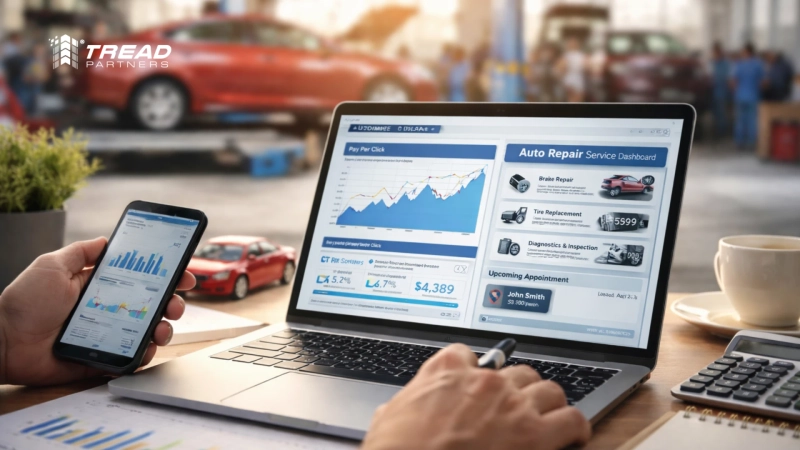
In 2026, successful PPC campaigns rely on tracking actual customer actions. That includes phone calls, appointment forms, and booked services. Integrating ad data and internal systems provides insight into which keywords and campaigns drive conversions to paying customers.
Thinking in terms of cost per booked job rather than cost per click improves your decision-making. That kind of clarity helps with safer, more predictable scaling.
4. Landing Pages That Actually Convert
Directing paid traffic to a random homepage often results in wasted spend. If someone has clicked on a brake repair ad, they are NOT looking to see a list of other car services.
Giving a specific offer page works, along with booking and trust elements. Confidence goes up with real reviews, real photos, certifications, and warranties.
Let’s not forget mobile optimization, since searches are mostly done on phones, booking should be easy and quick on mobile devices, too. Simplifying the process will increase your conversion rate.
5. Automation & AI With Oversight
Every year, tools for automation get better and better. Smart bidding strategies and automated campaign types make bid adjustments faster than any human ever could.
Although automation tools have improved, they still require oversight. Regularly checking search terms, negative keywords, and budget allocation helps avoid wasting money.
AI can optimize delivery, but AI cannot fully understand local profit margins, seasonal trends, or operational priorities. The best advertisers use automation along with human judgment.
6. PPC Should Work Alongside SEO & Retargeting
When integrated into other parts of automotive digital marketing, PPC achieves optimal performance.
Search ads and SEO work best together because search ads capture immediate demand and SEO builds long-term visibility. On the other hand, retargeting keeps your business in the line of sight of people who went to your website but didn’t convert.
When PPC is aligned with SEO efforts and consistent messaging, local auto repair advertising becomes more efficient and more profitable.
7. Costly PPC Mistakes to Avoid
There are a lot of campaigns that don’t do as well as they probably could because of avoidable mistakes.
Broad match keywords are likely to drain your budget without delivering meaningful results. Not adding negative keywords allows irrelevant searches to trigger your ads, which wastes budget. Poor ad copy that doesn’t include a strong call to action means that your ads will go unnoticed.
A big contributor to low campaign performance is a lack of follow-up. Even strong campaigns can underperform if incoming leads are not handled promptly and professionally.
Keeping your ad text and targeting up to date, along with good internal communication, will help ensure these mistakes don’t happen.
PPC in 2026 Is About Precision, Not Spend
For 2026, automotive PPC is not centered on increasing budgets, but rather on integrating smarter execution. When shops and dealers treat advertising as a structured revenue channel, pay-per-click advertising becomes a predictable growth tool rather than a cost center.
Stability comes from an organized campaign structure, solid & clear tracking, directed messaging, and ongoing refinement. When all components of the process align, PPC becomes a reliable growth pull, from click to booked appointment. Such businesses will gain a measurable competitive advantage.