



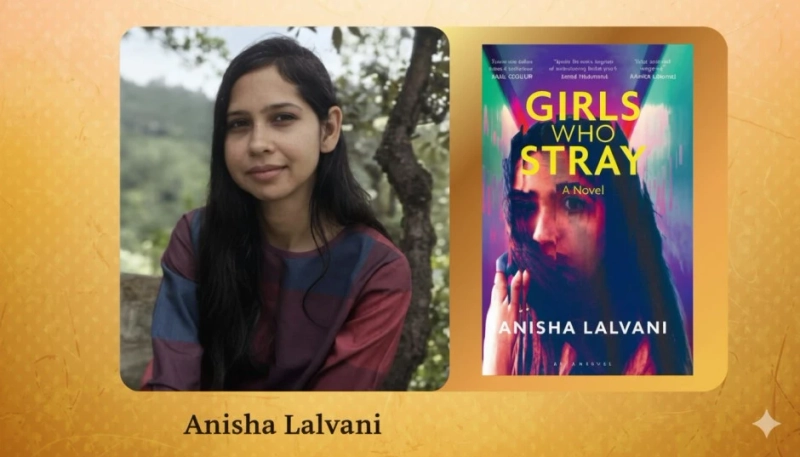
Author Anisha Lalvani has never treated writing as a race. Her debut novel Girls Who Stray took eight years to complete, a span that held within it hesitation, rediscovery, and an unwavering commitment to honesty. The novel, published by Bloomsbury India, stands as a layered reflection on modern anxiety, patriarchy, and personal identity.
In a world that often glorifies speed, Author Anisha Lalvani writes at her own pace. Her words come from introspection, not impulse. They emerge from years of living, observing, and waiting for the right sentence to reveal itself.
The Beginnings of a Literary Journey
Anisha Lalvani’s story begins in Mumbai, a city that pulses with creativity and contradiction. She studied English Literature at St. Xavier’s College and later pursued her Master’s at Mumbai University. These years shaped her love for storytelling, not only as a reader but as someone who would one day build stories of her own.
After finishing her studies, she moved to Delhi to explore the world of publishing. She worked at Yoda Press, an independent press known for its courageous titles, and later with Namita Gokhale at the Jaipur Literature Festival. Those experiences deepened her understanding of what it means to be part of the literary ecosystem.
Her professional path eventually took her into the development sector, where she continues to work in communications with a think tank. Yet, through all these transitions, writing never left her side.
The Long Creation of Girls Who Stray
Author Anisha Lalvani admits that Girls Who Stray demanded more patience than she expected. “It took me eight years of my life,” she says with quiet pride. “I procrastinated a lot, but I knew I had to finish it. It was something bigger than me.”
The story became her way of exploring the thoughts and emotions that had been building inside her. Rather than recording them privately, she wanted to shape them into fiction that others could read, experience, and perhaps find themselves in.
The result was a novel that examines modern disconnection, relationships, and guilt with both empathy and precision.
When Reading Turned Into Writing
For Author Anisha Lalvani, literature has always been a dialogue. She describes writing as a continuation of the conversations she has had with the books she loves. “Writing is like speaking back to the authors you admire,” she says, “even if they are gone.”
Her academic years immersed her in great works that taught her how language could open doors to understanding. That influence never left her.
It was only when she saw her name printed under the Bloomsbury logo, holding her book for the first time, that she truly recognized herself as an author. It was a moment that sealed her identity as a storyteller.
A Voice That Evolved with Time
Writers often look back and see their style evolve, and Author Anisha Lalvani is no exception. Over the years, she learned to trust simplicity and rhythm. Her friend and mentor Deepti Kapoor advised her to strip away unnecessary details and focus on what mattered. That guidance helped her embrace clarity without losing personality.
Her writing now flows naturally, unforced and distinct. She believes that the voice of a writer must never feel manufactured. It must arise from instinct, from a deep understanding of what the story demands.
The World Inside Girls Who Stray
At first glance, Girls Who Stray might appear to be a story about crime and guilt. But beneath its thriller framework lies a study of the modern mind. Author Anisha Lalvani captures the unease of a generation overwhelmed by information and technology.
She also writes powerfully about gender and power. The novel touches on misogyny, privilege, and the invisible emotional labor that women often carry. One of its most poignant sections follows a young woman reflecting on her own experiences while the city around her erupts in protest after the Nirbhaya case. This merging of personal and political creates a strong emotional undercurrent throughout the book.
The novel also draws inspiration from the Nithari Noida murders, weaving real events into fiction that feels both immediate and haunting.
Writing Beyond the First Book
After years of devotion to Girls Who Stray, Author Anisha Lalvani is now working on her second novel. It follows a woman who witnesses the murder of a maulvi inside a masjid, again inspired by real-life events. The story explores truth, morality, and silence, themes that she continues to return to.
She admits that progress has been slow but intentional. This time, she hopes to balance intuition with routine. Her goal is to build discipline without losing the spontaneity that gives her voice its vitality.
The Influence of Real Life
Author Anisha Lalvani writes from lived experience. The people she meets, the cities she inhabits, and the moments that stay with her often find a way into her fiction. But she transforms them before they reach the page.
For her, this act of reshaping reality into narrative is the most rewarding part of writing. It turns private experience into something universal.
Lessons from the Creative Process
Writing has taught her persistence and patience. It has shown her that discipline is as important as imagination. Most importantly, it has given her joy. “The thrill of writing a beautiful sentence is unlike anything else,” she says.
She also finds fulfillment in the connections her words create. When strangers write to tell her that her work resonated with them, it reminds her why she writes at all.
The Truth Behind a Writer’s Life
To many, being an author appears glamorous. But Author Anisha Lalvani is honest about the challenges. Balancing a full-time job with writing is exhausting. Creative work rarely pays enough to sustain itself, and publishing is often a slow, uncertain process.
“Writing takes time,” she says. “In a fast world, it teaches you to slow down.” She hopes readers recognize the patience and vulnerability that lie behind every book.
Accepting and Challenging Feedback
Feedback is a part of every writer’s journey, and Anisha approaches it with an open but firm mindset. She has learned when to listen and when to trust her instincts. Some edits strengthened her story, while others she resisted because they touched parts of the book that were too close to her heart.
Her approach to editing is rooted in respect. It is a dialogue, not a debate. She believes that a writer’s voice must remain authentic even through revision.
Finding Motivation
Every creative person faces periods of doubt. Author Anisha Lalvani keeps herself going through confidence in her vision. When doubts arise, she reminds herself of why she started. She believes that writing itself generates motivation, one sentence at a time.
Finding Inspiration Beyond the Page
Outside writing, she draws inspiration from cinema, documentaries, and reading. Films and true crime stories feed her fascination with human psychology. Reading, however, remains her truest source of creative renewal.
She recently finished reading Orbital by Samantha Harvey, which she describes as poetic and profound. She also admired Sally Rooney’s Intermezzo for its delicate exploration of grief and relationships. To her, reading is not optional for a writer. It is essential nourishment.
The Heart of Her Work
Author Anisha Lalvani writes about what it means to live in an age of contradiction. Her fiction captures both the chaos of modernity and the quiet spaces of introspection. Through her characters, she invites readers to confront the questions that often remain unspoken.
Her work resists haste and celebrates depth. It reminds us that sometimes the most powerful stories are those that take time to bloom.
The Journey Continues
As she continues to write, Author Anisha Lalvani moves with the same patience that shaped her first novel. She knows the next story will take its own time to find form, and she is ready to wait for it.
Her journey is far from over. It is only beginning to unfold into new shapes, new reflections, and new voices waiting to be heard.
This interview with Author Anisha Lalvani, writer of Girls Who Stray, was conducted by Unnati Shahi, founder of The Bookish Gossips.