



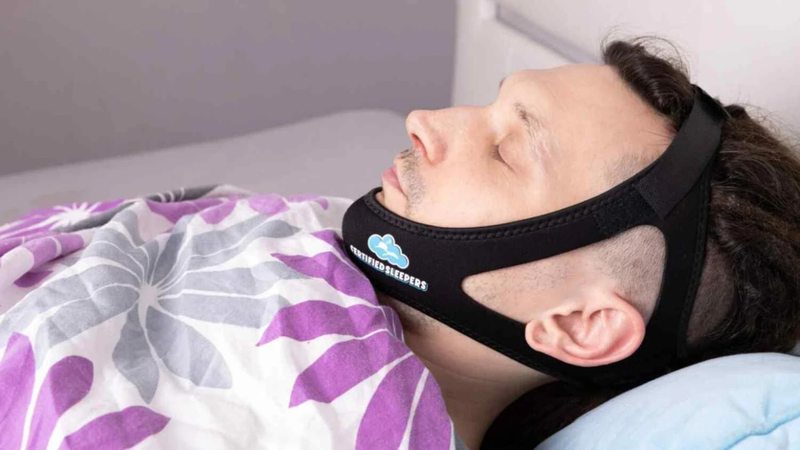
People discuss snoring as something that causes the most issues in the form of unwanted sound that ends up creating several issues for others as well. But at its core lie the main issues related to the breathing pattern. There are various approaches that people are exploring these days to control the issue of snoring, and the anti snore chin straps are being mentioned very frequently in the conversations. When it comes to understanding the role of these, one needs to look beyond the device and analyse the way the human body behaves during sleep.
Snoring as a Nighttime Behavior, Not Just a Symptom
The entire human body enters a state of reduced muscle tone during sleep. And this relaxation is not limited to limbs only because it goes all the way up to the jaw, tongue, throat, and other parts of the body. This is the main reason why jaw drops open unintentionally during sleep. And once the mouth opens, the airflow quickly shifts from the nasal passages to the oral airway. This leads to many issues by increasing turbulence and vibrations in the soft tissues.
The increasing popularity of anti-snoring chin straps is associated with the way they address this behavioral shift rather than blocking the anatomical blockage right away. Their clever design works best in supporting the jaw position naturally to keep the mouth in a closed posture without requiring any conscious effort.
The Role of Jaw Stability in Sleep Quality
Jaw position is something that is highly subtle, but it plays a major role in deciding the overall sleep quality and nighttime breathing. The tongue is more likely to stay forward and help preserve the airway when the jaw remains in its stable position. When the jaw opens frequently and falls backwards, the position of the tongue changes, which in turn narrows down the airway and leads to snoring.
The anti snoring chin straps work the best because they provide the required external support to counteract the muscle relaxation.
Breathing Patterns and Habit Formation
Breathing habits don’t stop when one falls asleep. In some cases, when people develop a habit of unnecessary mouth breathing, this habit continues through sleep as well. And when this habit continues, it reinforces snoring tendencies and leads to several issues like dry mouth, disturbed sleep, and frequent awakenings. With the anti snore chin straps, such habits can be controlled very effectively.
Comfort, Compliance, and Sleep Continuity
Comfort is one of the most important requirements for sleeping. Sleep is something that is highly sensitive to disruptions, and even small discomforts can fragment the entire rest cycle. The anti snore chin straps fall under the category of items that are made with soft materials, lightweight construction, and enhanced adjustability to reduce pressure points.
Not a Universal Solution
Though these products are really nice and they are working great nowadays, as people are saying, certain clarifications are needed for the convenience of the snorers. First and foremost, it needs to be understood that snoring happens because of various reasons, and these chin straps are not the only solution in all cases. The snoring solutions are increasingly becoming cause-specific, and the anti-snore chin straps are being perceived as the most relevant solution, not the only solution.
Conclusion
In the broad and complex discussion about sleep health, the anti snore chin straps have now occupied a very specific place. And this is mainly because they address not one but multiple issues at the same time, starting from jaw stability to breathing behavior, and many more. All the individuals whose snoring habits are linked with mouth opening, these are some of the best and most effective solutions.