



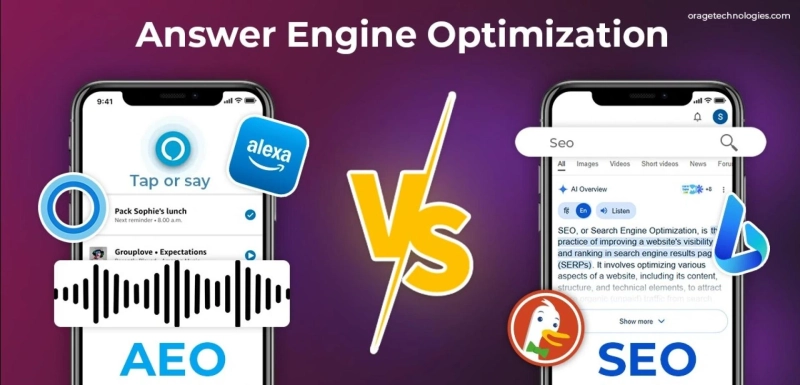
In the ever-changing landscape of digital marketing, one thing is certain: change. Search engine optimization (SEO) has been the gold standard for years when it comes to boosting online visibility and organic traffic. But the advent of artificial intelligence and voice search devices has thrown a new player into the ring: Answer Engine Optimization. This has raised an interesting question—AEO vs SEO—and whether or not traditional SEO is being displaced by the increasing power of answer-based strategies.
In this article, we’ll dive deep into what both SEO and Answer Engine Optimization entail, their similarities and differences, and whether AEO is truly taking over SEO or simply enhancing it.
What Is SEO?
Search Engine Optimization (SEO) is the process of enhancing a website's visibility on search engines such as Google, Bing, and Yahoo. The objective is to have a higher position on search engine results pages (SERPs) in order to gain more organic traffic. SEO is a holistic discipline that encompasses:
- Keyword research
- On-page optimization (meta tags, headers, content structure)
- Technical SEO (site speed, mobile-friendliness, indexing)
- Off-page SEO (backlinks, social signals)
- Content marketing
The fundamental objective is to increase content's visibility to search engines and user intent relevance. Classic SEO depends largely on knowing search algorithms and tailoring content accordingly.
What Is Answer Engine Optimization?
Answer Engine Optimization is a new field of SEO that aims to optimize content for answer engines—tools such as Google's featured snippets, ChatGPT, Perplexity AI, Bing Copilot, and voice assistants like Siri or Alexa. Rather than concentrating on keyword ranking, Answer Engine Optimization is all about the presentation of accurate, brief, and to-the-point answers to user questions.
In short, AEO is designed for an age where humans desire instant responses without digging through pages of search results. Whether through a voice query querying, "What's the optimal time to post on Instagram?" or through a chatbot nudging towards a straight answer, Answer Engine Optimization makes your content ready to be the answer.
AEO vs SEO: What's the Difference?
Although SEO and AEO have some underlying concepts in common, they are distinct in methodology and application.
1. User Intent Focus
- SEO: Emphasizes search intent, i.e., informational, navigational, transactional, and commercial queries.
- AEO: Emphasizes answer intent, where users seek an instant, definitive response—ordinarily to a question.
2. Content Length & Format
- SEO: Usually encourages long content, dense with information, images, and internal linking.
- AEO: Focuses on concise, organized, and readable answers, usually in the form of bullets, lists, or brief paragraphs.
3. Ranking Mechanism
- SEO: Sorts web pages according to more than 200 parameters such as backlinks, content match, and page experience.
- AEO: Aims for position zero, featured snippets, voice answers, and AI summary boxes—usually not requiring a user to click.
4. Technology Dependence
- SEO: Based on search engine crawlers, sitemaps, and indexing.
- AEO: Leverages natural language processing (NLP), organized data (such as schema markup), and AI models informed on semantic relationships.
5. Traffic Targets
- SEO: Mostly focuses on traffic to sites.
- AEO: Doesn't necessarily drive traffic at all—its victory is in visibility and authority, even when the user doesn't click through.
Why AEO Is Picking Up Speed
The virtual world is changing fast. With growing numbers of users embracing voice search and AI-powered chatbots, Answer Engine Optimization assumes a critical role.
1. Voice Search Is On Fire
More than 40% of adults now use voice search daily, and the trend continues to grow. Voice assistants like to have short, straightforward answers—just what AEO will provide.
2. AI-Powered Search Interfaces
With models such as AI-powered ChatGPT, Gemini, and Bing Copilot providing immediate, context-sensitive responses, the old SEO is losing relevance. These models are more interested in brief, authoritative responses, not keyword-loaded articles.
3. Featured Snippets and Zero-Click Searches
Increasing numbers of Google searches receive zero clicks. That's because users get their answer straight away in a snippet. Answer Engine Optimization is designed to secure these snippets by formatting content to fit the reading habits of AI.
How to Optimize Answer Engine
If you're prepared to make the switch, this is how to optimize for Answer Engine Optimization:
1. Know User Questions
Know the very questions that your ideal audience is asking. AlsoAsked, AnswerThePublic, and People Also Ask can be used to access conversational questions.
2. Utilize Structured Data
Apply schema markup to enable AI and answer engines to interpret your content's context. This raises your probability of being displayed in snippets or AI-based answers.
3. Employ Inverted Pyramid Style
Place the answer first, and then follow it with supporting facts. This style works best for voice assistants and conversational AIs that favor conciseness and readability.
4. Optimize for Featured Snippets
Use bullet points, tables, and summaries. Break paragraphs down to 40–50 words and get straight to the answer in the first few lines.
5. Establish Authority
Answer engines trust reliable sources. Employ specialist quotes, reference good sources, and maintain your information up-to-date and precise.
Will Answer Engine Optimization Supplant SEO?
It's easy to answer in the affirmative, particularly in light of the AI usage explosion. Yet things are not that black and white.
AEO Augments SEO—Not Replaces It
Instead of doing away with SEO, Answer Engine Optimization can be seen as an improvement over it. Consider AEO as an added layer on top of SEO. You still require fast-loading sites, contextual backlinks, and good content. But now, this content needs to be optimized to answer questions directly and effectively.
Different Goals, Different Metrics
SEO is long-term ranking, traffic, and domain authority. AEO, on the other hand, has success metrics as immediate visibility, snippet inclusion, and being the top source for voice or AI responses. They target various points on the user journey.
Co-Existence Is the Future
Search engines are turning into answer engines. Google itself is combining classic results with AI-written responses in the form of Google Search Generative Experience (SGE). Therefore, optimizing for both AEO and SEO isn't a choice—it's a necessity.
Case Studies: AEO in Practice
1. Healthline
Healthline reigns supreme when it comes to featured snippets for health-related searches. By organizing content with direct answers, FAQs, and schema markup, they've optimized for SEO and AEO.
2. Investopedia
Their explanations and definitions are frequently quoted by AI tools and show up in Google's answer boxes. Their writing is both detailed and to the point—excellent for Answer Engine Optimization.
3. Neil Patel
Neil Patel has created an AEO-friendly website using question-based blog structures and FAQs, which frequently get referenced by AI-derived answers and feature prominently on SERPs.
Challenges of Answer Engine Optimization
Although highly effective, AEO is not without its challenges.
1. Reduced Click-Through Rates
If the users receive the response from a snippet or AI, they may not even come to your site—leading to zero-click searches.
2. Measuring ROI Is Tricky
In contrast to SEO, which is based on metrics such as traffic, bounce rate, and time on site, Answer Engine Optimization success is more difficult to measure. Tools for voice search performance tracking are still in development.
3. Content Theft Concerns
AI tools occasionally summarize your work without giving credit. Although AEO is concerned with getting cited, this can be aggravating for artists nonetheless.
The Intersection of SEO and AEO
To succeed in the new digital age, your approach needs to marry the best of both.
- Apply SEO to gain long-term exposure, create backlinks, and establish brand authority.
- Employ AEO to conquer voice search, featured snippets, and conversational AI platforms.
Both depend on good content and user intent but for different reasons in the search process. Spending on one without the other is no longer viable.
Conclusion: The Future Is Hybrid
So is Answer Engine Optimization replacing SEO?
Not really—but it is transforming it.
With voice search and AI more prominent, the way people search is evolving. SEO isn't about ranking pages anymore; it's about providing answers before the user clicks. The most intelligent brands are already pivoting, merging classic SEO methods with AEO strategies to make sure they're being seen on both search and AI platforms.
If you're not already considering Answer Engine Optimization, you should be now. It's not a substitute for SEO—it's the next phase of its development. And those who seize it will rule tomorrow's search landscape.