


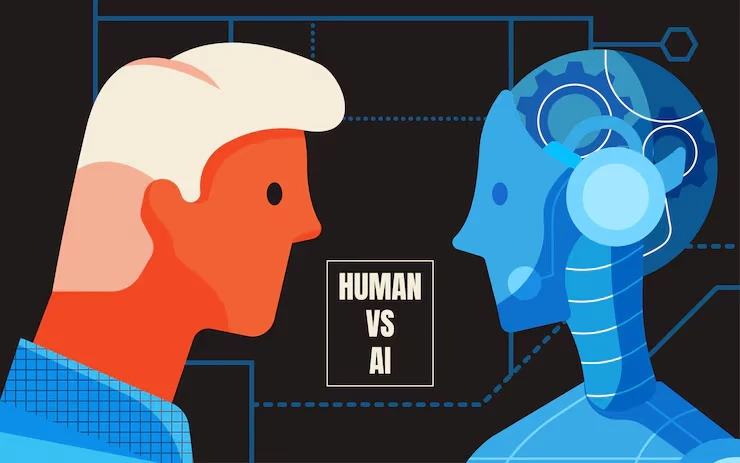
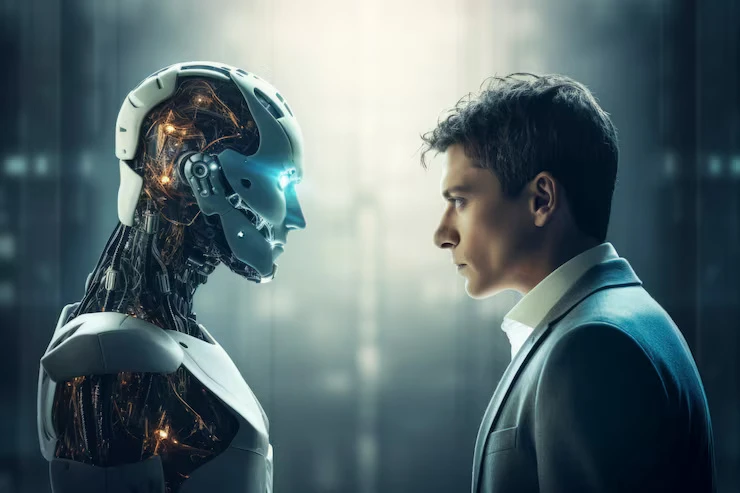
The rise of Artificial Intelligence (AI) has sparked one of the most talked-about debates of our time: AI vs Human Intelligence. With rapid advancements in machine learning, automation, robotics, and generative AI, many people are asking a crucial question — Can AI replace human jobs?
This blog explores how AI compares with human intelligence, which jobs are at risk, which new opportunities are emerging, and why humans still remain irreplaceable in many areas.
What Is the Difference Between AI and Human Intelligence?
To understand the debate, it’s important to clarify what makes AI and human intelligence different.
1. AI is fast and data-driven
AI systems can process massive amounts of data, identify patterns, and perform tasks much faster than humans. Tools powered by machine learning or deep learning can handle repetitive tasks with high accuracy.
2. Humans are creative and emotionally intelligent
Humans excel at creativity, moral decision-making, empathy, emotional understanding, and thinking beyond rules. These are areas where even the most advanced AI models fall short.
3. AI learns from data; humans learn from experience
AI depends on training datasets, algorithms, and programming. Humans learn from life experiences, emotions, social interactions, and intuition — all of which give us multidimensional intelligence.
Will AI Replace Human Jobs?
The biggest concern today is job displacement. Yes, AI will replace certain jobs, especially those involving repetitive, predictable, or manual data tasks. However, AI will also create new jobs, just as technology has always done.
Jobs Most Likely to Be Affected by AI
These roles involve routine tasks and can easily be automated:
- Data entry jobs
- Tele-calling and customer support
- Basic accounting and bookkeeping
- Manufacturing and assembly-line work
- Administrative support tasks
- Logistics and warehouse automation
Businesses increasingly use AI tools, chatbots, and RPA (Robotic Process Automation) to reduce time and labour costs.
Jobs Least Likely to Be Replaced
These roles require emotional intelligence, creativity, strategy, or complex human judgment:
- Healthcare professionals
- Teachers and mentors
- Leaders and managers
- Creative designers and writers
- Marketing strategists
- Skilled craftsmen and artisans
- Entrepreneurs and business planners
Even though AI can generate images or write content, it still lacks true originality, intuition, and emotional depth.
A Better Question: How Will AI Transform Human Jobs?
Instead of asking, “Will AI replace humans?” we should ask, “How can humans use AI to become more productive and efficient?”
AI is not just replacing jobs — it is transforming them.
AI will remove repetitive tasks
Professionals like marketers, designers, programmers, and analysts can automate routine tasks and focus more on strategy and innovation.
AI will boost human creativity
Tools like generative AI, AI writing assistants, and AI design tools help people create faster, test ideas quickly, and think beyond limitations.
AI will support decision-making
By processing huge datasets, AI helps businesses make smarter decisions in areas like:
- Sales forecasting
- Customer behavior analysis
- Supply chain optimization
- Product improvement strategies
Humans still make the final call, but AI provides powerful insights.
Why Humans Will Always Matter
Even though AI is incredibly powerful, there are several reasons why human intelligence will never be completely replaced.
1. Human creativity is unmatched
AI can remix existing data, but it cannot think like a human. It cannot imagine something that has never existed before.
2. Humans understand emotions
Fields like customer service, counseling, leadership, and healthcare require emotional depth — a quality AI cannot replicate.
3. Ethics and morality require human judgment
AI works on rules, logic, and patterns.
But society needs people to make moral decisions, especially in areas involving law, governance, fairness, and humanity.
4. Humans adapt better
AI systems cannot adapt instantly to unexpected situations without being reprogrammed or retrained. Humans can.
The Future: Collaboration, Not Competition
The future of work is not AI vs Humans — it is AI with Humans.
AI will become a powerful assistant that handles:
- Data-heavy tasks
- Repetitive actions
- Predictive analytics
- Complex calculations
- Large-scale automation
Humans will take charge of:
- Creativity
- Strategy
- Relationship-building
- Innovation
- Leadership
- Emotional and ethical judgment
This partnership will unlock new possibilities across industries.
How You Should Prepare for the AI Era
Whether you’re a business owner, student, employee, or entrepreneur, here’s how you can stay ahead:
1. Learn how AI works
Understanding the basics of AI, machine learning, and automation tools gives you a big advantage.
2. Use AI tools to boost productivity
From writing and marketing tools to design, coding, and analytics platforms — AI can increase efficiency by 50–300%.
3. Develop human-centric skills
Skills like creativity, communication, emotional intelligence, and leadership will always remain in demand.
4. Stay updated with trends
The world of AI evolves every month. Following trusted sources keeps you informed and competitive.
Final Thoughts
So, can AI replace human jobs?
Yes — some jobs.
But AI cannot replace human intelligence, creativity, emotions, or originality.
Instead of fearing AI, the smart approach is to embrace it, learn it, and use it to improve your career or business. Humans who understand AI will replace humans who don’t — not the other way around.
If you wanna know more, then follow the trends and information at iEdgeSoft Solutions Blog.