



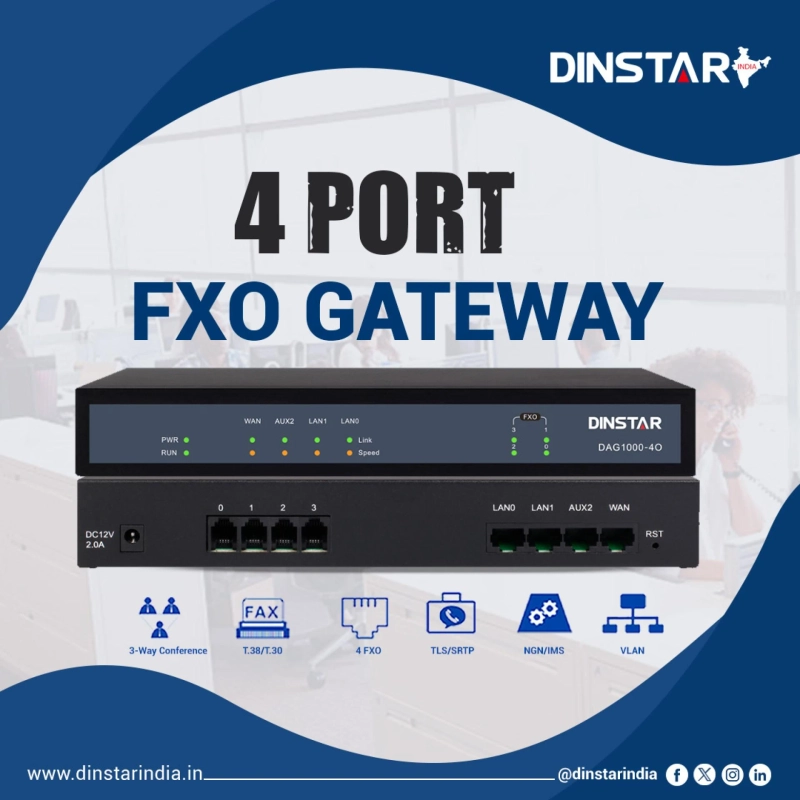
In today’s rapidly evolving communication landscape, businesses are increasingly adopting VoIP (Voice over Internet Protocol) solutions to enhance efficiency and reduce operational costs. However, many organizations still rely on traditional telephone lines for daily communication. This is where a 4 Port FXO Gateway plays a crucial role—bridging the gap between legacy analog systems and modern IP-based telephony networks.
A 4 Port FXO Gateway allows businesses to connect traditional PSTN (Public Switched Telephone Network) lines with VoIP systems. It enables smooth communication between analog phones and IP PBXs or SIP servers, providing the flexibility to maintain existing infrastructure while enjoying the benefits of IP telephony.
What is a 4 Port FXO Gateway?
A 4 Port FXO Gateway is a compact VoIP device designed to connect up to four analog PSTN lines to an IP-based phone system. The term “FXO” stands for “Foreign Exchange Office,” which refers to the interface that connects to the telephone line provided by the local telephone company.
In simple terms, an FXO Gateway acts as a translator between analog and digital signals. It converts analog voice signals from PSTN lines into digital packets for VoIP transmission and vice versa. This makes it possible for calls from traditional telephone lines to be managed, routed, and recorded within an IP PBX environment.
How Does a 4 Port FXO Gateway Work?
The working principle of a 4 Port FXO Gateway revolves around signal conversion and intelligent call routing. When a call is received from a PSTN line, the gateway converts the analog voice signal into a digital VoIP format using standard SIP (Session Initiation Protocol). The SIP protocol ensures compatibility with most IP PBXs, IP phones, and SIP-based communication platforms.
Similarly, when a VoIP user initiates a call to an external number, the gateway routes the call through one of its FXO ports, using the PSTN lines to establish the connection. This bidirectional communication allows seamless integration between old and new telephony infrastructures.
Moreover, a 4 Port FXO Gateway is typically equipped with advanced call management features such as call forwarding, routing rules, call waiting, caller ID, and failover support—ensuring reliable and uninterrupted communication.
Key Features of a 4 Port FXO Gateway
- Multiple FXO Ports:
- With four dedicated FXO ports, the gateway can handle multiple analog lines simultaneously, allowing businesses to manage several calls at once without congestion.
- SIP Compatibility:
- The device supports SIP, ensuring smooth interoperability with leading IP PBX systems and VoIP service providers.
- Easy Configuration and Management:
- Most 4 Port FXO Gateways come with a web-based interface for easy configuration, firmware upgrades, and performance monitoring.
- Failover and Backup:
- In case of network failure, the gateway can automatically switch to backup routes or analog lines to maintain continuous communication.
- High Voice Quality:
- Equipped with echo cancellation, jitter buffering, and voice compression technologies, the gateway ensures crystal-clear audio during calls.
- Flexible Deployment:
- Whether used in small offices, branch locations, or call centers, the gateway offers scalability and can easily integrate into existing network infrastructures.
Benefits of Using a 4 Port FXO Gateway
Cost Efficiency:
A 4 Port FXO Gateway helps reduce communication costs by enabling VoIP calls while still utilizing existing PSTN lines. Businesses can avoid high long-distance charges and make cost-effective local and international calls through VoIP.
Smooth Migration to VoIP:
Organizations can transition to IP telephony gradually without replacing their entire analog setup. The gateway serves as a bridge during this hybrid communication phase.
Improved Call Handling:
With features like routing rules and automated call distribution, the gateway optimizes call management and ensures efficient use of resources.
Business Continuity:
In case of an internet outage or IP PBX failure, calls can automatically switch to PSTN lines, ensuring uninterrupted operations.
Scalability:
A 4 Port FXO Gateway can be easily expanded with additional gateways as the business grows, providing flexibility and scalability for future requirements.
Applications of 4 Port FXO Gateways
A 4 Port FXO Gateway finds applications across various business environments:
- Small and Medium Enterprises (SMEs): To connect office phone systems with analog lines while adopting VoIP.
- Remote Branch Offices: Ideal for maintaining connectivity between central IP PBX systems and remote locations.
- Call Centers: To handle multiple incoming and outgoing calls using both VoIP and traditional lines.
- Hotels and Hospitality: For integrating room extensions and front desk telephony with the main IP system.
- Educational Institutions: To connect administrative offices with campus-wide IP networks for effective communication.
Choosing the Right 4 Port FXO Gateway
When selecting a 4 Port FXO Gateway, businesses should consider factors like:
- SIP compatibility with existing PBX or VoIP service
- Voice quality and codec support (G.711, G.729, etc.)
- Ease of configuration and management tools
- Failover options and redundancy features
- Scalability and future expansion support
Evaluating these parameters ensures that the chosen gateway meets both current and future communication needs.
Conclusion
A 4 Port FXO Gateway is an essential device for businesses seeking to integrate traditional analog lines with modern VoIP networks. It enables organizations to enjoy the cost benefits and advanced features of IP telephony without discarding their existing PSTN infrastructure.
With its ability to handle multiple lines, provide high-quality voice communication, and ensure system reliability, the 4 Port FXO Gateway offers an efficient and future-ready communication solution for businesses of all sizes.