



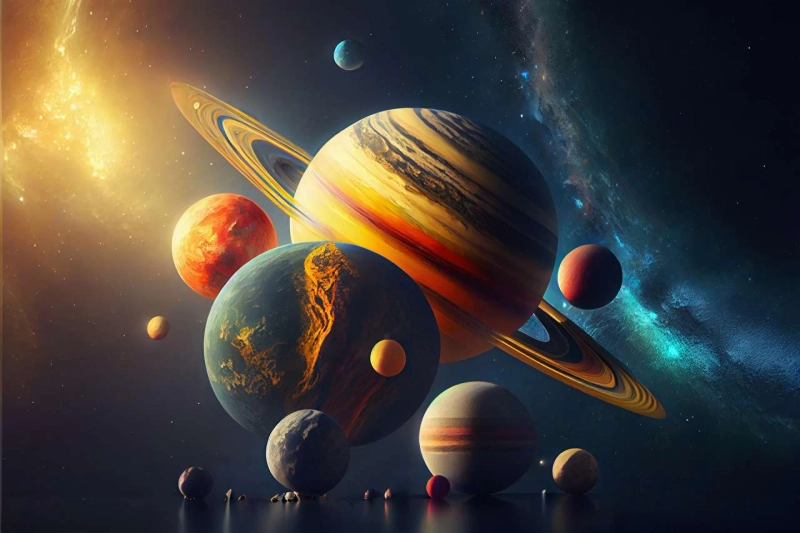
Our solar system, a captivating web of planets, moons, and the radiant Sun, has countless wonders that continue to amaze and intrigue individuals of all ages. From the breathtaking rings of Saturn to the relentless storms on Jupiter, each celestial body bears a unique story waiting to be unveiled. In this article, we go through 10 captivating facts about our solar system, each highlighting a unique fact about each planet.
The Sun\'s Enormous Size and Energy Output
The Sun, at the center of our solar system, is a massive ball of gas. Its diameter is about 109 times that of Earth. It generates an astonishing amount of energy through nuclear fusion, fusing hydrogen into helium. This continuous fusion reaction releases enormous energy, which reaches Earth in the form of light and heat. The energy output of the Sun is so tremendous that it is equivalent to around 386 billion billion megawatts. Read more about the Sun\'s mass percentage relative to Earth here.
Jupiter\'s Great Red Spot
Jupiter, the largest planet in our solar system, boasts an incredible feature known as the Great Red Spot. This colossal storm has been raging for at least 350 years and is so large that it could engulf Earth three times over. Despite its enduring nature, the exact cause of its reddish hue remains a subject of scientific debate.
Saturn\'s Breathtaking Rings
Saturn, the second-largest planet, is renowned for its stunning and extensive ring system. These rings are composed of countless small particles, ranging in size from dust to boulders. They are primarily made of water ice and are believed to be remnants of comets, asteroids, or shattered moons. Scientists speculate that gravitational forces from Saturn\'s moons might be responsible for shaping and maintaining these majestic rings.
Saturn also holds the crown to be the planet with the largest number of moons. Want to know the total number of Saturn\'s moons?
Earth\'s Unique Moon
Earth\'s moon is the fifth-largest natural satellite in the solar system. Its relatively large size in proportion to Earth is a rarity among terrestrial planets. The Moon\'s gravitational pull affects Earth\'s tides, which, in turn, influence various natural processes and life on Earth. It is thought to have formed from debris resulting from a collision between Earth and a Mars-sized celestial body, a theory known as the Giant Impact Hypothesis.
Mars\' Olympus Mons, the Largest Volcano
Mars, often referred to as the "Red Planet," is home to Olympus Mons, the largest known volcano in our solar system. This massive shield volcano stands at a staggering height of approximately 13.6 miles, making it almost three times the height of Mount Everest. Its size is a testament to the relatively low Martian gravity and the planet\'s volcanic past. Despite its colossal dimensions, the volcano is estimated to be dormant.
Mercury, the Smallest Planet
Mercury, the closest planet to the Sun, holds the title for being the smallest planet in our solar system. Its small size is attributed to its high density, primarily composed of metal and rock. Due to its proximity to the Sun, surface temperatures on Mercury can reach scorching highs of around 800 degrees Fahrenheit during the day and plummet to freezing lows of -290 degrees Fahrenheit at night.
Venus, the Hottest Planet
Venus, often called Earth\'s "sister planet," is the hottest planet in our solar system, despite not being the closest to the Sun. Its extreme surface temperatures can soar to a scorching 870 degrees Fahrenheit due to a thick atmosphere composed mainly of carbon dioxide, which traps heat in a runaway greenhouse effect. The intense heat and pressure on Venus make it a hostile environment for any known forms of life.
Uranus\' Unique Tilted Axis
Uranus is known for its unique feature: its extreme tilt. Unlike other planets that have their rotational axes roughly perpendicular to their orbital planes, Uranus\'s axis is tilted at an angle of about 98 degrees. This peculiar tilt results in extreme seasonal variations, with each pole experiencing around 42 years of continuous sunlight, followed by 42 years of darkness.
Neptune\'s Windiest Environment
Neptune is the farthest known planet from the Sun. It boasts the strongest winds, with recorded speeds reaching up to 1,500 miles per hour. These powerful winds are primarily a result of the planet\'s rapid rotation and its frigid temperatures, which can drop as low as -370 degrees Fahrenheit. The distinct bluish hue of Neptune\'s atmosphere is attributed to the presence of methane, which absorbs red light, reflecting a blue color.
Want to know why Neptune is named as the Blue Planet?
Pluto\'s Reclassification and the Kuiper Belt
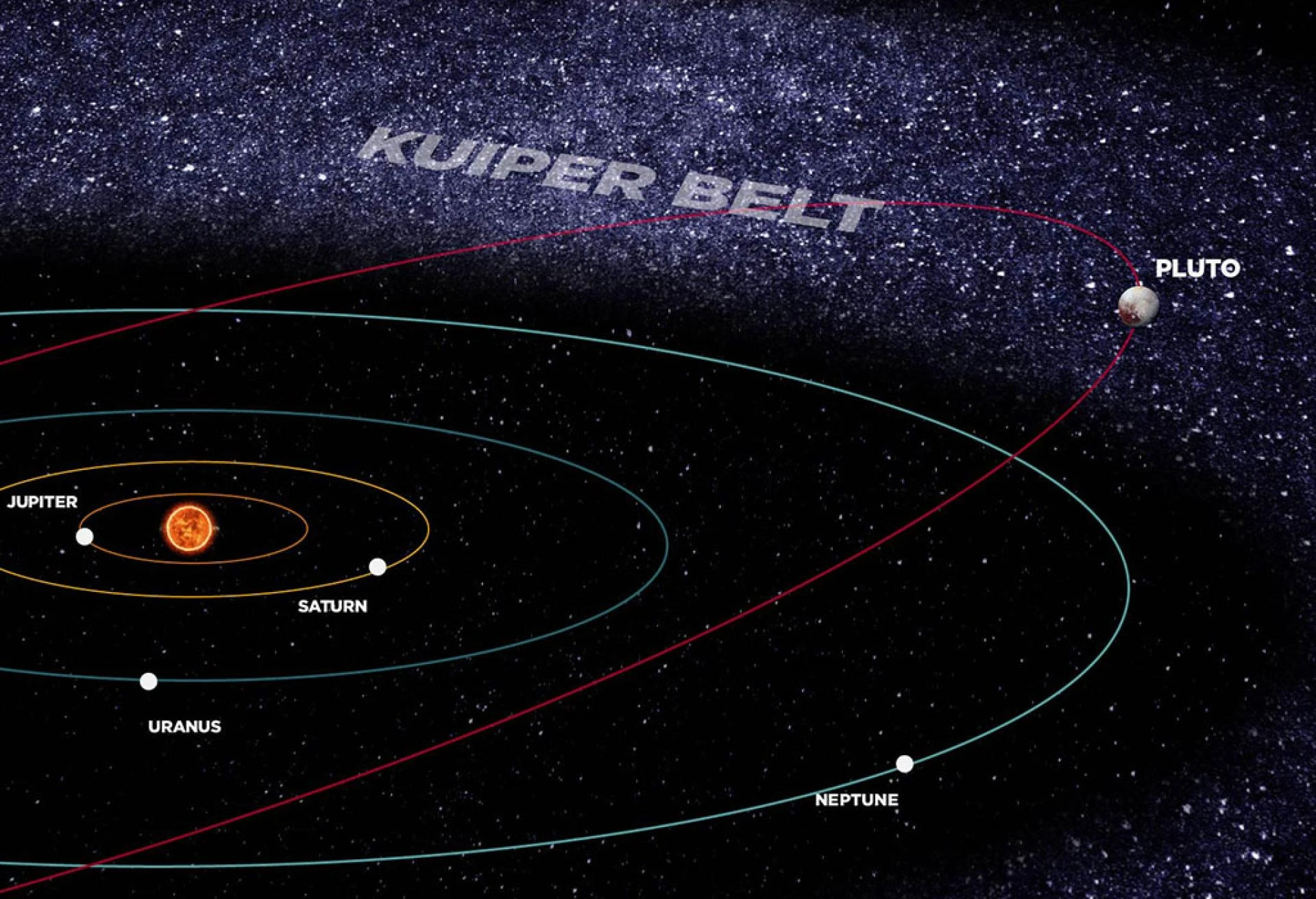
Pluto, once considered the ninth planet in our solar system, was reclassified as a "dwarf planet" in 2006. This decision came as a result of the International Astronomical Union\'s redefinition of a planet, which required a celestial body to have cleared its neighboring region of debris. The discovery of the Kuiper Belt, a region of icy bodies beyond Neptune, led to Pluto\'s reclassification as it shares its orbital zone with other similar objects.
These fascinating aspects of our solar system highlight the diversity and complexity of the celestial bodies that surround us, inviting further exploration and discovery.