



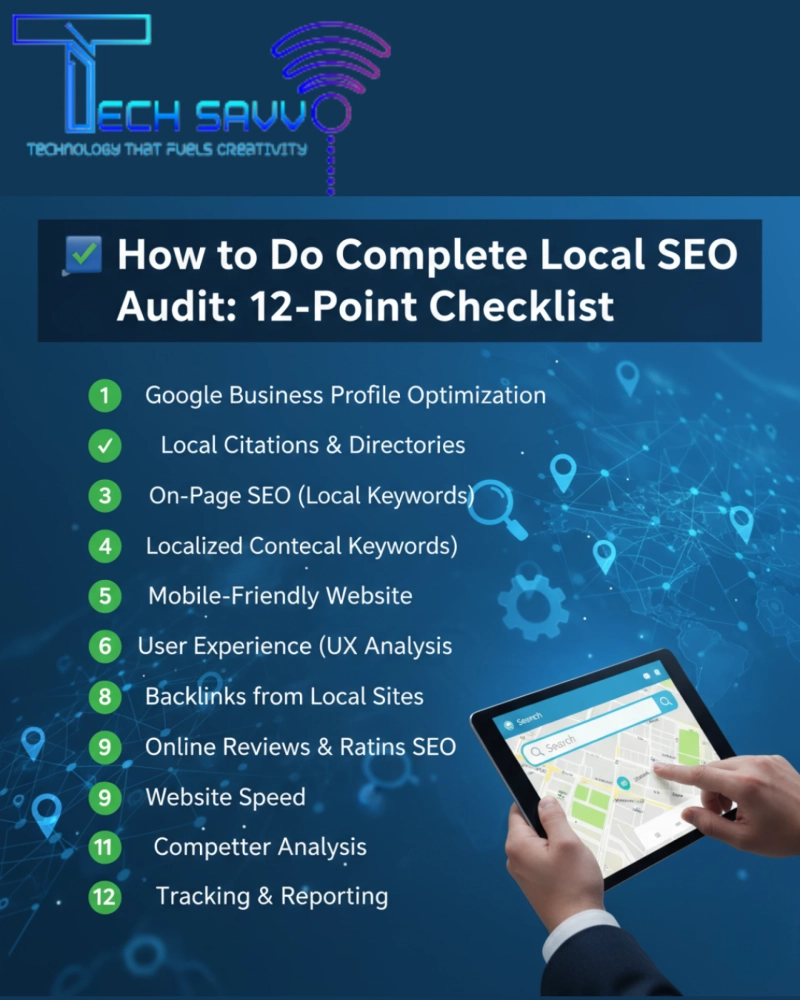
📝 How to Do a Complete Local SEO Audit: 12-Point Checklist with Examples
A Local SEO Audit is an essential process for businesses targeting customers in a specific geographic location. It involves a methodical review of your online presence to discover strengths, weaknesses, and opportunities for achieving better rankings in local search results (like Google's 'Local Pack'). This comprehensive 12-point checklist is designed to help you conduct a thorough audit, including relevant examples from the Indian context.
The Local SEO Audit Checklist
1. Keyword Topic/AI Prompt Audit 🔑
"Here, it's all about making sure the keywords you're focusing on truly match what people in your local area are actually looking for online. You also need to think ahead about how users, especially with all the AI tools popping up, might search for the services you offer.
- Action: Review your current ranking and the organic traffic you're receiving for terms related to your location. See if you're targeting common local search phrases like 'service near me,' 'best service in [city],' or 'service [zip code].' Also, try to figure out the kinds of questions or prompts users might type into AI tools, for example, something like 'Suggest a reliable South Indian restaurant near Connaught Place, Delhi.'"
- Example: A boutique hotel in Jaipur should audit keywords beyond "best hotel Jaipur" to include hyper-local terms like "boutique stay near Hawa Mahal," "heritage hotel Jaipur with swimming pool," and targeting prompts like "Find a highly-rated family-friendly hotel in Jaipur with a view."
2. Website Audit 🌐
Review the technical health of your website, its mobile-friendliness, and the overall effectiveness of local optimization.
- Action: Check for the presence of schema markup (especially Local Business schema) on your local landing pages. Make sure your Name, Address, and Phone number (NAP) are consistent and prominently displayed, generally in the footer. Ensure that the site loads quickly and is completely mobile-responsive.
- Example: A private hospital in Mumbai must ensure its website not only loads quickly on lower-bandwidth connections but also uses the Local Business schema to accurately tag all branches' addresses and contact information.
3. Google Business Profile Audit 📍
Your Google Business Profile (GBP) is the key factor in local SEO.
Action: Ensure that your business category is the most precise and accurate. Verify that your business hours (including any Indian public holidays or regional holidays) and NAP are correct. Consistently upload high-quality, geotagged photos. Create an engaging, keyword-rich description and take advantage of the Posts feature for updates, offers, or events (e.g., Diwali sale).
- Example: A coaching center in Kolkata must update its GBP hours to reflect special weekend batch timings, upload pictures of their faculty and classroom, and use Posts to announce new courses or entrance exam dates.
4. Review Monitoring and Management ⭐
Want to keep your online reputation in great shape? Make it a point to actively look for, reply to, and review what customers are saying.
Ask for Feedback: Gently encourage your customers to share their thoughts by leaving reviews on your Google Business Profile (GBP).
Respond Thoughtfully: Always reply to every review, both good and bad, in a professional manner and as quickly as you can. Try to weave in some relevant keywords naturally into your responses.
Learn from the Feedback: Pay attention to the overall tone of the reviews. Look for patterns or recurring issues that might point to areas where your service could be improved.
- Example: A cloud kitchen delivering food in Bangalore should monitor reviews for comments on delivery speed, food quality, and packaging. They must respond to a negative review about late delivery, apologizing and explaining any local traffic or weather issues, while reassuring the customer of an action plan.
5. Local Business Listing/Citation Audit 🔗
A citation constitutes any online mention of your business's Name, Address, and Phone number (NAP). Consistency across all platforms is vital.
Action: Examine your listings on key local directories like Just dial, Sulekha, Yellow Pages India, India mart, and industry-specific directories. Immediately address any inconsistencies in your NAP. Remove any duplicate listings.
- Example: A car repair workshop in Chennai should ensure its NAP is identical across its GBP, Just dial listing, and niche listings like a local mechanics' association website. Even a slight variation, like "Anna Salai Road" vs. "Anna Salai," must be corrected.
6. Backlink Audit 📈
Review the quality and relevance of the websites that provide backlinks to your site.
Action: Target high-quality, locally relevant backlinks. Disavow low-quality, spammy links. Actively look for links from local newspapers, community organizations, and local business partners.
- Example: A sustainable clothing brand based in Pune should aim for backlinks from local news publications that cover sustainability, local fashion bloggers, or the website of a Pune-based NGO they partner.
7. Local Content Audit ✍️
Examine the content on your website to confirm it is optimized for local significance and credibility.
Action: Conduct an audit of blog posts, service pages, and landing pages to verify they reference specific local landmarks, neighborhoods, and regional information. Identify any content gaps that could address local user inquiries.
- Example: A travel agent specializing in the Himachal Pradesh circuit should audit their blog for content that clearly differentiates between areas like Manali and Kasol, mentioning specific local attractions, travel tips, and seasonal advice.
8. Google Search Console Review ⚙️
Identify any technical problems or indexing issues that may affect local rankings.
Action: Review the Coverage Report for any errors. Confirm that your local landing pages and business profile pages are properly indexed. Look for any Manual Actions or security concerns. Examine the Core Web Vitals report, particularly regarding mobile speed.
- Example: A real estate developer in Gurugram should use Search Console to ensure all their new project landing pages are submitted via an updated sitemap and that mobile usability is flawless, given most Indian property searches start on a phone.
9. Analytics Review 📊
Study user interactions and traffic channels to better understand the local user path.
Action: Evaluate organic traffic divided by location. Review user behavior statistics like Bounce Rate and Time on Page for local landing pages. Identify the local keywords that generate the most conversions (calls, form fills, store visits).
- Example: A fitness studio in Hyderabad finds that traffic from a specific local neighborhood has a very high bounce rate. The audit may reveal that their landing page content isn't locally specific enough for that area, prompting a content update.
10. Competitor Analysis 🥊
Comprehend the successful tactics of local competitors to guide your strategic planning.
Action: Identify the top 3-5 competitors within the Local Pack and organic listings. Assess their GBP optimization (categories, total reviews, photographs). Review their website architecture, content subjects, and local citation profile.
- Example: A coffee shop in a busy Chennai market should analyze its competitors' GBP to see if they're using specific attributes (e.g., "free Wi-Fi," "outdoor seating") that they are missing, and if their content is ranking for high-intent queries like "best filter coffee near me."
11. AI Search for Local Businesses 🤖
Anticipate the move towards generative AI and voice search for local discovery.
Action: Test your business's visibility in AI-based search results (like Google's SGE or other AI chatbots). Inquire with questions like "Where can I get the best [product] in [area]?" or "Find me a highly-rated [service] near [landmark]." Confirm that your GBP and structured data provide clear, factual answers that the AI can easily extract.
- Example: A travel agency specializing in Kerala backwater tours should verify that when an AI is prompted with "Plan a 3-day backwater trip from Kochi," it accurately pulls their company details and unique tour offerings as a reliable source.
12. Prioritizing Your Action Items ✅
The audit will generate a comprehensive list of tasks. Prioritization makes sure you handle the high-impact items first.
Action: Organize tasks according to Impact (High, Medium, Low) and Effort (High, Medium, Low). Begin with the "High Impact/Low Effort" tasks, such as correcting NAP inconsistencies in major citations and optimizing the GBP primary category.
- Example: The immediate priority for an electrician in New Delhi might be fixing an outdated phone number on their GBP (High Impact, Low Effort), followed by a complete backlink cleanup (Medium Impact, High Effort).